Advertiser disclosure: This guide to Zelle scams is free and independent. Safe Mobile Banking may earn a commission from some companies we review, but Zelle and its operator, Early Warning Services, LLC, don’t pay for this page. How we make money.
Short answer
Zelle scams work because Zelle money lands in an enrolled person’s bank account within minutes and can’t be reversed. Most start with a text, call or email that pushes you to send money fast. Your bank will never ask you to send money to yourself, and Zelle has no paid account “upgrade.” If you’re tricked into paying, a refund is required only for certain qualifying imposter scams.
- A “fraud alert” asking you to move money is the scam.
- Never read a security code back to anyone who calls you.
- Pay strangers with a credit card, not Zelle.
See the 5 rules that stop most Zelle scams (Free. Takes 2 minutes. Based on Zelle’s own warnings.)
Last verified: November 19, 2026, against Zelle’s scam education pages and help center, Federal Trade Commission consumer advice, Consumer Financial Protection Bureau guidance and complaint data, and the New York Attorney General’s lawsuit.
What are the most common Zelle scams?
Zelle scams fall into two groups. In the first, a scammer poses as someone you trust, such as your bank, a utility or Zelle itself. In the second, a stranger sells or buys something and the money only moves one way. Zelle’s own scam pages, the Federal Trade Commission and the New York Attorney General describe all nine tricks below. The holiday season adds more payments to strangers for tickets, gifts and marketplace deals, which is exactly where these scams live.
| Scam | What they ask for | The tell |
|---|---|---|
| Fake bank fraud alert | A reply, then a call with “your bank” | A text about a charge you didn’t make |
| “Pay yourself” to stop fraud | A Zelle payment to your own phone or email | Your bank never asks you to send money to yourself |
| The security code | The code your bank just texted you | They called you, then asked for it |
| Fake “Zelle Dispute” email address | A payment to an address with your name in it | “Dispute,” “Fraud” or “Claim” in the address |
| Fake account upgrade email | A fee to “release” a buyer’s payment | Zelle has no upgrades |
| Overpaying buyer | A refund of the “extra” money | Paid more than your price, wants change back |
| Utility or government imposter | A Zelle payment today to avoid a shutoff | A threat plus a deadline plus Zelle |
| Job with an upfront fee | Money for training, equipment or a background check | A real employer never charges you for a job |
| Tickets, pets and deals that never arrive | Zelle first, delivery later | A seller you’ve never met who only takes Zelle |
How do Zelle scams work? The 9 tricks, one by one
1. A fake fraud alert text from “your bank”
It starts with a text that looks like a fraud alert, often about a big purchase you didn’t make. Reply, and you get a call from a number that appears to be your bank. Fake fraud alerts ranked third among the top text scams of 2024, and people reported $470 million in losses to text scams that year, according to the Federal Trade Commission. The FTC says these callers quickly claim all your money is at risk, then pressure you to move it.
2. “Send the money to yourself” to stop the fraud
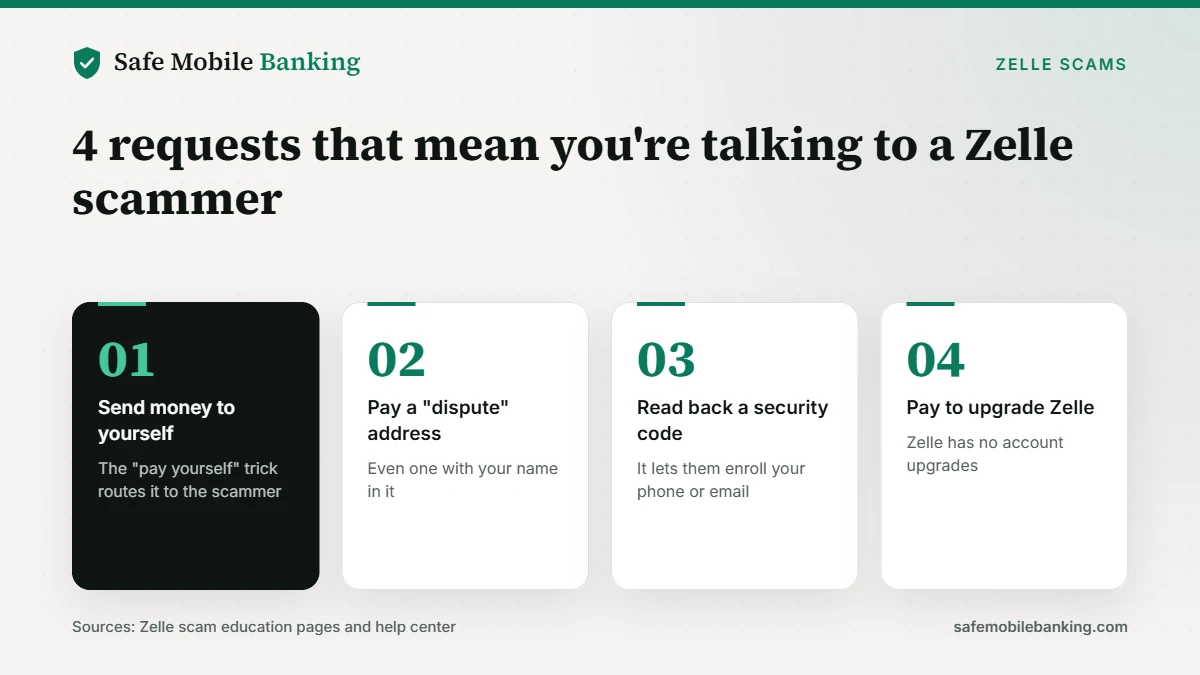
This is the payoff of trick one. Zelle calls it the “Pay Yourself” scam. The fake bank agent says the way to stop the fraud is to send a Zelle payment to your own phone number or email. In reality, the scammer has already linked your number or email to their own bank account, so the payment goes to them. Zelle’s rule is plain: your bank will never ask you to send money to yourself.
3. The security code you read back
Here’s how the scammer pulls off trick two. When anyone enrolls with Zelle, the bank sends a one-time security code to confirm who they are. The caller says they need your code to “authorize” the payment to yourself. If you read it back, Zelle says they can enroll their own bank account with your email or phone number. Wells Fargo, for one, says it will never text or call to ask for that code after it sends it.
4. A “Zelle Dispute” email address with your name in it
Zelle warns of a newer version. Instead of your own email or number, the caller gives you an address to pay, built to look official. Zelle says these addresses may combine your name with words like “Zelle Dispute,” your bank’s name, “Fraud” or “Claim.” Zelle’s warning is broad: your bank will not ask you to send money by Zelle to any account, so any request like this could be a scam.
5. The fake account “upgrade” email
This one targets sellers. A buyer says they’ve paid, then you get an email that looks like it’s from Zelle saying the payment is on hold until you pay to upgrade your account. Zelle says there are no upgrades, so no one can upgrade your account. It also says it only sends email from @zelle.com or @zellepay.com, never from Gmail, Yahoo, AOL or other common domains. A Zelle logo in the profile picture proves nothing.
6. The buyer who overpays and wants a refund
Zelle describes a buyer who claims to have paid more than your asking price, then asks for a refund of the difference before canceling the original order. The FTC describes the check version: a buyer “accidentally” sends a check for too much and asks you to refund the balance. The FTC says it can take weeks for a bank to figure out a check is fake, and by then you’re stuck paying the money back. Zelle is fast and final, which makes it an easy tool for that refund.
7. The utility or government imposter
The New York Attorney General gives a real example. A caller posing as a Con Edison employee told a New Yorker his power would be shut off that day unless he paid by Zelle. He sent $1,476.89 to an account named “Coned Billing.” When he realized it was a scam, his bank told him it couldn’t get the money back. A threat, a same-day deadline and a demand for Zelle together are the warning.
8. The job that charges you first
Zelle warns about fake job posts and recruiters who ask for an upfront fee for training, equipment or a background check. Its answer is short: a legitimate employer will never ask you to pay for a job. Be just as wary of an “agency” that wants money to find you work.
9. Tickets, pets and deals that never show up
Zelle says reported scams include buying tickets and buying puppies. You pay, and the seller vanishes. Because you authorized the payment, Zelle says you may not be able to get your money back. The FTC adds a simple test: anyone who says you can only pay by bank transfer, payment app, wire, crypto or gift card is probably a scammer.
How to avoid Zelle scams: 5 rules
Most Zelle scams fall apart when you follow these five rules.
- Hang up and call back. If a call or text you didn’t expect says there’s fraud, end it. Call the number on the back of your debit card or in your bank’s app. Zelle says not to trust caller ID, because scammers can fake it.
- Never move money to “protect” it. No bank asks you to send money to yourself, to a “safe” account or to a dispute address.
- Keep your codes to yourself. A code your bank texts you is for you only. Anyone who calls and asks for it is trying to get into your account.
- Use Zelle only with people you know. Zelle says to send money only to people you know and trust. For a stranger, use a credit card, which the FTC says gives you more protection and the right to dispute charges.
- Check your bank balance, not your email. Before you ship or hand over an item, open your banking app and confirm the money is there.
Not sure about a payment request right now? Our free payment scam checker asks eight yes-or-no questions and gives you a risk level in about a minute.
Can you get your money back from a Zelle scam?
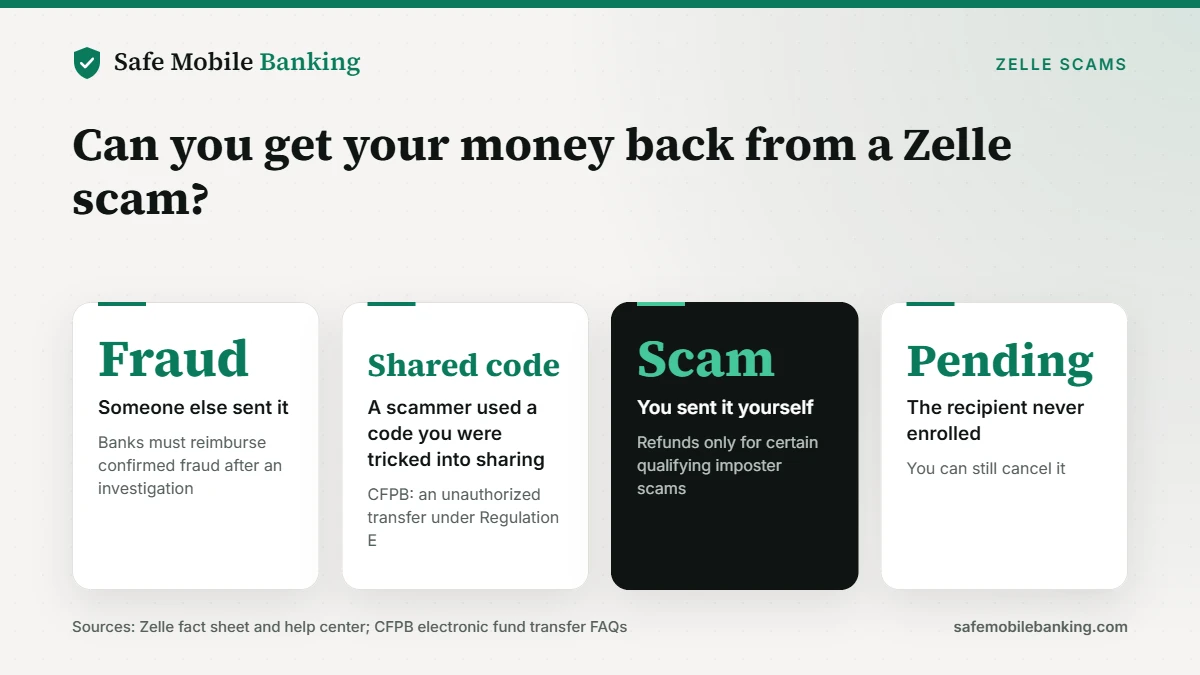
It depends on who pressed Send. Zelle’s own guide, Understanding Fraud and Scams, draws the line between fraud and scams.
- Someone else sent it (fraud). If someone got into your account and sent money without you, that’s unauthorized. Zelle’s network rules require banks to fully reimburse confirmed fraud after a reasonable investigation.
- A scammer used a code or login you were tricked into sharing. The Consumer Financial Protection Bureau’s electronic fund transfer FAQs say a transfer made with account access information you were fraudulently induced to share counts as unauthorized under Regulation E. Tell your bank exactly what happened.
- You sent it, but you were tricked (scam). That’s an authorized payment. Zelle requires banks to reimburse only “certain qualifying imposter scams where the customer authorized the transaction,” according to its fact sheet on Zelle and scams. Zelle doesn’t publish which scams qualify, so your bank decides.
- The person hasn’t enrolled yet. You can cancel the payment from your Zelle activity. Zelle says that’s the only time a payment can be canceled. If the person doesn’t enroll within 14 days, Wells Fargo says the money returns to your account.
Speed matters. The Consumer Financial Protection Bureau says to report an unauthorized transfer within 60 days of the statement that shows it, or you could be liable for later transfers. Your bank generally has 10 business days to investigate and must resolve it within 45 days.
What should I do if I sent money to a Zelle scammer?
Do these five things in order, starting today.
- Call your bank or credit union now. Use the number on your card or in your app. The FTC’s advice for Zelle and bank transfers is to report it immediately and ask the bank to reverse the payment and refund your money.
- Say whether you shared a code or login. If you did, ask the bank to treat it as an unauthorized transfer and to put its decision in writing.
- Change your online banking password and turn on every alert your bank offers.
- Report it to the FTC at ReportFraud.ftc.gov. Zelle also points people to the FBI’s Internet Crime Complaint Center at IC3.gov. New Yorkers can report Zelle losses to the Attorney General’s Consumer Frauds Bureau.
- Forward the scam text to 7726 (SPAM) and phishing emails to reportphishing@apwg.org, as Zelle and the FTC suggest.
Our guide on how to report a scam covers every reporting option, and our bank account hacked checklist helps if someone got into your account.
What do Zelle scam complaints and lawsuits show?
From November 19, 2025 to November 19, 2026, consumers filed 648 money transfer complaints against Early Warning Services, LLC in the CFPB Consumer Complaint Database. 299 were complaints about fraud or scams, and 160 were about other transaction problems. All 648 were closed with an explanation. Many people file Zelle complaints against their own bank instead, so this count understates the total. Our money app complaint report compares 26 money apps.
Complaints are consumers’ claims as logged by the Consumer Financial Protection Bureau. The bureau doesn’t verify them, and a complaint isn’t proof of wrongdoing.
On August 13, 2025, the New York Attorney General sued Early Warning Services, alleging Zelle was designed without key safety features and that scammers took more than $1 billion from users between 2017 and 2023. On July 20, 2026, Justice Phaedra Perry-Bond of the New York County Supreme Court denied nearly all of the company’s motion to dismiss, according to a Ballard Spahr analysis. When the suit was filed, an Early Warning spokesperson called it “nothing more than a copycat” of a federal lawsuit dismissed in March 2025, Banking Dive reported. The allegations haven’t been proven in court.
Is Zelle itself safe to use?
Yes, for paying people you know. Zelle says more than 99.95% of payments are completed without any report of scam or fraud; that’s the company’s own figure. The Zelle scams above work by tricking you into sending money, not by breaking into Zelle. Our full Zelle safety review covers limits, cancellations and how Zelle compares with Venmo and a credit card. The same tricks show up in our guides to Venmo scams, Cash App scams and Facebook Marketplace scams. If your bank texts sign-in codes, our guide to preventing SIM swap fraud closes another gap. See how we rate money apps.
Read our full Zelle safety review (Refund rules, limits and the scams to skip.)
Zelle scams FAQ
Can a Zelle payment be reversed after a scam?
Not by you once the person has enrolled. Zelle says payments to enrolled recipients can’t be reversed, and you can cancel only while the recipient hasn’t enrolled yet. Call your bank right away anyway. Banks must reimburse confirmed fraud, and some qualifying imposter scams are refunded. Ask the bank to put its decision in writing.
Will my bank refund me if I was scammed on Zelle?
Maybe. If someone else sent the money from your account, banks on the Zelle network must reimburse confirmed fraud after an investigation. If you sent it yourself because you were tricked, Zelle requires refunds only for certain qualifying imposter scams, such as someone posing as your bank. Zelle doesn’t publish the full rules, so each bank decides.
Does Zelle ever ask you to upgrade your account?
No. Zelle says there are no account upgrades, so anyone who asks you to pay to upgrade your Zelle account or release a pending payment is running a scam. Zelle also says it only sends email from zelle.com or zellepay.com addresses, never from Gmail, Yahoo or AOL. Don’t click links in the email. Report it to your email provider.
Why would my bank ask me to send money to myself on Zelle?
It wouldn’t. Zelle says your bank will never ask you to send money to yourself, and will not ask you to send money by Zelle to any account. In this scam, the caller has already linked your phone number or email to their own bank account, so the payment you think is going to you goes to them. Hang up and call your bank.
How do I report a Zelle scam?
Call your bank or credit union first and ask it to reverse the payment. Then report the scam to the Federal Trade Commission at ReportFraud.ftc.gov. Zelle also lists the FBI’s Internet Crime Complaint Center at IC3.gov. Forward scam texts to 7726. If you live in New York, you can also report a Zelle loss to the Attorney General’s Consumer Frauds Bureau.
Are Zelle scams worse during the holidays?
The tricks don’t change, but the chances do. More people buy tickets, gifts and marketplace items from strangers in November and December, and a Zelle payment to an enrolled person can’t be reversed. Zelle’s own scam pages warn about ticket, marketplace and job scams. Use a credit card for anything you buy from someone you haven’t met.
Sources
- Zelle: How to Spot a Pay Yourself Scam
- Zelle: How to Avoid an Online Marketplace Scam (fake upgrade emails)
- Zelle: How to Spot a Job Scam
- Zelle: Understanding Fraud and Scams
- Zelle Help Center (reversals and cancellations)
- Zelle: Fact sheet, Zelle and scams
- Wells Fargo: Zelle FAQs
- FTC: Top text scams of 2024
- FTC: How to spot, avoid and report fake check scams
- FTC: A way to spot scams: how someone asks you to pay
- FTC: What to do if you were scammed
- CFPB: Electronic fund transfers FAQs
- CFPB: How do I get my money back after an unauthorized transaction?
- CFPB Consumer Complaint Database (company: Early Warning Services, LLC; product: money transfer)
- New York Attorney General: lawsuit against Early Warning Services (August 2025)
- Ballard Spahr via Mondaq: court refuses to dismiss New York’s case (July 2026 ruling)
- Banking Dive: Early Warning’s response to the lawsuit
This guide is information, not financial or legal advice. Check your bank’s current Zelle terms before you act.