Advertiser disclosure: Is Remitly safe? We answer that independently. Safe Mobile Banking may earn a commission from some companies we review, but we don’t earn anything from Remitly, and commissions never change what we say. How we make money.
Short answer
Is Remitly safe? Yes, for sending money abroad to people you know. Remitly, Inc. holds 64 active state licenses in the federal-state NMLS registry, and NMLS lists no regulatory actions against it. Remitly shows the fee and exchange rate before you send and refunds the fee if a transfer arrives late. The real risk is a scammer who talks you into sending money, because a paid-out transfer is hard to get back.
- Licensed money transmitter, NMLS ID 1028236
- Cancel for a full refund until the money is picked up or deposited
- Holds are common when Remitly needs to verify you
See Remitly’s rates and fees (Free to check. Remitly shows the fee and rate before you send.)
Last verified: November 19, 2026, against NMLS Consumer Access, Remitly’s US user agreement, help center and error resolution notice, Remitly Global, Inc.’s November 2026 SEC filing, the Consumer Financial Protection Bureau complaint database and the Apple App Store.
Is Remitly safe? The short version
| Question | Answer | Source |
|---|---|---|
| Who runs it? | Remitly, Inc., a Seattle company owned by Nasdaq-listed Remitly Global, Inc. (RELY) | NMLS; SEC filing |
| Is it licensed? | Yes. 64 active state licenses, most of them money transmitter licenses | NMLS Consumer Access |
| Is it a bank? | No. It’s a money transmitter. Its Global Card account is held at Fifth Third Bank, Member FDIC | Remitly |
| Regulatory actions | None posted in NMLS | NMLS Consumer Access |
| Complaints, last 12 months | 335 filed with the federal consumer bureau | CFPB database |
| Late delivery | Fee refunded if money arrives after the promised time | Remitly user agreement |
| App rating | 4.9 out of 5 from about 2.8 million ratings | Apple App Store |
Is Remitly legit?
Yes. Remitly is a real, licensed company, not a scam. NMLS Consumer Access, the licensing registry run for state regulators, lists Remitly, Inc. at 401 Union Street in Seattle with 64 active licenses, including money transmitter licenses in New York, California and Texas. Its parent, Remitly Global, Inc., trades on Nasdaq and files reports with the Securities and Exchange Commission.
It’s also big. In its quarterly report filed November 4, 2026, Remitly said it had about 10.3 million active customers and moved $24.4 billion in the three months ended September 30, 2026. Its largest receive countries are India, Mexico and the Philippines.
How does Remitly work?
You pay Remitly in the US, and its partners pay your recipient abroad. You choose how the money arrives: a bank deposit, a mobile wallet or cash pickup. Remitly says its disbursement network reaches more than 5.8 billion bank accounts and mobile wallets and about 490,000 cash pickup locations.
You can pay with a bank account, a debit card or a credit card. Remitly warns that the payment method can change both the speed and the fee, and that a card issuer may add its own fee when you pay by credit card.
How much does Remitly cost?
It depends on the amount, where the money is going, how you pay and how it’s delivered. Remitly’s cost guide says it shows a detailed overview of the fee and exchange rate in the transfer summary before you send, and it doesn’t charge recipients any fees. New customers may get a reduced fee or a promotional exchange rate on their first transfer.
Two things to watch:
- The exchange rate is part of the price. Remitly says rates refresh regularly and can change with the amount, destination and options you pick. Compare the amount your recipient gets, not just the fee. Our money transfer fee calculator shows the cost hidden in an exchange rate.
- Some details appear only after you sign in. Remitly’s public pricing pages show current rates and fees, but its help center says you sign in and start a transfer to see your delivery options and your exact rate.
Why is my Remitly transfer on hold?
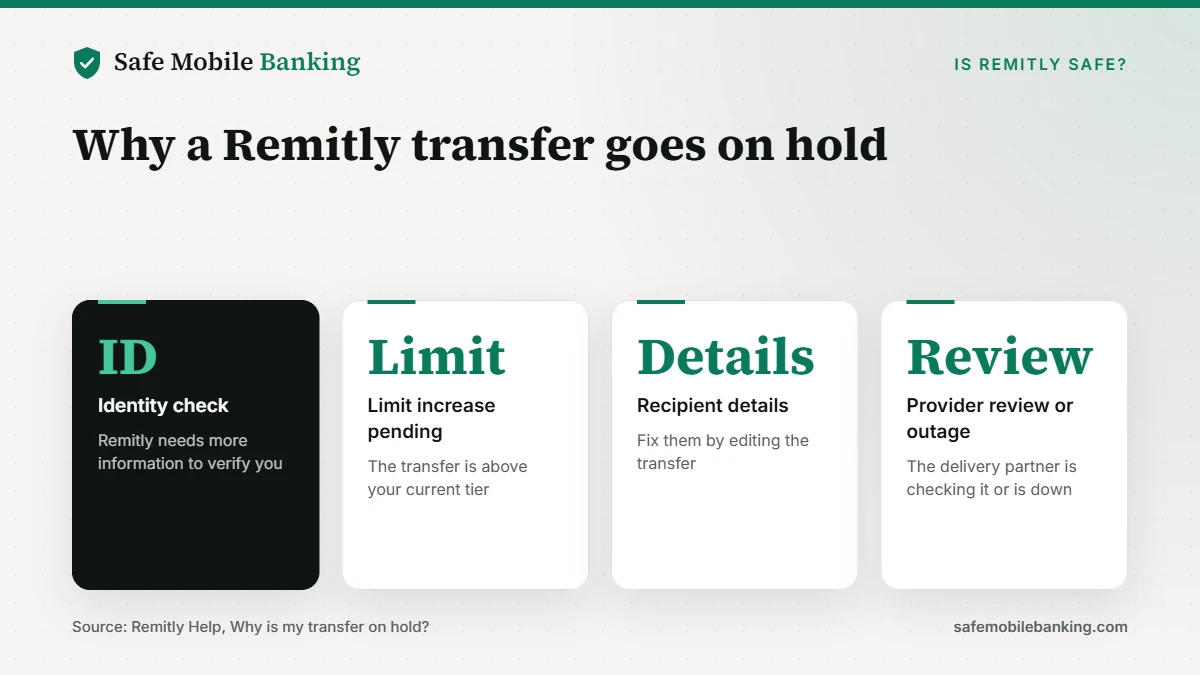
Usually because Remitly needs something from you. Its help article, Why is my transfer on hold?, lists five reasons:
- Remitly needs more information to verify your identity.
- You asked for a higher sending limit, and the transfer is above your current tier.
- Something is wrong with your recipient’s delivery details.
- The delivery provider is reviewing the transfer to meet international rules.
- The bank or cash pickup provider is temporarily unavailable.
Check the notifications in your Remitly account and the email Remitly sends about the hold. If the recipient details are wrong, you can edit the transfer. Remitly’s user agreement says it may cancel a transfer if you don’t fix a problem within 72 hours, and it then refunds the full amount, taxes and fees.
A hold is a normal verification step. A stranger who calls about a hold and asks for your code, your password or another payment is not Remitly.
How much can you send with Remitly?
Up to $300,000 in one transfer from the US, as of August 2026, according to Remitly’s send limits page. Your own limit may be lower. Remitly says it depends on your verification level, your payment method, the destination country and your transfer history, and that it may ask for more documents. You see your available limit before you complete a transfer.
Can you cancel a Remitly transfer or get a refund?
Yes, if you move fast. Remitly’s error resolution and cancellation notice says you can cancel and get a refund of everything you paid, including fees, as long as the money hasn’t been deposited to a bank account or picked up. Remitly says it refunds you within three business days of the request.
You have 180 days from the promised delivery date to report an error. Remitly also has a delivery promise. Its user agreement says that if your money is delivered after the date and time shown before you sent it and on your receipt, you can ask for a refund of the fees. You have to request that refund yourself.
How to send money safely with Remitly: 4 checks
- Send only to people you know. Remitly’s security page says not to pay someone you don’t know or whose identity you can’t verify, and never to pay to claim a prize or a “guaranteed” loan.
- Use only remitly.com or the app. Remitly says its real websites are on remitly.com. Look-alike domains and links in surprise emails are phishing.
- Know what Remitly won’t ask for by email. Remitly says it won’t email you for your full Social Security number, your date of birth, or your card number, PIN or security code.
- Double-check the recipient before you send. Once money is deposited or picked up, cancellation is no longer an option.
What’s the real Remitly customer service number?
Use the numbers Remitly publishes in its own documents. Its error resolution notice lists 1-888-736-4859 and the email us-complaints@remitly.com. Its user agreement lists 1-844-604-0924 for delivery-promise fee refunds. The help center also offers 24/7 chat and phone in the app.
Search results for Remitly sign-in and phone help include PDF “guides” hosted on unrelated websites. Don’t call numbers from those. Fake support lines are a common way scammers get account codes, as our guide on how to report a scam explains.
What is the Remitly Global Card?
It’s a Visa debit card and account inside the Remitly app. Remitly says the card is issued by Lead Bank and the account is powered by Stripe Payments Company, with funds held at Fifth Third Bank, Member FDIC. Neither Remitly nor Stripe is a bank. There are no monthly fees on the card itself, and Remitly says sending with it gets its best exchange rate in most corridors.
An optional plan costs $9.99 a month. It adds Pay Later, which gives up to $250 to send now and repay within three weeks at 0% interest. Pay Later is issued by Coastal Community Bank, Member FDIC, and not everyone is approved.
What do Remitly’s complaint records show?
From November 19, 2025 to November 19, 2026, consumers filed 335 complaints about Remitly, Inc. in the CFPB Consumer Complaint Database. 317 were about money transfers. The top issues were other transaction problems (112), fraud or scams (78) and money not available when promised (73). Remitly closed all 335 with an explanation.
Complaints are consumers’ claims as logged by the Consumer Financial Protection Bureau. The bureau doesn’t verify them, and a complaint isn’t proof of wrongdoing.
Outside the US, Remitly’s quarterly report says its Australian subsidiary is responding to an investigation by AUSTRAC, Australia’s financial intelligence agency, about anti-money laundering compliance. Remitly says the matter is ongoing and it can’t predict the outcome. Our money app complaint report compares complaint records across 26 money apps.
Who should use Remitly, and who should skip it?
A good fit if you:
- Send money to family or friends abroad on a regular schedule.
- Want to see the fee, rate and delivery time before you pay.
- Need cash pickup or mobile wallet delivery, not just a bank deposit.
Skip it if you:
- Are paying someone you’ve never met, or someone who contacted you first.
- Need purchase protection for goods. Remitly is built for sending money to people you know.
- Want an account that pays interest on a balance.
Comparing options? Our Wise safety review and Xoom safety review cover two other licensed transfer services, and how we rate explains every test in the score.
How Remitly scored, test by test
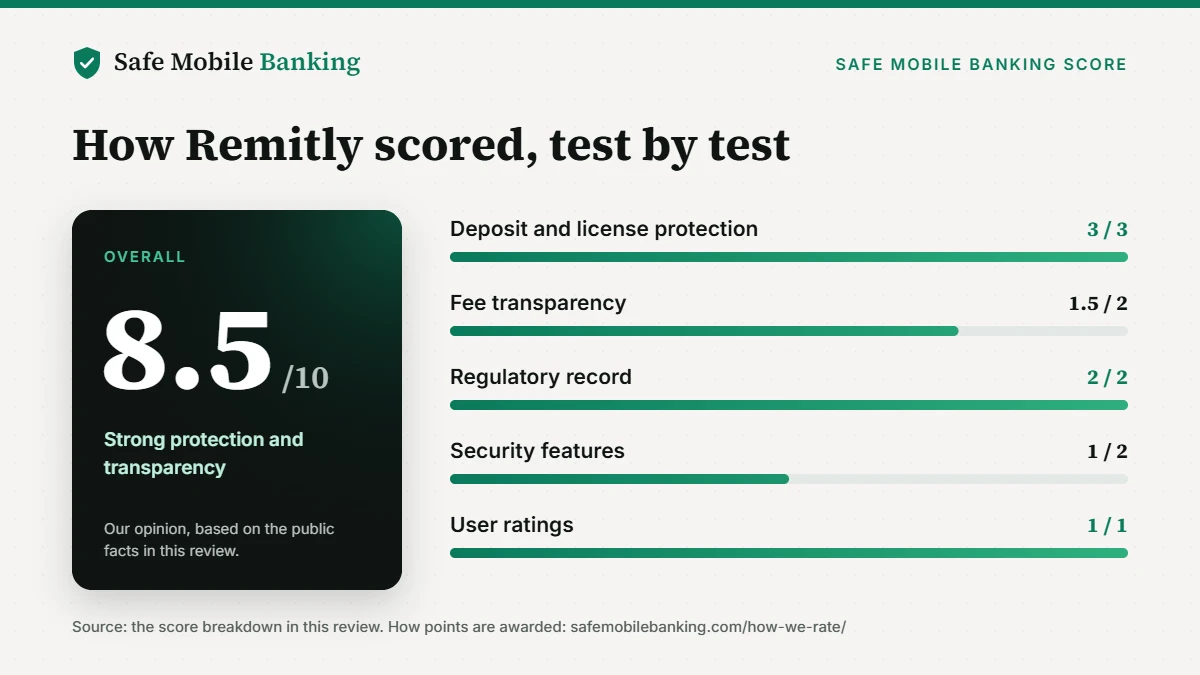
The Safe Mobile Banking Score is 8.5 out of 10 (strong). Each test follows our written point rules, checked against public records on November 19, 2026.
| Test | Points | Why |
|---|---|---|
| Deposit and license protection | 3 / 3 | Remitly, Inc. holds 64 active state licenses in NMLS (ID 1028236), most of them money transmitter licenses. Money in its Global Card account is held at Fifth Third Bank, Member FDIC. |
| Fee transparency | 1.5 / 2 | Remitly’s public pricing pages show current rates and fees, but delivery options and your exact rate appear only after you sign in and start a transfer. |
| Regulatory record | 2 / 2 | NMLS lists no regulatory actions, and Remitly’s November 2026 quarterly report lists no US enforcement proceeding. The 335 complaints filed with the federal consumer bureau in 12 months are under 1,000, and the top issue was 33% of them. |
| Security features | 1 / 2 | Phone sign-in uses a one-time code sent by text, which counts as optional two-step login (0.5). We confirmed transfer notifications in the account and by email (0.5). |
| User ratings | 1 / 1 | 4.9 on the App Store from about 2.8 million ratings. |
Check Remitly’s rate for your transfer (You see the fee, rate and delivery time before you pay.)
Is Remitly safe? FAQ
Is Remitly safe to send money?
Yes, to people you know. Remitly, Inc. is a licensed money transmitter with 64 active state licenses in NMLS and no regulatory actions posted there. It shows the fee and exchange rate before you send. The risk is sending money to a scammer: once a transfer is deposited or picked up, Remitly’s cancellation right no longer applies.
Is Remitly legit?
Yes. Remitly, Inc. is a real company based in Seattle, licensed under NMLS ID 1028236, and its parent, Remitly Global, Inc., trades on Nasdaq. Its November 2026 quarterly report says it had about 10.3 million active customers. It’s a money transmitter, not a bank.
Why is my Remitly transfer on hold?
Remitly says a hold usually means it needs more information: identity verification, a pending sending limit increase, wrong recipient details, a review by the delivery provider, or a provider that’s temporarily down. Check your Remitly account notifications and email. If you don’t fix a problem within 72 hours, Remitly may cancel and refund the transfer.
Can I cancel a Remitly transfer?
Yes, until the money is deposited to a bank account or picked up. Remitly’s cancellation notice says you get back all funds you paid, including fees, within three business days of the request. Contact Remitly through the app or at 1-888-736-4859 as soon as you can.
Does Remitly charge fees?
Sometimes. Remitly says you might pay a fee depending on the options you pick, and it shows the fee and exchange rate in the transfer summary before you send. It doesn’t charge recipients. A credit card issuer may add its own fee, and new customers may get a reduced fee or a promotional rate on the first transfer.
Is Remitly FDIC insured?
Remitly isn’t a bank, and money in transit to a recipient isn’t a bank deposit. Money held in the Remitly Global Card account is held at Fifth Third Bank, Member FDIC, through Stripe Payments Company, according to Remitly. Check the account terms for how coverage applies.
Related reviews
Sources
- NMLS Consumer Access: Remitly, Inc. (NMLS ID 1028236)
- Remitly Global, Inc.: Form 10-Q for the quarter ended September 30, 2026
- Remitly Help: How much does Remitly cost?
- Remitly Help: Why is my transfer on hold?
- Remitly: Send limits from the United States
- Remitly: US user agreement (delivery promise, holds)
- Remitly: Error resolution and cancellation notice
- Remitly: Transaction and account security
- Remitly: Remitly Global Card
- Remitly: Sign in with your phone number
- CFPB Consumer Complaint Database (company: Remitly, Inc.; Nov 19, 2025 to Nov 19, 2026)
- Remitly on the Apple App Store
Safe Mobile Banking is a publisher, not a financial advisor. This review is general information, not financial advice. Check Remitly’s current terms before you send.