Advertiser disclosure: This guide to PayPal scams is free and independent. Safe Mobile Banking may earn a commission from some companies we review, but PayPal Holdings, Inc. doesn’t pay for this page. How we make money.
Short answer
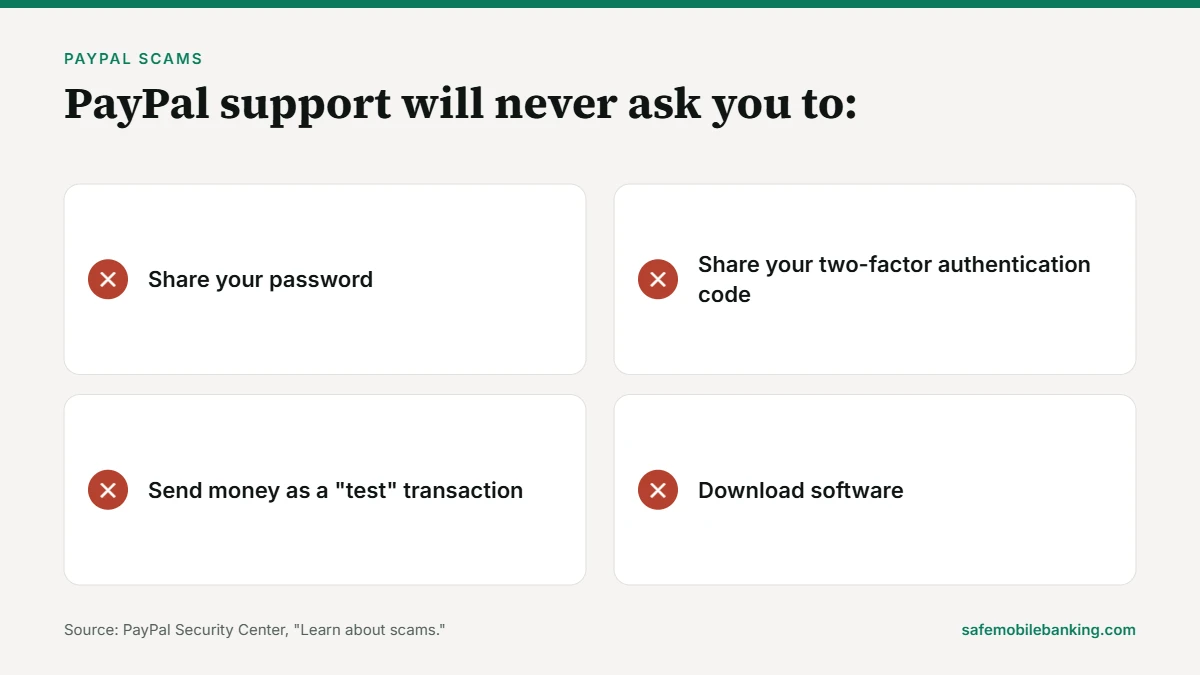
PayPal scams work when you send money, share a code or ship an item before the deal is real. PayPal says a seller who pushes you to pay with Friends and Family may be a scammer, because those payments aren’t covered by Purchase Protection. It also says a “customer service” request to share your password or two-factor code, send a “test” payment or download software is never legitimate.
- Never pay a stranger with Friends and Family.
- Never call a phone number printed in an invoice note.
- Never wire a buyer’s “overpayment” back.
- Pay sellers with Goods and Services. It costs the buyer nothing.
See the 5 rules that stop most PayPal scams (Free. Takes 2 minutes. Based on PayPal’s own scam pages.)
Last verified: November 20, 2026, against PayPal’s scam and security pages, Federal Trade Commission consumer advice and the Consumer Financial Protection Bureau complaint database.
What are the most common PayPal scams?
PayPal publishes its own list of common scams and how to spot them. This guide covers the nine that turn on a PayPal payment, an invoice or a package. Several target holiday shoppers and sellers directly: fake stores, gift purchases from strangers and orders that ship.
The stakes are real. The FTC says people reported losing about $16 billion to fraud in 2025, the highest on record. Imposter scams were the most reported category, nearly one in three fraud reports, and business impersonators took nearly $1 billion.
| Scam | What they ask for | The tell |
|---|---|---|
| Friends and Family purchase | Pay for an item with Friends and Family | A seller who refuses Goods and Services |
| Fake invoice or money request | A call to the phone number in the note | An alarmist note about an “issue” on your account |
| Fake PayPal support | Your password, two-factor code or a “test” payment | PayPal says these requests are never legitimate |
| Overpayment | Wire back the extra money | A real buyer doesn’t overpay |
| Buyer’s shipping account or label | Ship with their account or prepaid label | They control where the package goes |
| Package rerouting | Nothing up front. They reroute after you ship | A bad address, then a “not received” claim |
| Fake online store | Pay for a deal that’s far below market price | A “donate with PayPal” button at checkout |
| Marketplace buyer who can’t meet | Ship to their “shipping agent” | Texts only, offers more than your price |
| Reshipping job | Reship packages and share your bank details | A job that needs your Social Security number to “pay” you |
How do PayPal scams work?
PayPal draws a clear line. Fraud is when someone gets into your account without permission. A scam is when you approve a payment yourself but get the wrong thing or nothing at all. That difference matters, because a payment you sent on your own is much harder to get back.
Most PayPal scams follow the same pattern: urgency, a believable story and one request that moves money or control to the scammer. Here is how each of the nine works.
1. The Friends and Family payment trick
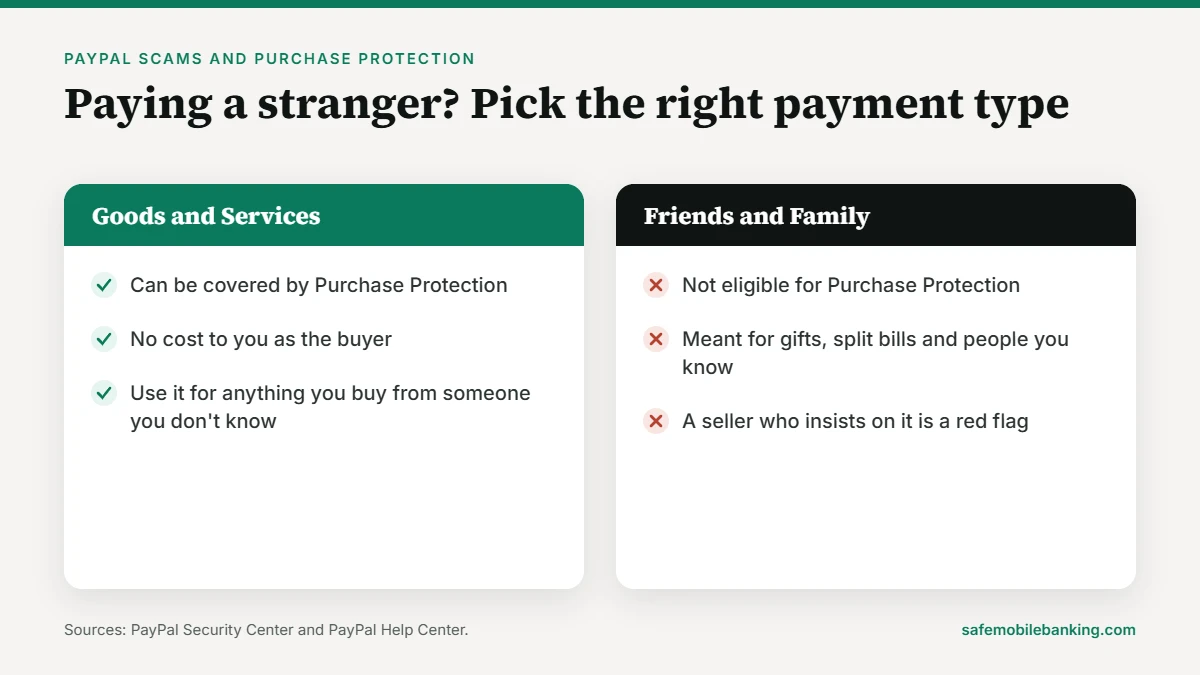
A seller on Facebook Marketplace, Craigslist or another classified site asks you to pay with Friends and Family. PayPal says to refuse, because the seller may know that a Friends and Family payment won’t be covered by Purchase Protection. Goods and Services payments are eligible for that protection, and PayPal says there’s no cost to the buyer for using them.
2. Fake invoices and money requests
You get a real PayPal invoice or money request for something you never ordered. Often it carries an alarmist note telling you to call a “customer service” number fast. Other versions arrive as emails dressed up to look like PayPal. PayPal’s advice: don’t pay it, don’t call the number and never send money to a crypto wallet named in an invoice. Log in to the PayPal app or website yourself to check. Our PayPal scam email guide covers the email versions in detail.
3. Fake PayPal customer service
Someone calls, texts or messages you as “PayPal support.” PayPal says that requests to share your password or two-factor authentication code, send money as a “test” transaction or download software are never legitimate. The FTC lists 1-888-221-1161 as PayPal’s customer service number, but PayPal says it will never call you from that number to ask for your personal or account information. So a call that looks like it comes from PayPal is not proof. Hang up and contact PayPal through its Help Center.
4. The overpayment scam (sellers)
A buyer pays more than your price, then asks you to wire back the difference or wire “shipping fees” to their shipper. PayPal warns the payment may come from a stolen card or bank account. If the real account holder reports it, the money can be pulled from your account, and you lose the item, the shipping and whatever you wired. The FTC gives the same warning about checks: don’t accept one for more than the selling price.
5. “Use my shipping account” and prepaid label scams (sellers)
The buyer asks you to ship with their account or their prepaid label, often with a story about a discount. That lets them redirect the package and then claim it never arrived. PayPal says you must ship to the address on the Transaction Details page to be covered by Seller Protection, and advises not to accept shipping labels from customers.
6. Package rerouting (sellers)
The buyer gives a bad address, watches the tracking, then asks the carrier to send the package somewhere else. Next comes a complaint that the item never arrived. Because it wasn’t delivered to the address on the Transaction Details page, PayPal says you aren’t covered by Seller Protection. PayPal’s fix: ask your carrier to block rerouting and confirm the buyer’s address before you ship.
7. Fake online stores
Fake shops sell popular clothing, shoes and electronics at prices that look too good. PayPal says they are often advertised on social media and can even show up in search results. They tend to vanish within days or weeks, and buyers get a counterfeit or nothing. One tell PayPal calls out: a checkout that asks you to “donate with PayPal” instead of making a normal payment.
8. The marketplace buyer who can’t meet
PayPal lists the warning signs for online marketplaces and classified sites. The buyer can’t meet in person, wants the item sent to a “shipping agent,” offers more than you asked, wants you to send money through Western Union or MoneyGram, or only texts and won’t talk on the phone. If any of these apply, PayPal says to end the conversation.
9. Reshipping and fake job offers
A work-from-home job asks you to receive packages and ship them out of the country. Packages may be addressed to someone else. The “employer” asks for your Social Security number and bank details for direct deposit. PayPal says you’ll generally never get paid and will have exposed yourself to fraud. If packages start arriving, refuse delivery or return them to sender.
Which PayPal scams hit holiday shoppers and sellers?
Holiday buying means more payments to people and shops you don’t know. Three of the nine PayPal scams above fit the season best.
- Fake stores. Deal ads on social media for popular gifts at prices far below market. Check for a physical address, a phone number and dispute details before you pay.
- Friends and Family for gifts and tickets. If a stranger selling concert tickets or a game console asks you to skip Goods and Services, say no.
- Shipping tricks for sellers. More orders means more chances for a buyer’s label, a rerouted package or an overpayment.
Not sure about a payment right now? Run it through our free payment scam checker. It asks 8 yes-or-no questions and stores nothing.
How to avoid PayPal scams: 5 rules
- Pay strangers with Goods and Services. It’s the payment type eligible for Purchase Protection, and the buyer pays no fee for it.
- Check your PayPal activity yourself. PayPal says payments, even those on hold or pending, show up in your activity. An email or screenshot isn’t a payment.
- Never call a number from an invoice, text or email. Open the PayPal app or type paypal.com yourself.
- Never share your password or two-factor code. No real PayPal agent asks for either.
- Sellers: ship only to the Transaction Details address, with your own account. Don’t accept buyer labels, and block rerouting with your carrier.
What should you do if you paid a PayPal scammer?
- Report it in PayPal. PayPal says to report a payment you didn’t authorize right away through its Resolution Center. Report unwanted invoices or money requests from inside the PayPal app or website.
- Forward fake emails. Send suspicious emails or website links to phishing@paypal.com, then delete them.
- Secure your account. If you shared a password or code, change your password and turn on two-step verification. The FTC also recommends multi-factor authentication or a PIN on payment apps.
- Call your bank or card issuer if a linked card or bank account paid.
- Report it to the FTC at ReportFraud.ftc.gov. Our guide to reporting a scam lists every other place to file.
What do complaints about PayPal show?
The Consumer Financial Protection Bureau logged 13,219 complaints against Paypal Holdings, Inc. received between November 20, 2025 and November 20, 2026. That parent company also owns Venmo, so the total covers both. The most common issue was “unauthorized transactions or other transaction problem” (2,780 complaints). There were 1,704 complaints about fraud or scams. PayPal Holdings gave a timely response to all but one complaint, according to the bureau’s data. You can search the records yourself in the CFPB complaint database.
Complaints are consumers’ claims as logged by the Consumer Financial Protection Bureau. The bureau doesn’t verify them, and a complaint isn’t proof of wrongdoing.
Is PayPal itself safe to use?
These are scams that target PayPal users, not a judgment on PayPal. Our PayPal safety review covers licensing, FDIC coverage, fees and the regulatory record, and gives PayPal a Safe Mobile Banking Score. If you also use Venmo or Zelle, read our Venmo scams and Zelle scams guides. See how we rate every app.
Read our full PayPal safety review (Licensing, Purchase Protection and the 5-test score.)
PayPal scams FAQ
Can PayPal refund money I sent to a scammer?
If you paid a seller with Goods and Services, the purchase can be covered by Purchase Protection, so report it in the Resolution Center right away. Friends and Family payments aren’t eligible, so getting that money back is much harder. Report it to PayPal anyway, and call your bank or card issuer if a linked account paid.
Will PayPal ever call and ask for my password or code?
No. PayPal says a “customer service” request to share your password or two-factor authentication code, send money as a “test” transaction or download software is never legitimate. It also says it will never call you from 1-888-221-1161 to ask for personal or account information. If someone does, hang up and contact PayPal through its Help Center.
Is a PayPal invoice for something I didn’t buy a scam?
Treat it as one. PayPal says not to pay an invoice or money request for something you never ordered, not to call any phone number in the note and never to send money to a crypto wallet named in it. Report it from inside the PayPal app or website, where you can also check whether any action is really needed.
Why do scammers ask for Friends and Family payments?
Because Friends and Family payments aren’t covered by PayPal’s Purchase Protection. PayPal says a seller who pushes you to pay that way when you’re buying something may be a scammer. Goods and Services payments can be covered, and PayPal says there’s no cost to the buyer for using them.
How can sellers avoid PayPal scams?
Ship only to the address on the Transaction Details page, using your own shipping account. Don’t accept a buyer’s prepaid label, ask your carrier to block rerouting and never wire back an “overpayment.” PayPal says shipping elsewhere can cost you Seller Protection, and an overpayment may come from a stolen card or bank account.
Where do I report PayPal scams?
Report unauthorized payments in PayPal’s Resolution Center and unwanted invoices from the app or website. Forward fake emails to PayPal’s phishing address, listed in the steps above, then delete them. Report the scam to the FTC at ReportFraud.ftc.gov, and call your bank or card issuer if one of them paid.
Sources
- PayPal: What are common scams and how do I spot them?
- PayPal Security Center: Learn about scams
- PayPal: What are ‘Friends and Family’ payment scams?
- PayPal: What are invoice scams and money request scams on PayPal?
- PayPal: Common scams on online marketplaces and classifieds websites
- PayPal: How to spot online shopping scams
- FTC: Mobile Payment Apps: How To Avoid a Scam When You Use One
- FTC: How To Spot, Avoid, and Report Fake Check Scams
- FTC: People reported losing $3.5 billion to imposter scams in 2025
- CFPB: Consumer Complaint Database (Paypal Holdings, Inc., complaints received Nov 20, 2025 to Nov 20, 2026)
This guide is general information, not financial or legal advice. Scam tactics change. Check PayPal’s Security Center for its latest warnings.