Advertiser disclosure: This guide to Venmo scams is free and independent. Safe Mobile Banking may earn a commission from some companies we review, but Venmo and its parent, PayPal Holdings, Inc., don’t pay for this page. How we make money.
Short answer
Venmo scams almost always need you to do one thing: send money, share a code, or ship an item before the money is real. Venmo says its agents will never ask for the verification code sent to your phone, never ask you to send money to “verify” an account and never move you to another payment app. Payments sent without the purchase toggle aren’t covered by Purchase Protection, so a stranger who asks you to skip it is a warning sign.
- Venmo support will never ask for your sign-in code.
- A screenshot or email is not a payment. Check your Venmo balance.
- Turn on “purchase” for anything you buy from a stranger.
See the 5 rules that stop most Venmo scams (Free. Takes 2 minutes. Based on Venmo’s own scam list.)
Last verified: November 18, 2026, against Venmo’s scam and Purchase Protection pages, Federal Trade Commission consumer advice and the Consumer Financial Protection Bureau complaint database.
What are the most common Venmo scams?
Venmo publishes its own list of common scams on Venmo. This guide covers the nine that turn on a payment. Holiday shopping means more payments to strangers for gifts, tickets and gift cards, and several of these tricks target exactly that. Imposter scams were the most reported fraud category in 2025, nearly one in three fraud reports, according to the Federal Trade Commission.
| Scam | What they ask for | The tell |
|---|---|---|
| Fake Venmo support call | The code texted to your phone | Venmo agents never ask for that code |
| Fake sign-in text | A tap on a link, then your password | Venmo’s real code text has no link |
| Prize or cash reward | Your Venmo sign-in on another site | A link that asks for your Venmo sign-in |
| Seller who wants a friends payment | Payment with the purchase toggle off | Hard-to-find item, “pay me first” |
| Fake payment proof | Ship first; the money “releases” later | Screenshot or email, nothing in your balance |
| Stolen card buyer | The item, sent fast | The money can be pulled back after you ship |
| “Accidental” payment | A new payment back to them | A stranger paid you, then asks for a refund |
| Friend look-alike | An urgent payment or request | Same photo, new username, sudden crisis |
| Check for Venmo swap | A Venmo payment for a check you deposit | Money goes out before the check bounces |
How do Venmo scams work? The 9 tricks, one by one
1. A call from “Venmo support” asking for your code
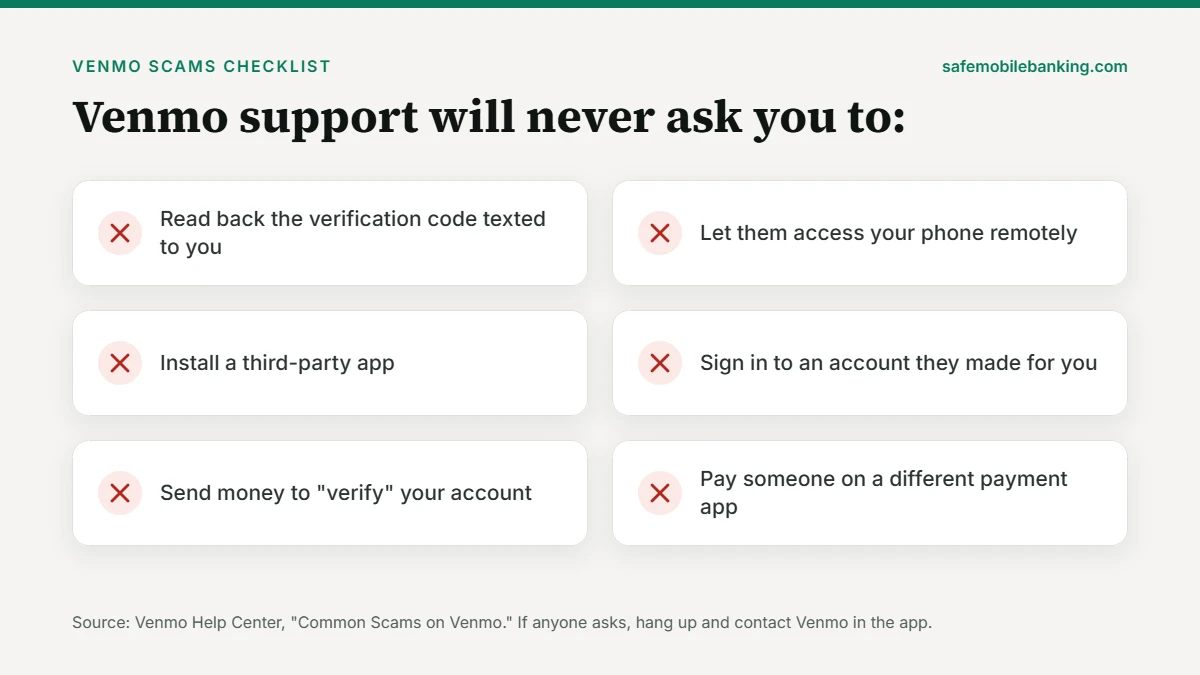
The scammer tries to sign in to your account and hits Venmo’s multi-factor check, which sends a code to your phone. Then they call you, claim to be Venmo and ask you to read the code back to confirm it’s you. Venmo says plainly that an agent will never ask for this code under any circumstances. It also says it will never ask to access your device remotely, never ask you to install another app and never create an account for you.
2. A fake sign-in text with a link
This version skips the call. You get a text that looks like Venmo’s code message, but it carries a link to a copy of the sign-in page. Venmo says its real multi-factor message does not contain a link. If a “Venmo code” text has one, delete it.
3. “You won money from Venmo”
A text or email says you won a prize or cash reward and asks you to sign in through a link. Venmo tells users never to enter their Venmo login anywhere except Venmo.com and the Venmo app, and says it only emails from addresses ending in venmo.com. The Federal Trade Commission’s four signs of a scam list a surprise prize as sign number two.
4. A holiday seller who wants a friends-and-family payment
This is the trick to watch during holiday gift shopping. A stranger has the hard-to-find console, sneakers or concert tickets. They ask you to pay first, and to send it as a regular payment instead of marking it as a purchase. Venmo says this tactic is common with rare, popular items. It matters because Purchase Protection applies only to eligible payments, and a payment you send without turning on the “purchase” toggle is not one of them, according to Venmo’s eligibility rules.
5. Fake payment proof when you’re the seller
You list something. The buyer sends a screenshot or an email that looks like a Venmo receipt. Some say the money will reach you only after you ship and upload tracking. Venmo says that feature doesn’t exist. The only proof of payment is money in your Venmo balance, checked in the app.
6. A buyer paying with a stolen card
Some payments are real at first. A scammer pays you with a stolen card or bank account, you ship, and later the real owner reports the charge. Venmo warns that the money can then be removed from your account. You can lose the item and the money.
7. The “accidental” payment
A stranger sends you money, then messages you to say it was a mistake and asks you to send it back as a new payment. Venmo’s advice is not to send a new payment. Contact Venmo instead, as soon as possible, so it can help reverse the original one. Then block the sender.
8. Someone posing as your friend
A scammer copies a friend’s name and photo, then requests money from people in that friend’s network, using what they can see in the public feed. The story is usually urgent. Venmo suggests tapping the profile to check its history, contacting your friend outside Venmo and tightening who can see your friends list and transactions.
9. A check in exchange for a Venmo payment
Someone sends you a check and asks you to send money on Venmo. Venmo says the check will typically clear at first and bounce later, and then you owe your bank. Venmo’s rule is short: do not exchange a check for a Venmo payment.
What other Venmo scams should I watch for?
Venmo also lists tech support lines run by scammers, romance scams that build trust before asking for money, job offers that ask you to pay upfront or move someone else’s money, and landlords who want a deposit before you get keys or paperwork. The common thread is the same: pressure to send money now.
How to avoid Venmo scams: 5 rules
Most Venmo scams fall apart when you follow these five rules.
- Never share a code. The code Venmo texts you is for you only. No agent needs it.
- Pay strangers as a purchase, or don’t pay them. Use the purchase toggle or an approved business profile. Venmo says approved business accounts show “Eligible items covered by Purchase Protection” under the Pay button.
- Trust your balance, not a screenshot. Open the app and check before you ship anything.
- Don’t send money back. Report it. If a stranger pays you by “mistake,” contact Venmo so it can reverse the original payment.
- Lock down your account. The Federal Trade Commission says to protect payment apps with multi-factor authentication or a PIN, and the Consumer Financial Protection Bureau recommends a passcode, PIN or fingerprint before any payment.
Does Venmo refund you if you get scammed?
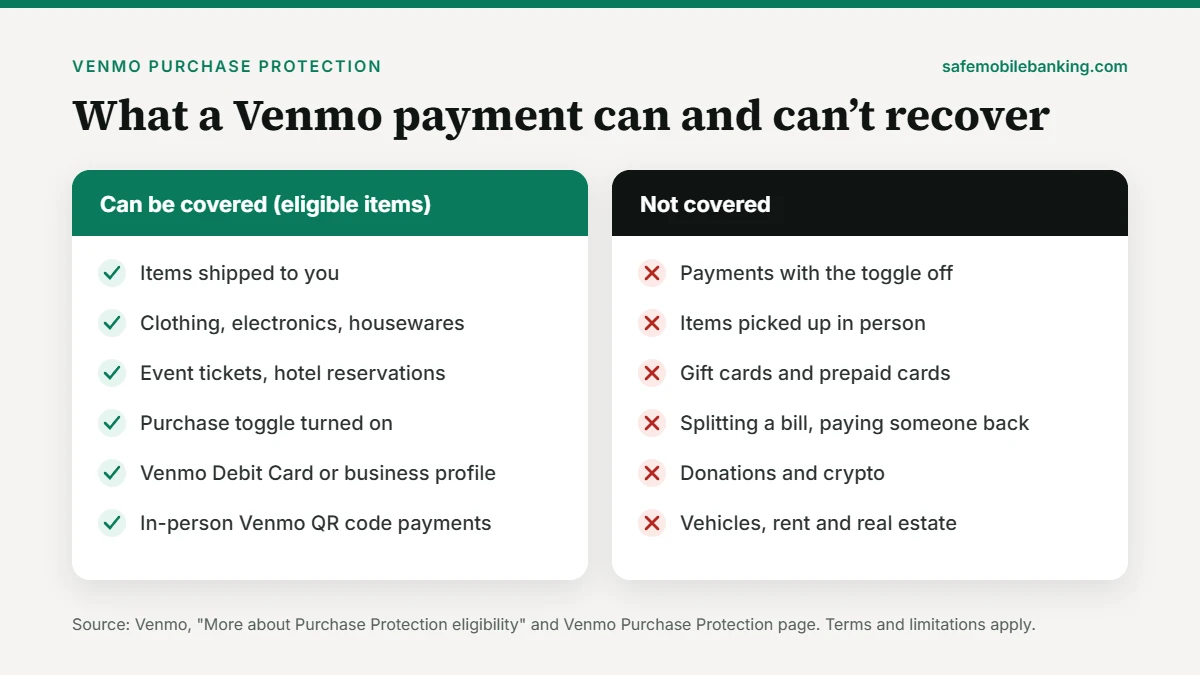
Usually not for payments you sent to a friend or stranger on your own. Purchase Protection can reimburse eligible purchases for the full payment plus original shipping, at no extra cost to the buyer, according to Venmo’s Purchase Protection page. But several holiday favorites are excluded. Venmo’s eligibility rules list these as ineligible:
- Payments sent without turning on the purchase toggle
- Items you pick up in person, except in-person Venmo QR code payments
- Gift cards and prepaid cards
- Splitting a bill or paying someone back
- Gambling and contests with an entry fee, donations and crypto
That puts several holiday Venmo scams, like gift card sales and in-person pickups, outside its coverage.
In its 2018 payment-app tips, the Consumer Financial Protection Bureau put the general problem simply: new mobile payment services generally don’t have a recall feature, so be certain before you press send. That’s why the rules above focus on stopping the payment, not chasing it.
What do Venmo scam complaints look like?
The federal consumer bureau logs Venmo complaints under its parent, PayPal Holdings, so the figures cover PayPal and Venmo together. From November 18, 2025 to November 18, 2026, consumers filed 13,117 complaints in the CFPB Consumer Complaint Database. 1,703 were complaints about fraud or scams, and 2,752 were complaints about unauthorized transactions or other transaction problems. Our money app complaint report compares PayPal and Venmo with 25 other money apps.
Complaints are consumers’ claims as logged by the Consumer Financial Protection Bureau. The bureau doesn’t verify them, and a complaint isn’t proof of wrongdoing.
What should I do if I paid a Venmo scammer?
If you lost money to one of these Venmo scams, do these five things in order.
- Contact Venmo now. In the app, go to Me, then Settings, then Get Help, then Chat With Us, and ask for an agent. The Federal Trade Commission lists Venmo’s phone line as 1 (855) 812-4430.
- Change your password if you shared a code or signed in through a link.
- Call your bank or card issuer if the payment came from a linked card or account.
- Report it to the FTC at ReportFraud.ftc.gov. Our guide on how to report a scam covers where else to report it.
- Block the account so it can’t contact you again.
Is Venmo itself safe to use?
Yes, for paying people you know. The scams above work by tricking the user, not by breaking into the app. Our full Venmo safety review covers FDIC coverage, fees, security settings and its Safe Mobile Banking Score. If you also use Cash App, the same tricks appear in our guide to Cash App scams, and buyers should read our Facebook Marketplace scams guide. See how we rate every app.
Read our full Venmo safety review (FDIC coverage, fees and the 5-test score.)
Venmo scams FAQ
Can Venmo reverse a payment I sent to a scammer?
Usually not if you sent it on your own as a regular payment. Venmo’s Purchase Protection covers eligible purchases, such as items shipped to you when the purchase toggle was on. It doesn’t cover payments sent without the toggle, gift cards or items picked up in person. Contact Venmo support right away anyway, and tell your bank if a linked card or account paid.
Will Venmo ever call and ask for my verification code?
No. Venmo says an agent will never ask for the verification code sent to your phone, under any circumstances. It also says it will never ask to access your device remotely, ask you to install another app or ask you to send money to verify your account. Anyone who asks for that code is trying to sign in as you.
Is it safe to sell to a stranger on Venmo?
It’s risky. Venmo warns that buyers send fake payment emails and screenshots, claim money releases after you ship, or pay with stolen cards that get pulled back later. Venmo tells users not to sell to strangers except as its User Agreement allows. If you do sell, confirm the money in your Venmo balance before you hand over or ship anything.
Are gift cards bought with Venmo covered by Purchase Protection?
No. Venmo’s eligibility rules list gift cards and prepaid cards as ineligible for Purchase Protection. That makes a gift card bought from a stranger on Venmo a risky holiday purchase. Buy gift cards from the store or brand that issues them, and never pay someone who insists on gift cards as payment.
What should I do if a stranger sends me money by mistake on Venmo?
Don’t send a new payment back. Venmo lists this as a common scam: a stranger pays you, then asks you to return it as a new payment. Venmo says to contact its support team as soon as possible so it can help reverse the original payment. Then block the sender to stop more payments or requests.
How do I report a Venmo scam?
Report it to Venmo first: in the app, go to Me, Settings, Get Help, Chat With Us, and ask for an agent. The Federal Trade Commission lists Venmo’s phone line as 1 (855) 812-4430. Then report it to the FTC at ReportFraud.ftc.gov. If a bank account or card paid, call that bank too.
Sources
- Venmo: Common Scams on Venmo
- Venmo: More about Purchase Protection eligibility
- Venmo: Purchase Protection for buyers and sellers
- FTC: Mobile Payment Apps: How To Avoid a Scam When You Use One
- FTC: How To Avoid a Scam
- FTC: People reported losing $3.5 billion to imposter scams in 2025
- CFPB: Helpful tips for using mobile payment services
- CFPB Consumer Complaint Database
This guide is information, not financial or legal advice. Check Venmo’s current help pages before you act.