Advertiser disclosure: This credit card payoff calculator is free and independent. No company pays for it, and it doesn’t collect anything you enter. How we make money.
Short answer
This credit card payoff calculator shows how long it takes to pay off a card balance, what it costs in interest, and the monthly payment needed to hit a payoff goal. At the Federal Reserve’s latest average APR of 22.36%, a $5,000 balance paid at $200 a month takes 2 years and 10 months and costs about $1,793 in interest.
- Plan by monthly payment or by payoff goal. Results update instantly.
- If a payment doesn’t cover the monthly interest, the calculator tells you.
- Nothing you enter is saved or sent.
Use the credit card payoff calculator (Free. No sign-up. Takes about 30 seconds.)
Last verified: November 18, 2026, against the Federal Reserve’s G.19 consumer credit release and the Consumer Financial Protection Bureau’s credit card guidance.
How the credit card payoff calculator works
Enter the balance from your latest statement and your card’s APR. Choose Monthly payment to see your debt-free date and total interest, or Payoff goal to see the payment that clears the card in the number of months you pick. The credit card payoff calculator assumes you stop adding new charges.
Credit card payoff calculator
Your debt-free date
Enter your balance and APR, then plan by monthly payment or by payoff goal.
Starts at 22.36%, the Federal Reserve’s latest average for card accounts charged interest. Use the APR on your statement.
Assumes no new charges and a fixed APR. Interest is estimated monthly (APR divided by 12), so your statement can differ by a few dollars.
Debt-free in
2 years 10 months
Debt-free by September 2029
- Monthly payment
- $200.00
- Total interest
- $1,793
- Total paid
- $6,793
- Pay $50 more a month
- Saves $478 and 8 months
Interest adds 36% to what you owe. The CFPB says the more you pay each month, the less interest you pay over time.
Check your credit utilizationYour numbers stay in this tab. Nothing is saved or sent.
How is credit card payoff calculated?
Each month, interest is added to the balance first, then your payment comes off. The credit card payoff calculator estimates that interest as your APR divided by 12, times the balance. Whatever is left of your payment lowers the balance, and the next month starts from the new, smaller number.
That’s why the early months feel slow. At 22.36% APR, a $5,000 balance builds about $93 of interest in its first month. A $200 payment pays that interest and knocks about $107 off the balance. As the balance shrinks, more of each payment goes to principal.
How much faster does a bigger payment pay off a card?
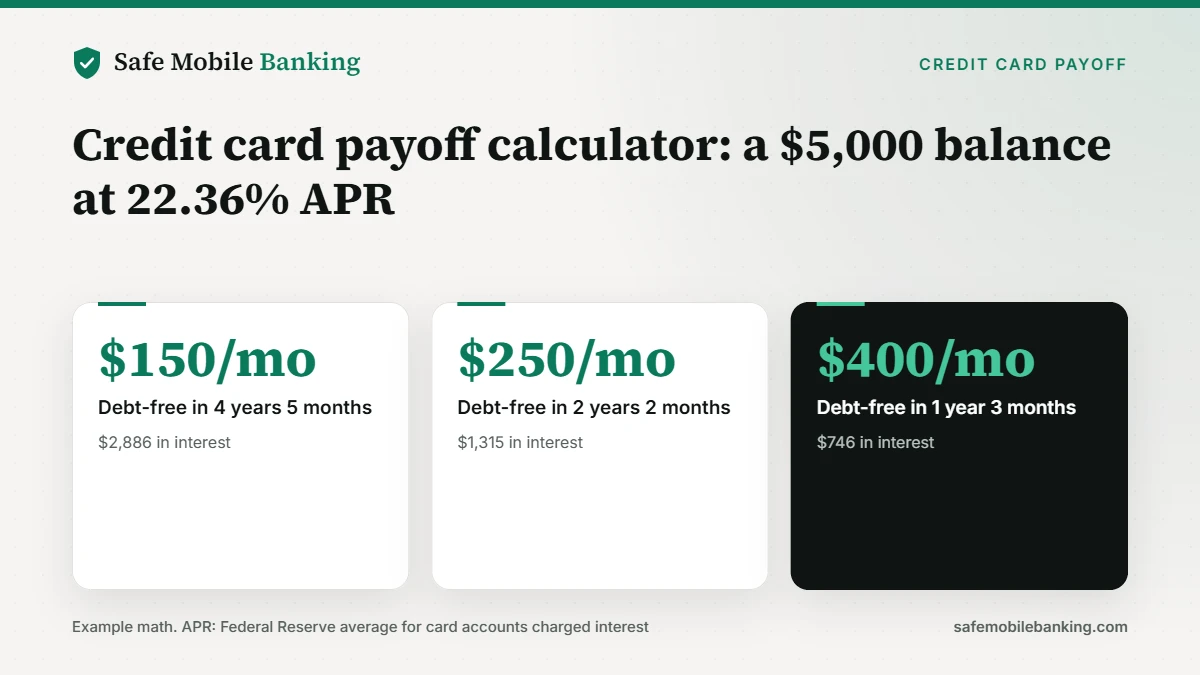
Much faster, and much cheaper. Here’s what the credit card payoff calculator shows for a $5,000 balance at 22.36% APR with no new charges:
| Monthly payment | Debt-free in | Total interest |
|---|---|---|
| $150 | 4 years 5 months | $2,886 |
| $200 | 2 years 10 months | $1,793 |
| $250 | 2 years 2 months | $1,315 |
| $400 | 1 year 3 months | $746 |
Going from $150 to $400 a month cuts more than three years and about $2,140 in interest. The credit card payoff calculator’s “Pay $50 more a month” line shows the same trade for your own numbers.
What does the minimum payment warning on my statement mean?
The Consumer Financial Protection Bureau explains that card issuers must tell you how long it will take to pay off your current balance if you make no new charges and pay only the minimum each month. Each statement must also show how much to pay monthly to clear the current balance in 36 months.
Those numbers ignore future purchases. The CFPB adds that you don’t have to pay more than the minimum, but the more you pay each month, the less interest you pay, and paying only the minimum could take years. To check your statement’s box, choose Payoff goal in the credit card payoff calculator and enter 36 months.
How do I pay off credit card debt faster?
- Pay more than the minimum. Even $50 a month makes a difference, and the credit card payoff calculator shows exactly how much.
- Stop adding new charges. Every payoff figure here, and on your statement, assumes the balance doesn’t grow.
- Pick a payoff date and work backward. Use Payoff goal to turn a date into a monthly payment you can schedule.
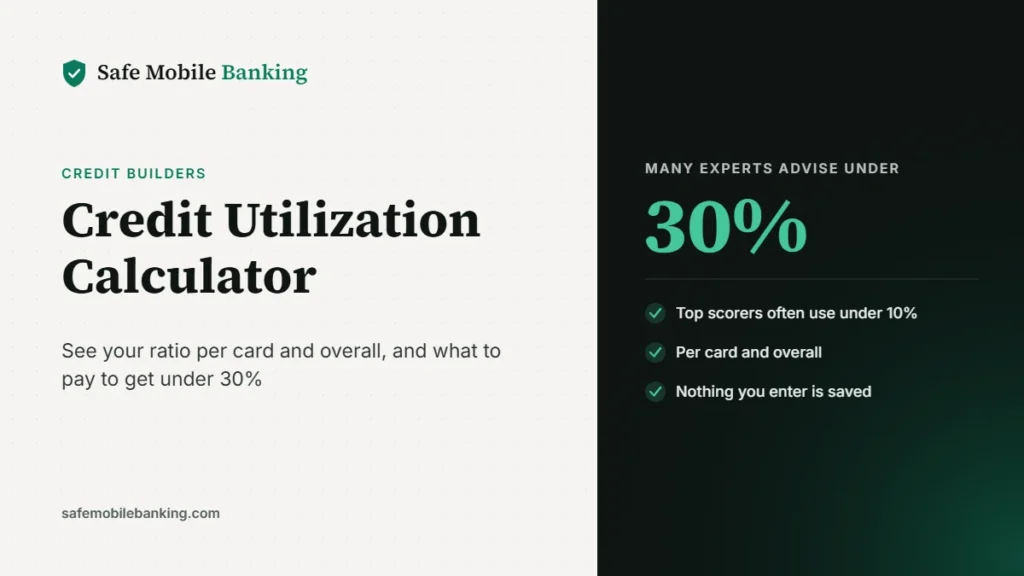
- Watch your utilization fall. The CFPB says scoring models look at how much of your credit limit you’re using. Our credit utilization calculator shows your ratio as you pay it down.
Which tools and guides go with this calculator?
- Credit utilization calculator
- Early mortgage payoff calculator
- Credit builder cards compared
- Is Credit Karma safe?
- Payment scam checker
Every app we review gets a Safe Mobile Banking Score. See how we rate them.
Check your credit utilization (Free. Per card and overall.)
Credit card payoff calculator FAQ
Does this credit card payoff calculator save what I enter?
No. The calculator runs entirely in your browser tab. Your balance, APR and payment aren’t stored, sent to a server or shared, and they disappear when you close the page. There’s no sign-up or email, so you can try as many payment amounts as you like.
What APR should I enter?
Use the purchase APR printed on your latest statement or shown in your card’s app. If you’re not sure, the default of 22.36% is the Federal Reserve’s latest average rate for credit card accounts that were charged interest. If parts of your balance carry different APRs, run each part separately.
Why does my payment barely lower my balance?
Interest comes first. At 22.36% APR, a $5,000 balance builds up about $93 of interest in a month, so a $100 payment cuts the balance by only about $7. The credit card payoff calculator shows this trap: if a payment doesn’t cover the monthly interest, it tells you the minimum that does.
How long does it take to pay off $5,000 at $200 a month?
At 22.36% APR and with no new charges, a $5,000 balance paid at $200 a month takes 2 years and 10 months and costs about $1,793 in interest. Raising the payment to $250 cuts that to 2 years and 2 months and about $1,315 in interest.
Does paying off a credit card help my credit score?
It can. The CFPB says credit scoring models look at how much of your credit limit you’re using, so keeping balances low helps, and paying off the balance in full each month helps get you the best scores. Our credit utilization calculator shows where your ratio stands.
Sources
- Federal Reserve: G.19 Consumer Credit, terms of credit
- CFPB: What the payoff box on a credit card bill means
- CFPB: How do I get and keep a good credit score?
This tool gives general information, not financial advice. Your card issuer’s statement is the final word on your balance, interest and minimum payment.