Advertiser disclosure: This early mortgage payoff calculator is free and independent. No company pays for it, and it doesn’t collect anything you enter. How we make money.
Short answer
This early mortgage payoff calculator shows how much sooner you’d own your home, and how much interest you’d save, by paying extra each month, once a year or as a lump sum. On a $300,000 balance at 7.11% with 30 years left, an extra $200 a month pays the loan off 7 years and 2 months sooner and saves about $119,667 in interest.
- Three ways to pay extra: monthly, yearly or one time.
- Check your loan for a prepayment penalty before a big lump sum.
- Nothing you enter is saved or sent.
Use the early mortgage payoff calculator (Free. No sign-up. Principal and interest only.)
Last verified: November 18, 2026, against Freddie Mac’s Primary Mortgage Market Survey and the Consumer Financial Protection Bureau’s mortgage guidance.
How the early mortgage payoff calculator works
Enter your current loan balance, interest rate and the years left on the loan. The early mortgage payoff calculator works out your regular principal and interest payment, then adds your extra payments to show the new payoff date and the interest you’d save. Change any number and the result updates.
Early mortgage payoff calculator
How much sooner you’d own your home
Enter your loan, then try extra payments monthly, yearly or as a lump sum.
Rate starts at 7.11%, Freddie Mac’s 30-year fixed average as of November 12, 2026. Use your own rate and balance from your statement.
You’d pay it off
7 years 2 months sooner
Debt-free by September 2049
- Monthly principal and interest
- $2,018
- Interest saved
- $119,667
- Total interest with extra
- $306,856
- Total interest without extra
- $426,523
- Original payoff
- November 2056
Principal and interest only. Taxes and insurance in an escrow payment aren’t included.
Compare with your card debtYour numbers stay in this tab. Nothing is saved or sent.
How do extra mortgage payments save interest?
The CFPB’s guide to how paying down a mortgage works explains that each payment is split: part pays down the principal and part pays interest. As the principal falls, you owe less interest each month because the balance is lower.
Extra payments speed that up, and the early mortgage payoff calculator shows by how much. On a $300,000 loan at 7.11%, about $1,778 of the first $2,018 payment is interest, so only about $241 reaches the principal. An extra $200 that month nearly doubles the principal paid, and every later month charges interest on the smaller balance.
How much can extra mortgage payments save?
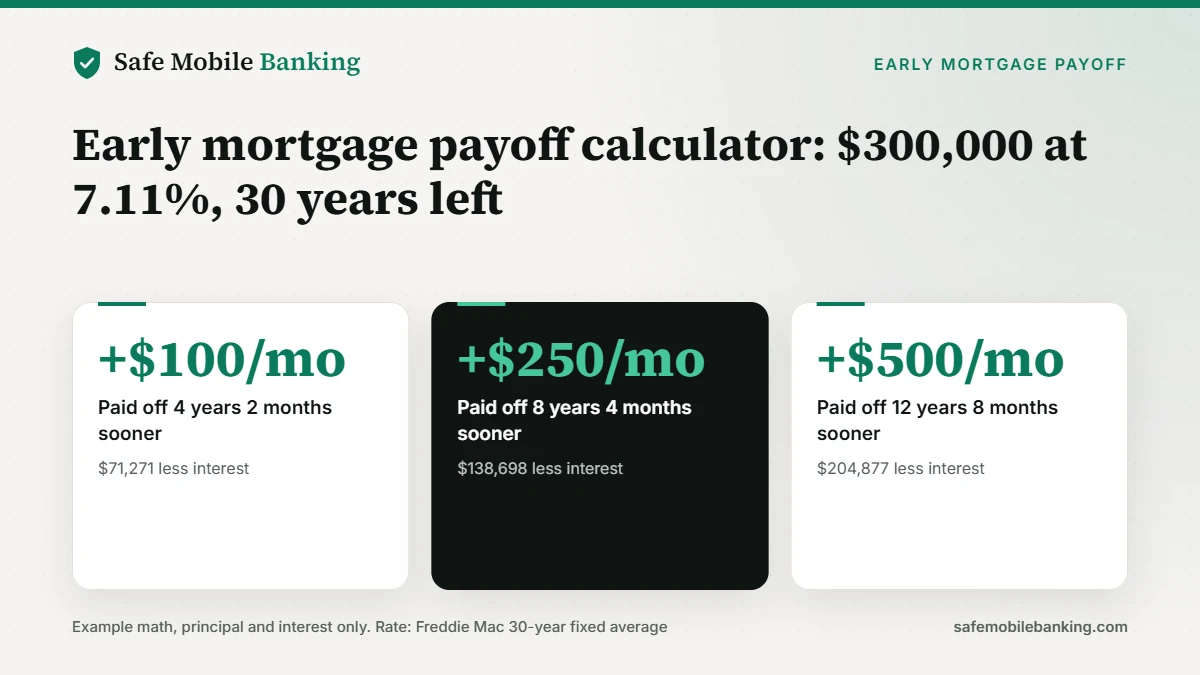
Here’s what the early mortgage payoff calculator shows for a $300,000 balance at 7.11% with 30 years left:
| Extra each month | Paid off sooner by | Interest saved |
|---|---|---|
| $100 | 4 years 2 months | $71,271 |
| $200 | 7 years 2 months | $119,667 |
| $250 | 8 years 4 months | $138,698 |
| $500 | 12 years 8 months | $204,877 |
In the early mortgage payoff calculator, a one-time $10,000 payment on the same loan cuts 3 years and 1 month and saves about $65,200. One extra payment of about $2,018 a year cuts 6 years and 1 month and saves about $101,967.
Is there a penalty for paying off a mortgage early?
Sometimes. The CFPB defines a prepayment penalty as a fee some lenders charge if you pay off all or part of your mortgage early. If your loan has one, you agreed to it at closing, and not all mortgages have one.
The CFPB says a penalty typically applies when you pay off the entire balance, such as by selling or refinancing, within a set number of years, usually three or five. It can also apply to paying off a large amount at once. Small extra principal payments normally don’t trigger it, but the CFPB suggests confirming with your lender.
When you send extra, ask your servicer how to mark it as extra principal, then check your next statement to see it applied.
Should extra money go to the mortgage or to card debt first?
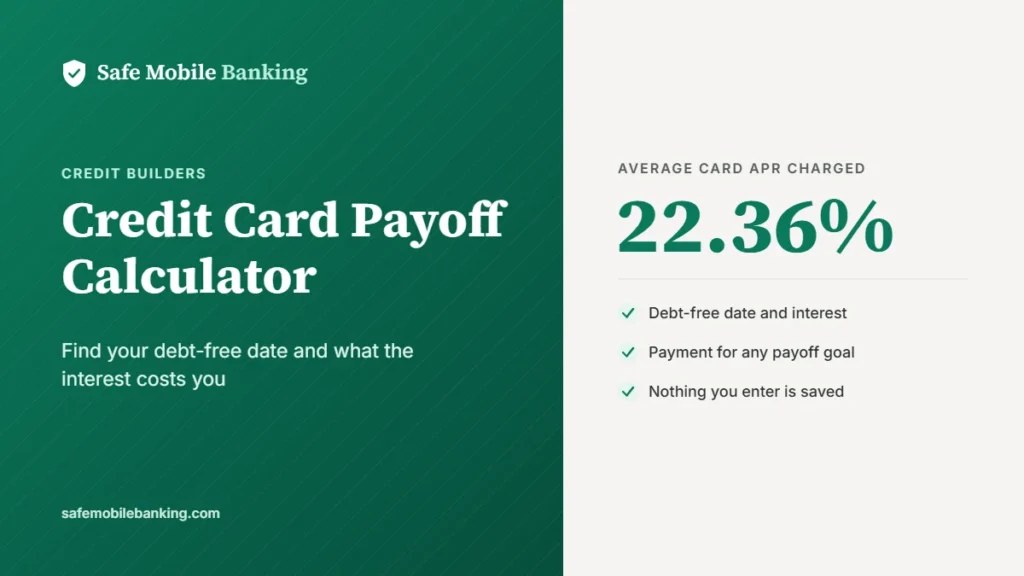
Compare the rates. The Federal Reserve’s latest average for credit card accounts charged interest is 22.36%, about three times a 7.11% mortgage rate. Each extra dollar on the higher-rate balance avoids more interest. Our credit card payoff calculator shows what an extra payment does to your card balance, so you can line it up next to this early mortgage payoff calculator.
Which tools and guides go with this calculator?
- Credit card payoff calculator
- Credit utilization calculator
- Is SoFi legit?
- What to do if your bank account is hacked
- Payment scam checker
Every app we review gets a Safe Mobile Banking Score. See how we rate them.
Compare with your card debt (Free. See your card’s debt-free date.)
Early mortgage payoff calculator FAQ
Does this early mortgage payoff calculator save what I enter?
No. The calculator runs entirely in your browser tab. Your balance, rate and extra payments aren’t stored, sent to a server or shared, and they disappear when you close the page. There’s no sign-up or email, so you can test as many extra payment amounts as you like.
Does the calculator include taxes and insurance?
No. It works with principal and interest only, the part of your payment that pays down the loan. Property taxes, homeowners insurance and mortgage insurance collected in an escrow account don’t change when the loan is paid off, so leave them out of every field.
Is there a penalty for paying extra on my mortgage?
Not on most loans. The CFPB says not all mortgages have a prepayment penalty, and that it typically applies when you pay off the entire balance within a set number of years, usually three or five. Small extra principal payments normally don’t trigger one, but check with your lender.
How much does an extra $200 a month save on a mortgage?
On a $300,000 balance at 7.11% with 30 years left, an extra $200 a month pays the loan off 7 years and 2 months sooner and saves about $119,667 in interest. Your result depends on your balance, rate and years left, so enter your own numbers in the calculator.
Is one extra mortgage payment a year worth it?
It adds up. On the same $300,000 loan at 7.11% with 30 years left, one extra payment of about $2,018 each year pays the loan off 6 years and 1 month sooner and saves about $101,967 in interest. Enter it in the Extra once a year field to test your own loan.
Sources
- Freddie Mac: Primary Mortgage Market Survey
- CFPB: How does paying down a mortgage work?
- CFPB: What is a prepayment penalty?
- Federal Reserve: G.19 Consumer Credit, terms of credit
This tool gives general information, not financial advice. Your servicer’s payoff statement is the final word on what you owe.