Advertiser disclosure: This Western Union fee calculator is free and independent. Western Union doesn’t pay for it, no money transfer company does, and it doesn’t collect anything you enter. How we make money.
Short answer
This Western Union fee calculator shows the real cost of a money transfer: the fee on your quote plus the exchange-rate markup, which most fee calculators leave out. Enter the amount, the fee and the rate or amount your quote shows. The calculator compares it with today’s market rate and shows the total in dollars and as a share of what you send. It works for MoneyGram, Remitly and any other provider too.
- U.S. providers must show you the exchange rate, fees and amount received before you pay.
- The fee is only part of the cost. A lower exchange rate than the market rate is a second, hidden cost.
- Nothing you enter is saved or sent, and it never asks for your login.
Use the Western Union fee calculator (Free. No sign-up. 33 currencies, live market rate.)
Last verified: November 18, 2026, against CFPB remittance guidance, the World Bank’s Remittance Prices Worldwide report and ExchangeRate-API’s daily rates.
How the Western Union fee calculator works
Get a quote from Western Union, MoneyGram or any provider, then copy three numbers into the Western Union fee calculator: the amount you send, the transfer fee, and either the exchange rate or the amount the recipient gets. The calculator loads today’s market rate for the currency you pick, works out how much less your recipient gets than the market rate would give, and adds that markup to the fee.
What your money transfer really costs
Enter the numbers from your quote. We compare them with today’s market rate.
Loading today’s rate…
Your numbers stay in this tab. Nothing is saved or sent.
What does a Western Union transfer really cost?
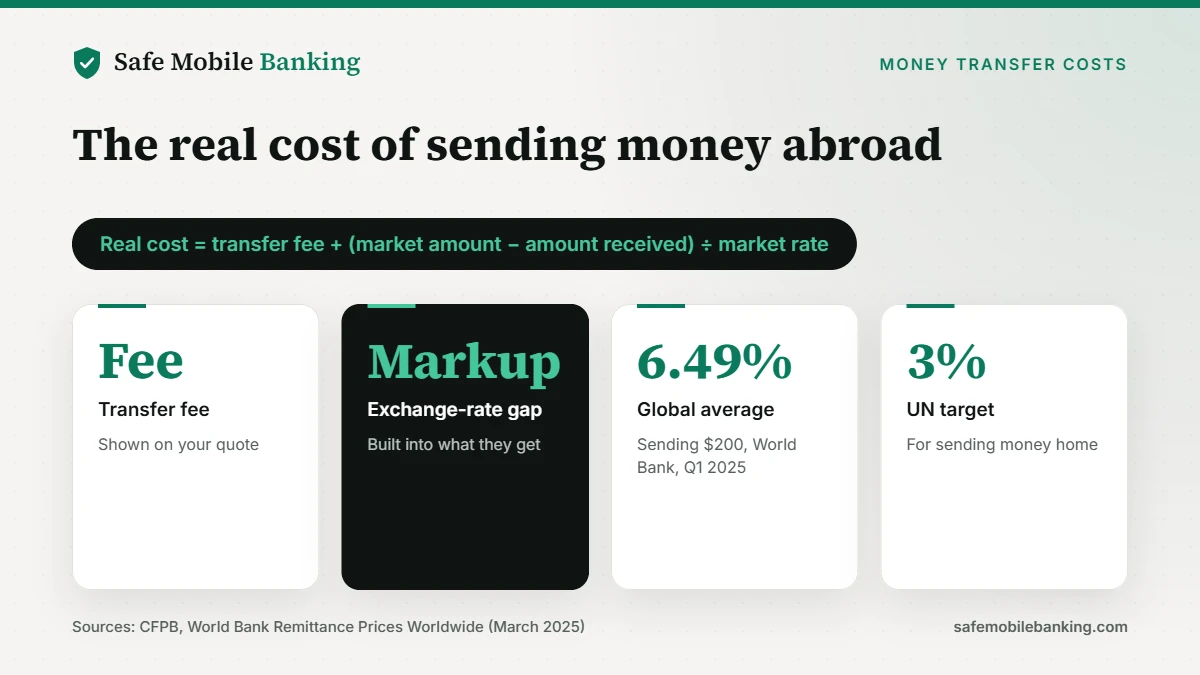
Two things: the transfer fee, which your quote shows in dollars, and the exchange-rate markup, which it doesn’t. The markup is the gap between the market exchange rate and the rate the provider gives you. It’s built into the amount your recipient gets, so it never shows up as a fee.
Here’s an example with round numbers. You send $200 to Mexico with a $5 fee. The market rate is 18.40 pesos per dollar, so $200 is worth 3,680 pesos. Your quote’s rate is 17.90, so your recipient gets 3,580 pesos. The 100-peso gap is worth $5.43. Your real cost is $10.43, or 5.22% of what you send, not the $5 the fee line suggests. That’s a 2.72% exchange-rate markup.
What must a money transfer company show you before you pay?
Federal rules require most U.S. money transfer providers to show you, before you pay, the exchange rate, the fees and taxes, and the amount that will be received, the CFPB explains. That disclosure is exactly what the Western Union fee calculator needs, and you’re under no obligation to send once you see it. The CFPB also says you generally have up to 30 minutes after paying to cancel, according to its guide to remittance transfers.
How much does it cost to send money abroad on average?
The World Bank’s Remittance Prices Worldwide report put the global average cost of sending $200 at 6.49% in the first quarter of 2025, up from 6.26% the quarter before. That’s more than double the UN’s target of 3%. The Western Union fee calculator compares your quote with both numbers, so you know whether you’re paying more or less than typical.
Is the market rate in this calculator exact?
It’s close, not perfect. The Western Union fee calculator loads a daily rate from ExchangeRate-API, and rates move during the day. That’s why the market rate box is editable: if you have a rate from your bank or a source you trust, type it in. For a fair comparison, check your quote and the market rate at about the same time.
How do I pay less to send money abroad?
- Compare the amount received, not the fee. The provider that delivers the most to your recipient for the same dollars is the cheapest.
- Check the exchange rate against the market rate. A no-fee transfer with a wide markup can cost more than one with a fee.
- Send larger amounts less often. Fixed fees weigh more on small transfers. The World Bank’s average cost for $500 was lower than for $200 in the same report.
- Check how you pay. Some providers price card-funded transfers differently from bank-funded ones, so compare the quote for the method you’ll use.
- Run every quote through the Western Union fee calculator. It takes the same three numbers from any provider.
Which tools go with this calculator?
- Is Wise safe? Our Safe Mobile Banking Score
- PayPal fee calculator, including international payments
- Instant transfer fee calculator
- How to report a scam
- Payment scam checker
Every app we review gets a Safe Mobile Banking Score. See how we rate them.
Check a payment request first (Free. 60 seconds. Nothing saved.)
Western Union fee calculator FAQ
Does this Western Union fee calculator save what I enter?
No. The calculator runs in your browser tab. Amounts you enter aren’t stored or shared. The only thing it loads is the day’s market exchange rates, and it never asks for a name, account number or sign-in.
How much does Western Union charge to send money?
It depends on the amount, the country, how you pay and how the money is received, so the only reliable number is the quote Western Union shows before you pay. That quote lists the fee, the exchange rate and the amount received. Enter those in the calculator to see the full cost, including the exchange-rate markup.
What is an exchange-rate markup?
It’s the difference between the market exchange rate and the rate a provider gives you. If the market rate is 18.40 pesos per dollar and your quote is 17.90, your recipient gets about 2.72% less than the market rate would deliver. That gap is a cost even though it isn’t listed as a fee.
What is the average cost of sending money abroad?
The World Bank’s Remittance Prices Worldwide report put the global average cost of sending $200 at 6.49% in the first quarter of 2025. The UN’s target is 3%.
Can I cancel a money transfer after I pay?
The CFPB says you generally have up to 30 minutes after paying to cancel a transfer sent through a U.S. provider. Never send money to someone you haven’t met in person, and run the request through our payment scam checker first.
Sources
- CFPB: Sending money abroad (what you see before and after you pay)
- CFPB: Helping consumers understand remittance transfers
- World Bank: Remittance Prices Worldwide, Issue 53 (March 2025)
- ExchangeRate-API: daily market rates used by the calculator
This tool gives general information, not financial advice. It doesn’t know any provider’s prices. It compares the quote you enter with a daily market rate, so your provider’s own disclosure is the number that applies.