Advertiser disclosure: This page answers “is Chime safe” and may contain partner links. Safe Mobile Banking may earn a fee if you sign up, at no cost to you. It never changes a Safe Mobile Banking Score. How we make money.
Short answer
Is Chime safe? Yes, for everyday banking, with limits you should know. Chime is a financial technology company, not a bank. Your deposits sit at The Bancorp Bank, N.A. or Stride Bank, N.A., and both are FDIC-insured, with coverage up to $250,000 when pass-through conditions are met. The weak spot is the regulatory record: two government orders in 2024 over refunds and complaint handling.
See Chime’s checking account terms (No monthly fees and no minimum opening deposit. Accounts are held at Chime’s partner banks.)
Last verified: November 22, 2026.
Is Chime safe? The facts at a glance
| Item | What we found | Source |
|---|---|---|
| What Chime is | A financial technology company, not a bank | Chime |
| Where deposits sit | The Bancorp Bank, N.A. or Stride Bank, N.A., Members FDIC | FDIC BankFind |
| Deposit insurance | Up to $250,000 per depositor, per insured bank, per ownership category, if pass-through conditions are met | Chime |
| Monthly fees | No monthly service fee, no minimum balance fee, no overdraft fee | Chime |
| Main fee to watch | $2.50 per out-of-network ATM or over-the-counter cash withdrawal | Chime fee table |
| Government orders | California DFPI, February 2024 ($2.5 million penalty); CFPB, May 2024 ($3.25 million penalty) | CFPB |
| Complaints, last 12 months | 12,425 filed with the federal consumer bureau | CFPB database |
| App Store rating | 4.8 from about 1.67 million ratings | App Store |
Is Chime a real bank?
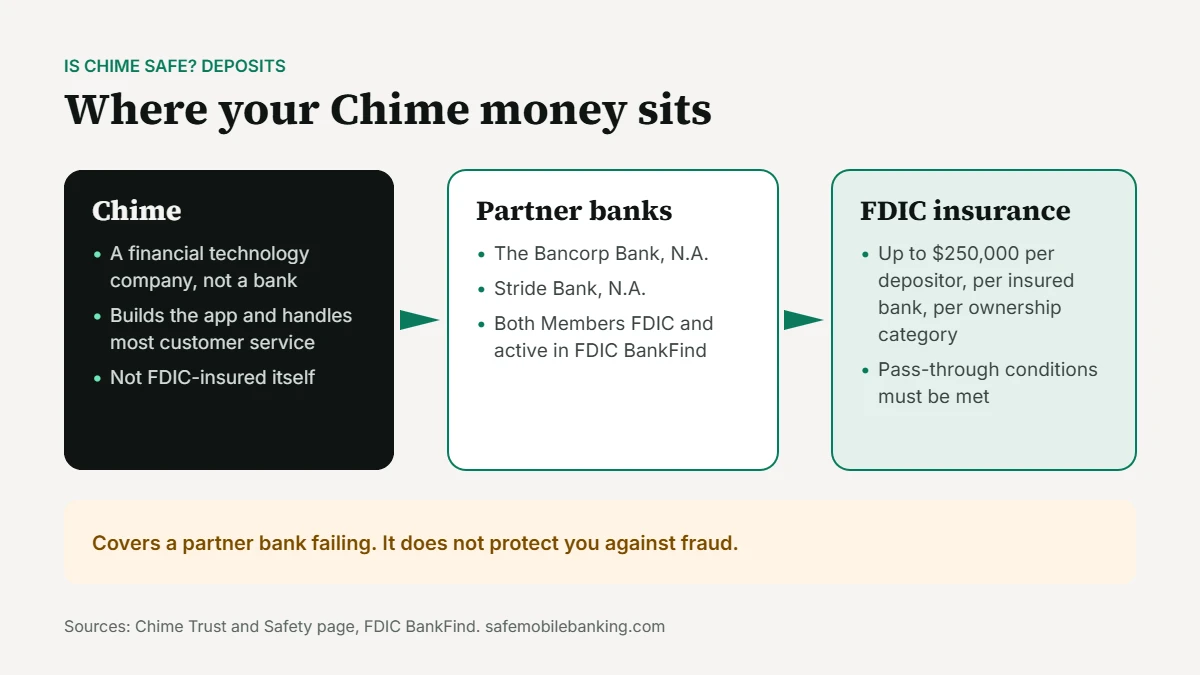
No. Chime says it is a financial technology company, not a bank. Banking services come from two partner banks: The Bancorp Bank, N.A. and Stride Bank, N.A. Chime designs the accounts and handles most customer service. The banks hold the money.
We checked both banks in the FDIC’s BankFind records. The Bancorp Bank, National Association (Sioux Falls, South Dakota, FDIC certificate 35444) and Stride Bank, National Association (Enid, Oklahoma, certificate 4091) are both active, FDIC-insured banks. The back of your card names the bank that issued it.
Is your money FDIC insured at Chime?
Yes, through the partner banks. Chime’s footer says Chime itself is not FDIC-insured. The banks are. Coverage is up to $250,000 per depositor, per insured bank, per ownership category, and certain conditions must be satisfied for pass-through insurance to apply.
Two limits matter. First, FDIC insurance covers the failure of an insured bank. Chime’s own page says it does not protect you against issues like fraud. Second, the limit is per depositor, per insured bank, so money you already hold at The Bancorp Bank or Stride Bank through another app counts toward the same $250,000.
How does Chime protect your account?
Is Chime safe from account takeovers? Chime lists several protections on its trust and safety page. We confirmed these:
- Login protection. Chime says it has enabled Face ID, two-factor and fingerprint authentication. It doesn’t say two-factor is turned on for every account, so check your settings.
- Card blocking. You can block your card in the app to stop new purchases and ATM withdrawals.
- Alerts. You can turn on daily balance updates and instant transaction notifications.
- Visa Zero Liability. Chime cards are backed by Visa’s Zero Liability Policy for unauthorized card charges.
- Encryption and audits. Chime says it uses AES-256 for data at rest and TLS 1.2+ in transit, and that its program is based on independent SOC 2 reports and ISO 27001 certification.
The fix you control is simple: turn on two-factor login and transaction alerts the day you open the account.
What did regulators find against Chime?
This is the main reason the answer to “is Chime safe” isn’t a flat yes. Two government orders sit inside the last three years. Both are about how Chime treated customers’ money and complaints, not about lost deposits.
CFPB consent order, May 2024
On May 7, 2024, the Consumer Financial Protection Bureau issued an order against Chime Financial, Inc. The bureau found that Chime failed to refund closed-account balances within 14 days in thousands of instances, including thousands of instances past 90 days. It called the conduct unfair. The order required a $3.25 million civil money penalty and at least $1.3 million in redress to consumers. Chime consented without admitting or denying the findings, except facts needed for the bureau’s jurisdiction.
California DFPI consent order, February 2024
On February 27, 2024, California’s Department of Financial Protection and Innovation announced a consent order with Chime and a $2.5 million penalty. The DFPI said Chime engaged in unfair acts in how it handled customer complaints. Chime agreed to improve customer service, including support 24 hours a day, seven days a week, and to report to the DFPI annually for two years. The DFPI said Chime cooperated and had already begun remediation.
Data breach lawsuit, April 2026
On April 3, 2026, two customers filed a proposed class action against Chime Financial in federal court in San Francisco (case 3:26-cv-02924). The suit alleges a cyberattack around April 1, 2026 caused an outage that left users unable to see balances or move money, and that customer data was exposed. Chime has not confirmed the data claims, according to reporting on the case. The allegations haven’t been proven in court.
How many complaints does Chime get?
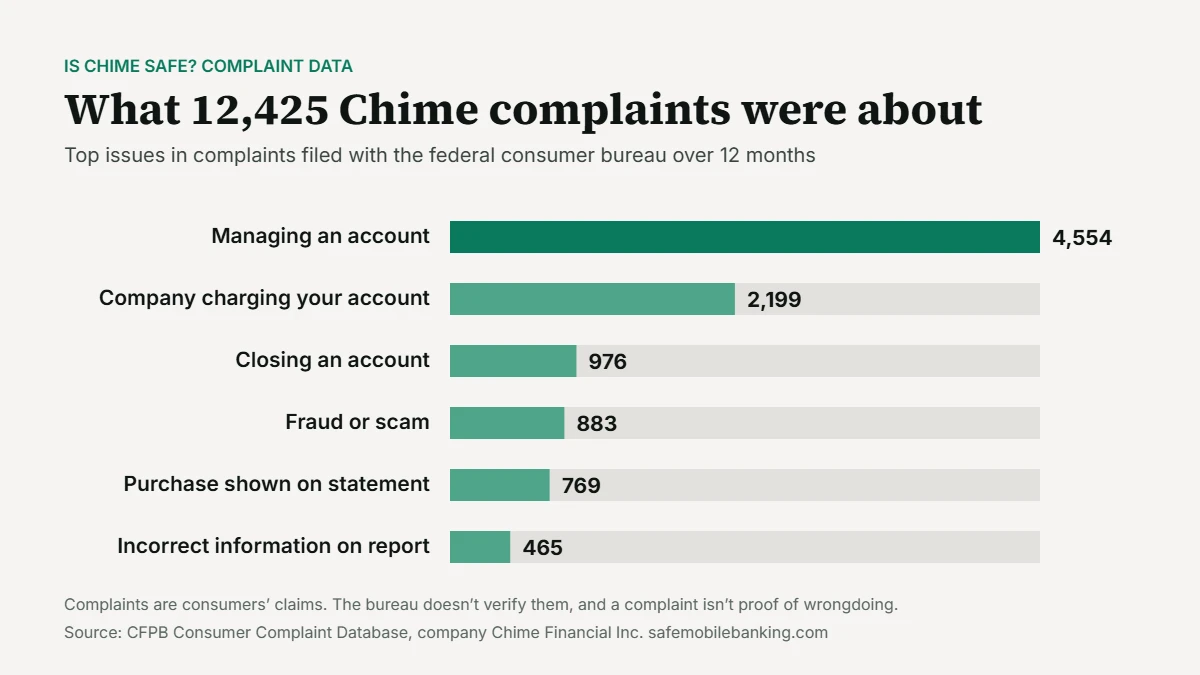
Between November 22, 2025 and November 22, 2026, consumers filed 12,425 complaints about Chime Financial Inc with the federal consumer bureau. That’s a big number, but Chime is also a big company. Here’s how they break down:
- 8,386 were about checking or savings accounts.
- 4,554 were complaints about managing an account, the largest single issue at about 37%.
- 2,199 were complaints about a company charging an account.
- 883 were complaints about fraud or scams.
- Chime responded on time to all but one, and 669 closed with monetary relief.
Read our Money App Complaint Report 2026 to compare Chime with 25 other apps.
Complaints are consumers’ claims as logged by the Consumer Financial Protection Bureau. The bureau doesn’t verify them, and a complaint isn’t proof of wrongdoing.
Is Chime safe to send money to strangers?
Treat it like cash. Chime’s own scam guide draws the line: fraud is someone using your account without permission, and a scam is you being tricked into approving a payment. Because you approved a scam payment, Chime says getting the money back is much harder.
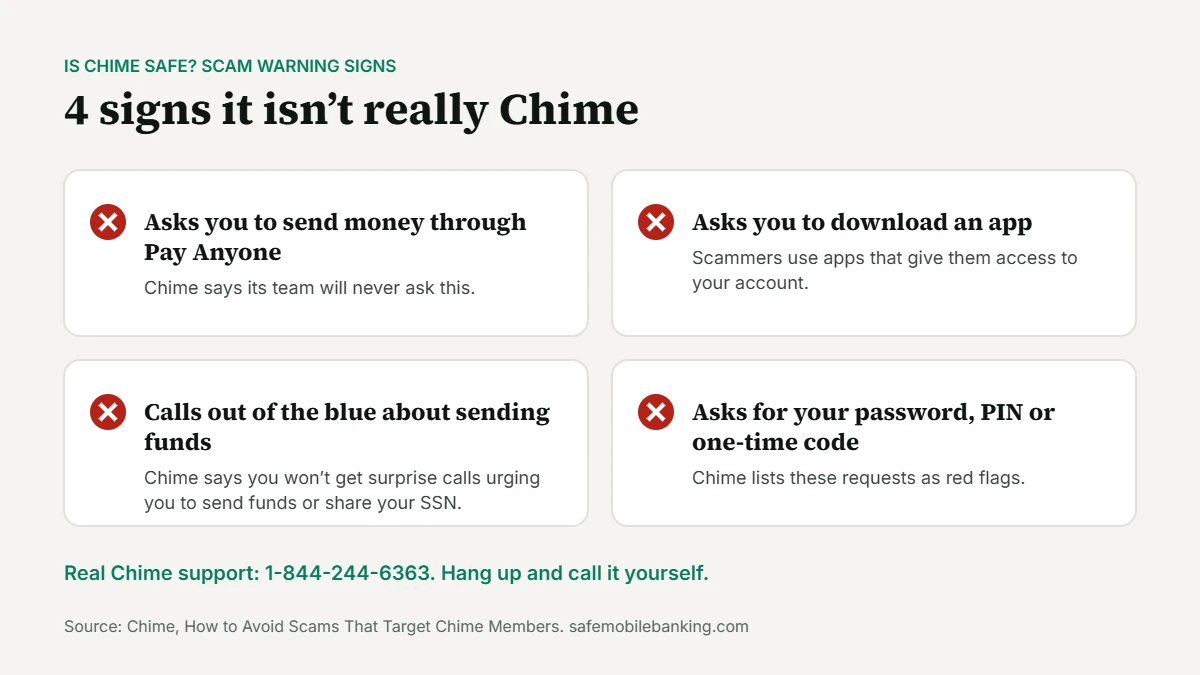
Chime says its team will never ask you to download apps or send money through Pay Anyone. You won’t get surprise calls from Chime urging you to send funds or share your Social Security number. The real customer service number is 1-844-244-6363. If you get a call, hang up and call that number yourself.
If you’ve been scammed, Chime says to freeze your card, change your password and contact support through official channels. Then follow our steps on how to report a scam.
Is Chime safe for you? Who it fits
Good fit
- You want a checking account with no monthly fee and no minimum opening deposit.
- You get paid by direct deposit and want access to MyPay or SpotMe.
- You keep well under $250,000 there and don’t hold other money at the same partner bank.
Skip it if
- You need cash often and can’t reach an in-network ATM, since each other withdrawal costs $2.50.
- You want a branch to walk into. Chime has none; you bank through the app, website or phone.
- A regulatory record inside the last three years is a deal-breaker for you.
Building credit too? See our Chime Credit Builder review for how Chime Card works.
See Chime’s checking account terms (No monthly fees and no minimum opening deposit. Accounts are held at Chime’s partner banks.)
How Chime scored, test by test
Each test follows the written rules on how points are awarded.
| Test | Points | Why |
|---|---|---|
| Deposit and license protection | 3 / 3 | Deposits sit at The Bancorp Bank, N.A. or Stride Bank, N.A., both active FDIC-insured banks in BankFind. |
| Fee transparency | 2 / 2 | The fee table, including the $2.50 out-of-network cash withdrawal fee, is public on Chime’s checking page before sign-up. |
| Regulatory record | 0 / 2 | CFPB consent order (May 2024) and California DFPI consent order (February 2024) are inside the three-year window. |
| Security features | 1.5 / 2 | Two-factor login is offered but not stated as on for every account (0.5). We confirmed card blocking, transaction alerts and Face ID or fingerprint login (1). |
| User ratings | 1 / 1 | 4.8 on the App Store from about 1.67 million ratings. |
Is Chime safe? Frequently asked questions
Is Chime a legit bank?
Chime is a financial technology company, not a bank. Banking services come from The Bancorp Bank, N.A. or Stride Bank, N.A., both FDIC-insured. Chime designs the accounts and handles most customer service, while the partner banks hold the deposits. Both banks show as active, insured institutions in the FDIC’s BankFind records.
Is money in Chime FDIC insured?
Yes, through Chime’s partner banks. Deposits are insured up to $250,000 per depositor, per insured bank, per ownership category, and certain pass-through conditions must be met. Chime itself isn’t FDIC-insured. The insurance covers the failure of an insured bank. Chime says it doesn’t protect you against issues like fraud.
Is Chime safe to send money to strangers?
Treat a Chime payment like cash. Chime says scam payments you approve are much harder to recover than fraud on your account. Its team will never ask you to send money through Pay Anyone or download an app. Send money only to people you know, and call 1-844-244-6363 yourself if someone claiming to be Chime contacts you.
Has Chime been in trouble with regulators?
Yes. In May 2024 the CFPB ordered Chime to pay a $3.25 million penalty and at least $1.3 million in redress after finding it delayed refunds of closed-account balances. Chime consented without admitting or denying the findings. In February 2024 California’s DFPI ordered a $2.5 million penalty over how Chime handled customer complaints.
What should I do if my Chime account is hacked or I’m scammed?
Chime says to freeze your card in the app, change your password and contact support through official channels, such as the app or 1-844-244-6363. Visa’s Zero Liability Policy helps protect you against unauthorized card charges. Then follow our steps on how to report a scam so the right agencies hear about it.
Does Chime charge fees?
Chime’s checking account has no monthly service fee, no minimum balance fee and no overdraft fee. The main charge is $2.50 for each cash withdrawal at an out-of-network ATM or over the counter. Chime’s fee table says withdrawals at Allpoint and Visa Plus Alliance ATMs, and FCTI ATMs in 7-Eleven stores, are free.
Sources
- Chime: Trust and Safety
- Chime: Online Checking Account and fee table
- Chime: How to Avoid Scams That Target Chime Members
- CFPB: Chime Financial, Inc. enforcement action
- CFPB: Chime Financial consent order (PDF)
- California DFPI: Chime Financial consent order press release
- CFPB Consumer Complaint Database
- FDIC BankFind
- Apple App Store: Chime – Mobile Banking
- ClassAction.org: Castaneda et al. v. Chime Financial, Inc.
- ClaimDepot: Chime Financial data breach lawsuit
This review is information, not financial advice. Check Chime’s current terms before you open an account.