Advertiser disclosure: This guide to the FedEx scam text is free and independent. Safe Mobile Banking may earn a commission from some companies we review, but FedEx doesn’t pay for this page. How we make money.
Short answer
A FedEx scam text is a fake delivery message, often with a tracking code and a link, that sends you to a look-alike site to collect a fee, your card number or your login. FedEx says it does not ask for payment or personal information by unsolicited text in return for a package. If you didn’t sign up for FedEx alerts, treat the text as fake.
- Don’t tap the link, reply or call a number in the text.
- Never pay a “redelivery,” “address” or “release” fee from a text.
- Track the package yourself at fedex.com or in the FedEx app.
- Forward the text to 7726 (SPAM) and to FedEx, then delete it.
See what to do if you tapped the link (Free. 5 steps. Based on FedEx and FTC guidance.)
Last verified: November 28, 2026, against FedEx’s fraud pages and Federal Trade Commission guidance.
What is the FedEx scam text?
You’re expecting holiday packages, and a text says your FedEx delivery is on hold. That’s the moment scammers count on. The FedEx scam text is smishing, which is phishing by text message. It claims there’s a problem with a shipment and links to a page that looks like FedEx but isn’t.
The Federal Trade Commission described the pattern in 2020: a text with a fake shipment tracking code and a link to “update your delivery preferences.” In one version, the link led to a fake Amazon page that offered a “free” prize after a “customer satisfaction survey,” then asked for a card number to pay for shipping.
FedEx lists its own warning signs. It says it does not request, by unsolicited mail, text or email, payment or personal information in return for goods in transit or in its custody. Its fraud page also warns about texts and emails that push you to a web address ending in .shop.
How do you spot a FedEx scam text?
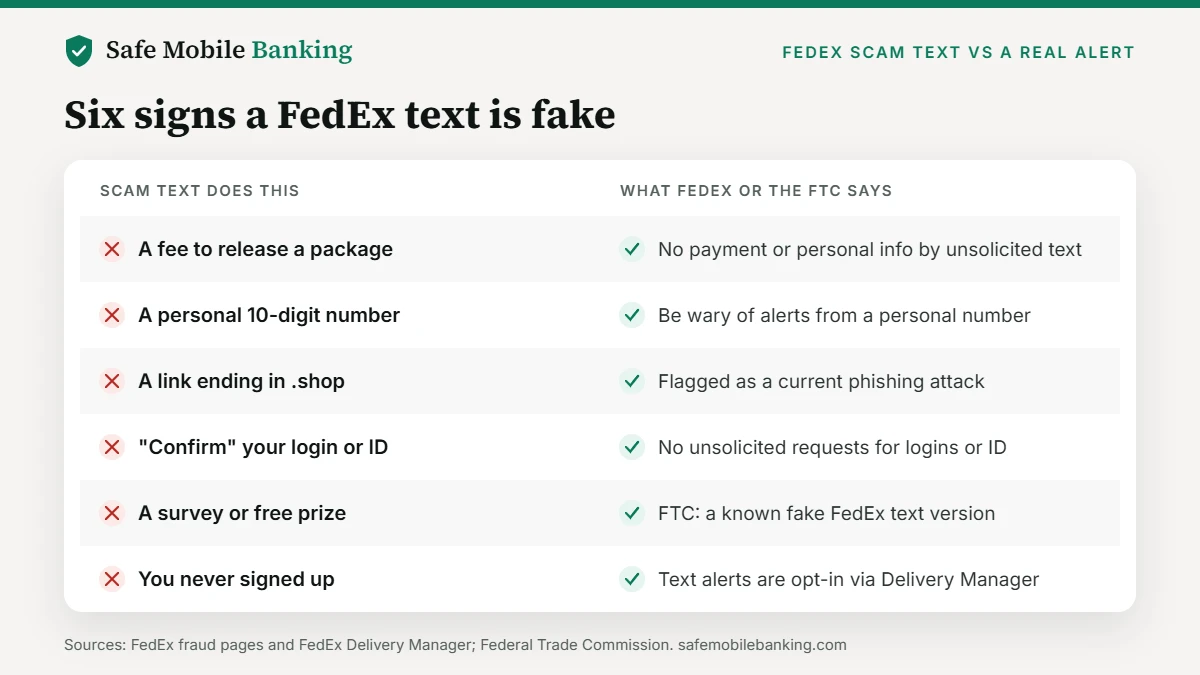
Most FedEx scam texts fail one test: you didn’t ask FedEx to text you. Use the table below for the rest. Each sign comes from FedEx or the FTC.
| Sign | What the scam text does | What FedEx says |
|---|---|---|
| A fee to release a package | Asks you to pay a small charge to redeliver or release a shipment | It doesn’t request payment or personal information by unsolicited text for goods in transit |
| A personal phone number | Comes from an ordinary 10-digit number | Be wary of shipment alerts from a personal 10-digit number |
| A .shop link | Points to a web address ending in .shop | Its fraud page flags .shop links as a current phishing attack |
| A login or ID request | Asks you to “confirm” your account, address or identity | It doesn’t request account credentials or identity details by unsolicited text |
| A survey or free prize | Offers a reward, then asks for a card number for “shipping” | The FTC calls this a known version of the fake FedEx text |
| You never signed up | Arrives out of the blue about “your parcel” | Text alerts are an option you choose in FedEx Delivery Manager |
Pressure is the other tell. A FedEx scam text wants you to act before you think: “final notice,” “returned to sender today,” “action required.” Don’t pay or sign in from a text link; go to fedex.com yourself.
Does FedEx ever text you with a link?
Yes, in two cases, which is why a FedEx scam text can look believable. First, FedEx Delivery Manager offers text alerts, and FedEx may text a code to verify an address change you asked for. Second, for international packages, FedEx says it may email or text a secure link to pay duties and taxes.
That second case is where FedEx scam texts hide. So don’t pay a “customs” or “duty” charge from the link. FedEx says to verify the amount with its Import Tool. Open fedex.com yourself, type in the tracking number from the shipper’s own receipt, and pay only there.
Why do FedEx scam texts spike at the holidays?
More packages mean more people expecting a delivery, so a fake alert lands on someone who is waiting for one. Ubersuggest data shows searches for “fedex scam text” in the US ran from 260 to 2,900 a month over the past year.
The scam is common across carriers. The FTC found that fake package delivery problems were the most reported text scam of 2024, followed by fake job offers and fake “fraud alerts.” People reported losing $470 million to all text scams that year, five times the 2020 total, even though the number of reports fell.
Card and payment fraud follows these texts. Complaints filed with the federal consumer bureau about money transfer, virtual currency and money services totaled 39,118 from November 28, 2025 to November 27, 2026; consumers picked “Fraud or scam” as the issue on 11,508 of them, 29.4%. Across the 29 money apps in our money app complaint report, 15.6% of complaints were about fraud, scams or unauthorized transactions.
Complaints are consumers’ claims as logged by the Consumer Financial Protection Bureau. The bureau doesn’t verify them, and a complaint isn’t proof of wrongdoing.
What should you do if you clicked a FedEx scam text?
Move fast, and start with your money. Tapping the link in a FedEx scam text is less serious than typing something in, but follow the steps that match what you shared.
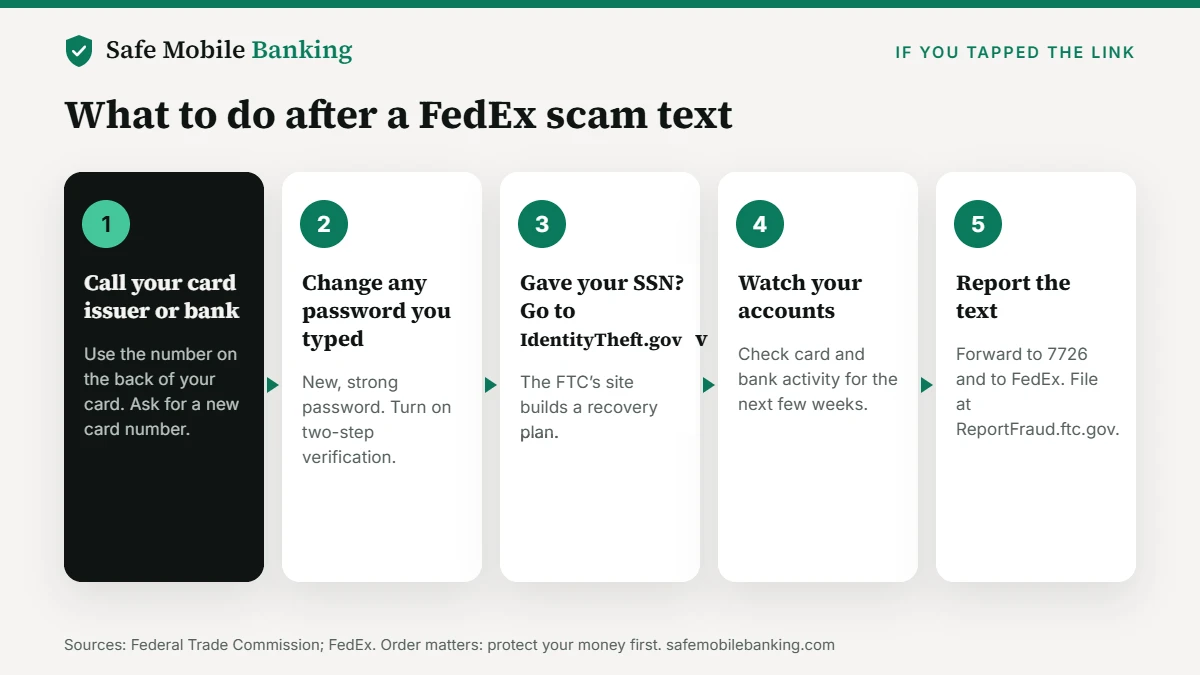
- Call your card issuer or bank. Use the number on the back of your card. The FTC says to report a scam credit card charge to the issuer and ask for a refund; for a debit card, report it to your bank or credit union. Ask for a new card number if you typed yours in.
- Change any password you entered. If you typed a login on the fake page, create a new, strong password for that account and for any other account that used the same one. Turn on two-step verification.
- Protect your identity if you gave your Social Security number. The FTC says to report misuse at IdentityTheft.gov for a recovery plan.
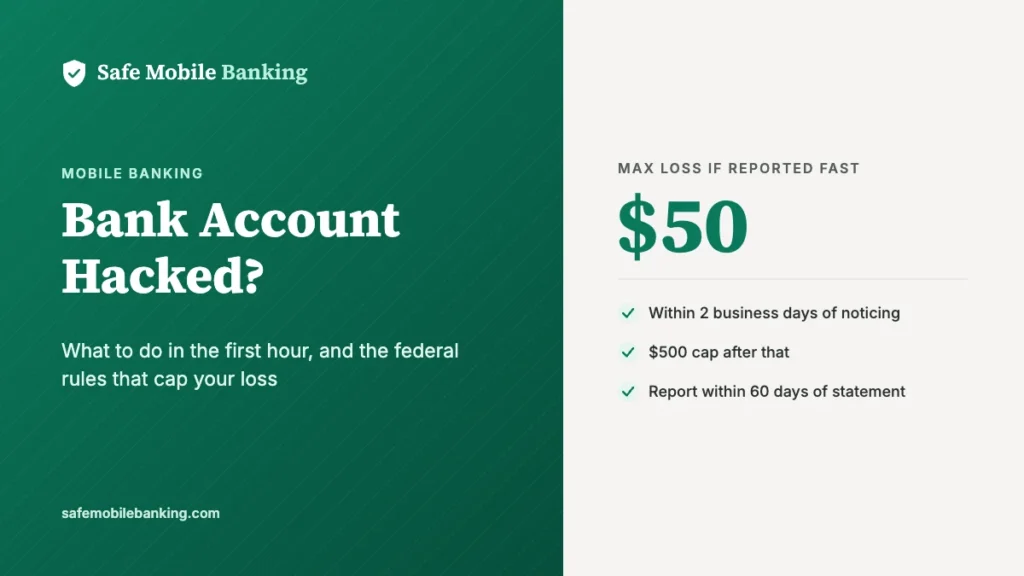
- Watch your accounts. Check card and bank activity for the next few weeks. If someone got into your bank login, follow our bank account hacked steps.
- Report the text. Reporting helps carriers block similar texts and helps the FTC track scams. The steps are below.
How do you report a FedEx scam text?
Report a FedEx scam text in three places. Don’t tap the link to do it.
- Your carrier. Copy the message and forward it to 7726 (SPAM). The FTC says you can also use the “report junk” or “report spam” option in your messaging app.
- FedEx. Forward suspicious messages to abuse@fedex.com, as FedEx asks on its fraud page. For charges you don’t recognize, FedEx lists a fraud line at 1.800.584.2681.
- The FTC. File a report at ReportFraud.ftc.gov. FedEx also points to the FBI’s Internet Crime Complaint Center (IC3) if you lost money.
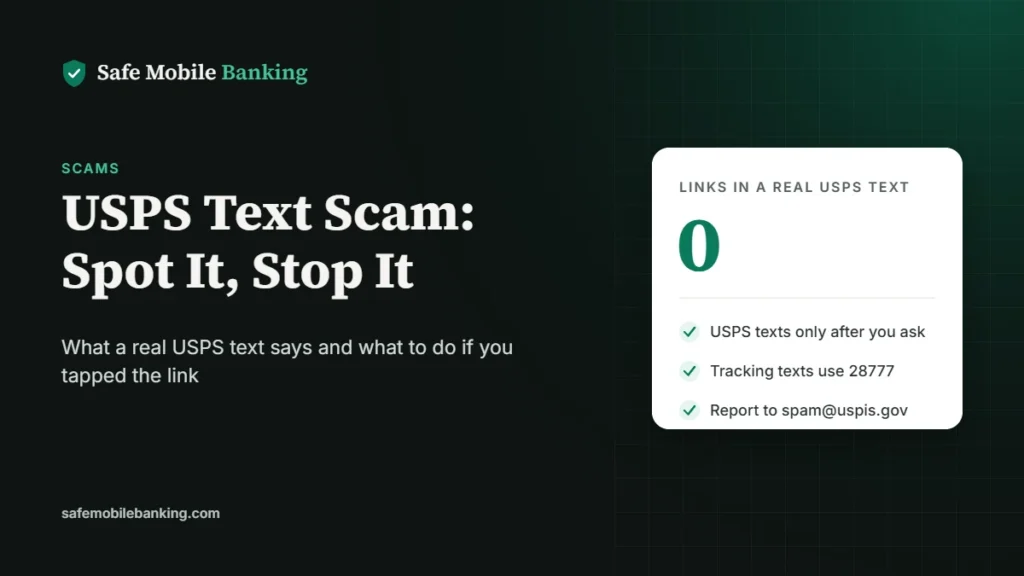
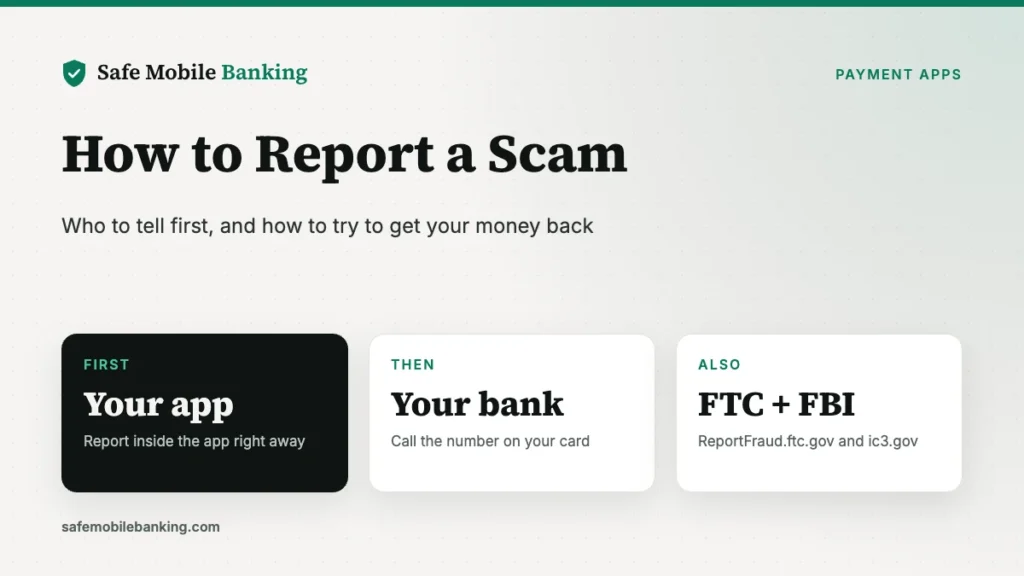
Got a fake text from another carrier? Our USPS text scam guide covers the Postal Service version, and how to report a scam lists where every type goes.
Check before you act on a delivery text
You have safer options than the link. Pick one before you do anything with a FedEx scam text:
- Track it yourself. Use the tracking number in the shipper’s own email or receipt, at fedex.com or in the FedEx app.
- Ask the seller. The store that shipped it can confirm the carrier and status.
- Call FedEx at a number you find. FedEx lists 1.800.GoFedEx (1.800.463.3339). Don’t use a number from the text.
- Do nothing. A real delivery problem shows up in tracking. Ignoring a fake text costs you nothing.
How can you stop FedEx scam texts?
You can’t stop every one, but you can cut the number that reach you.
- Filter unknown senders. The FTC notes your phone may filter and block messages from unknown senders. Our iPhone scam call settings guide shows the related call filters.
- Use your carrier’s blocking tool. The FTC says your wireless provider may offer one for calls and texts.
- Sign up for real alerts. If you want FedEx texts, enroll in FedEx Delivery Manager yourself, so you know which alerts you asked for.
Not sure whether a request for money is a scam? Run it through our free checker first.
Check a suspicious payment request (Free. 8 questions. Nothing you type is saved or sent.)
FedEx scam text FAQ
Does FedEx send text messages?
Yes, when you ask for them. FedEx Delivery Manager offers text alerts, and FedEx may text a code to confirm an address change you requested. FedEx says it does not ask for payment or personal information by unsolicited text in return for a package. If a text arrives that you never signed up for, check the shipment yourself at fedex.com instead of tapping the link.
Is a FedEx text with a tracking number real?
Not necessarily. The FTC warns that scammers send texts with a fake shipment tracking code and a link to update your delivery preferences. A tracking number in a FedEx scam text proves nothing. Copy the tracking number from the seller’s own email or receipt, enter it at fedex.com or in the FedEx app, and ignore the link in the text.
What if I tapped the link but didn’t enter anything?
Close the page and don’t return to it. Typing in your card number, login or Social Security number is the main risk. If you entered nothing, delete the text after you forward it to 7726 and to FedEx. If you did type something, call your card issuer or bank first, then change the password you used.
Can FedEx ask me to pay customs duties by text?
For international packages, FedEx says it may email or text a secure link to pay duties and taxes, which is why fake duty texts work. Don’t pay from the link. FedEx says to verify the amount with its Import Tool. Go to fedex.com yourself, enter the tracking number from the shipper, and pay only there.
How do I report a FedEx scam text?
Forward the text to 7726 (SPAM) so your carrier can spot and block similar messages, and forward it to FedEx at the abuse address on its fraud page. Then file a report with the Federal Trade Commission at ReportFraud.ftc.gov. Delete the message afterward, and don’t reply to it.
Will my bank give my money back after a FedEx text scam?
It depends on how you paid. The FTC says to report a scam credit card charge to the card issuer and ask for a refund, and to report a debit card charge to your bank or credit union. Call as soon as you can, using the number on the back of your card. Results vary by card and situation.
More scam guides
Sources
- FedEx: Recognize and report fraud (no payment or identity requests by unsolicited text, .shop warning, duties-and-taxes link, where to forward suspicious messages, fraud line)
- FedEx: Fraud prevention (payment and personal information for goods in transit, personal 10-digit numbers)
- FedEx Delivery Manager (text alerts, address-change codes)
- FTC: Is that text message about your FedEx package really a scam?
- FTC: New FTC data show top text message scams of 2024
- FTC: How to recognize and report spam text messages
- FTC: What to do if you were scammed
- CFPB Consumer Complaint Database (money transfer and money service complaints, November 28, 2025 to November 27, 2026; queried November 28, 2026)
This guide is general information, not financial or legal advice.