Advertiser disclosure: Safe Mobile Banking may earn a commission from some companies we review. We don’t currently earn anything from the lenders on this page, and commissions never change our picks. How we make money.
Short answer
The best credit builder loans return most of your money when you finish. Self is the strongest pick you can get anywhere in the US: $25 a month for 24 months, no hard credit pull, and $511 back at the end, so the real cost is $89. If a local credit union offers one, compare it first, because member-owned lenders often charge less.
- Best nationwide: Self Credit Builder Account ($89 total cost on the $25 plan)
- Best for a bigger credit line: CreditStrong ($1,000 to $25,000 reported)
- Lowest monthly payment: Kovo ($10 a month, but no money back)
Compare 5 credit builder loan options side by side (Costs from each lender’s own pricing page.)
Last verified: November 15, 2026, against each lender’s own pricing page. Rates and terms change, so confirm before you apply.
How credit builder loans work
A credit builder loan runs backwards. The lender puts the loan amount in a locked account in your name. You make fixed monthly payments, and each on-time payment is reported to the credit bureaus. When the term ends, the account unlocks and you get the principal back. The interest and fees are the price of the credit history.
That matters because a credit builder loan adds an installment account to your report, and installment history is something a credit card can’t give you. It also means the true cost isn’t the monthly payment. It’s what you pay in minus what you get back.
Not every product sold as a “credit builder” works this way. Kovo and Kikoff report payments too, but you don’t get your payments back at the end. We include them below because they cost less per month, and we show the trade-off plainly.
Credit builder loans compared
| Option | Monthly payment | Term | APR | Money back at the end | Credit check | Total cost |
|---|---|---|---|---|---|---|
| Self Credit Builder Account | $25, $35, $48 or $150 | 24 months | 15.51% to 15.92% | Yes: $511 to $3,069 | No hard pull | $89 to $531 |
| CreditStrong Instal | $28 (plus $15 to activate) | 48 months | 15.61% | Yes: $1,010 | No hard or soft pull | $349 |
| Credit union credit builder loan | Varies by credit union | Varies | Varies | Usually yes | Varies; membership required | Ask for the finance charge |
| Kovo Credit Builder | $10 | 24 months | Not listed on Kovo’s site | No | No hard pull | $240 |
| Kikoff Credit Account (not a loan) | From $5 | 12 months on Basic | No interest | No | No credit check | $60 on Basic |
Total cost = everything you pay in, minus what comes back to you. Self and CreditStrong figures are each lender’s own disclosure. Kovo and Kikoff totals are the monthly price times the term.
Self: the best credit builder loan you can get anywhere
Self offers four plans. You pay $25, $35, $48 or $150 a month for 24 months, and Self reports to all three credit bureaus each month. At the end you get $511, $717, $985 or $3,069 back. Self’s own disclosure puts the finance charge at $89 on the $25 plan, at a 15.92% APR. Self says there’s no hard pull on your credit, and you can pay off or close the account early.
Self isn’t a bank. The loans and deposits are made and held by Lead Bank, Sunrise Banks, N.A., or First Century Bank, N.A., each FDIC member. Pick the $25 plan unless you’re sure you can carry more: a missed payment hurts the credit you’re trying to build. Self also offers a secured Visa card, which we cover on our credit builder cards page.
CreditStrong: best for a bigger credit line
CreditStrong runs on an FDIC-insured bank and says it does no hard or soft pull. Its entry plan, Instal, costs $28 a month for 48 months after a $15 activation fee, at a 15.61% APR. You pay $1,359 in total and get $1,010 back, so the cost is $349. That’s twice as long and roughly four times the cost of Self’s smallest plan.
The reason to pick CreditStrong is size. Its MAGNUM accounts report an installment line of $1,000 to $25,000, starting at $16 a month, with a $25 non-refundable admin fee. A bigger reported loan can help if you’re preparing for a mortgage or car loan and already handle payments well. All CreditStrong accounts report to Experian, Equifax and TransUnion, and you can close early with no penalty.
Credit unions: often the cheapest credit builder loans
Many credit unions offer credit builder loans to members. They’re member-owned, so rates are often lower than online lenders, and some return part of the interest when you finish. The catch: you have to join first, and every credit union sets its own amount, term, rate and credit check.
Ask three questions before you sign: What is the total finance charge? Do you report to all three bureaus? Is any interest refunded when I finish? If the finance charge beats Self’s $89, take the credit union loan. You can find credit unions near you with the NCUA credit union locator.
Kovo: lowest monthly payment, but no money back
Kovo charges $10 a month for 24 months, or $240 in total. It reports payments as installment credit to TransUnion, Equifax, Experian and Innovis, and it says there’s no hard pull when you apply. Approval depends on background and income checks. What you get for the money is ID monitoring and personal growth tools. Kovo’s site doesn’t describe any savings balance paid back at the end.
That makes Kovo cheaper per month than Self, but more expensive overall: $240 against $89 for Self’s smallest plan. Choose Kovo only if $25 a month is truly out of reach.
Kikoff: a cheap alternative that isn’t a loan
Kikoff says plainly that its plan is not a credit builder loan and that you don’t get money back. It’s a revolving credit account you can only use in the Kikoff Store. The Basic plan is $5 a month for 12 months, or $60, with a $750 line reported to all three bureaus, no credit check and no interest. Because it’s revolving credit, it can help your utilization, which a loan can’t.
Kikoff pairs well with a credit builder loan if you have no credit card yet. Read our Kikoff review and how Kikoff works for the full breakdown.
How to choose between credit builder loans
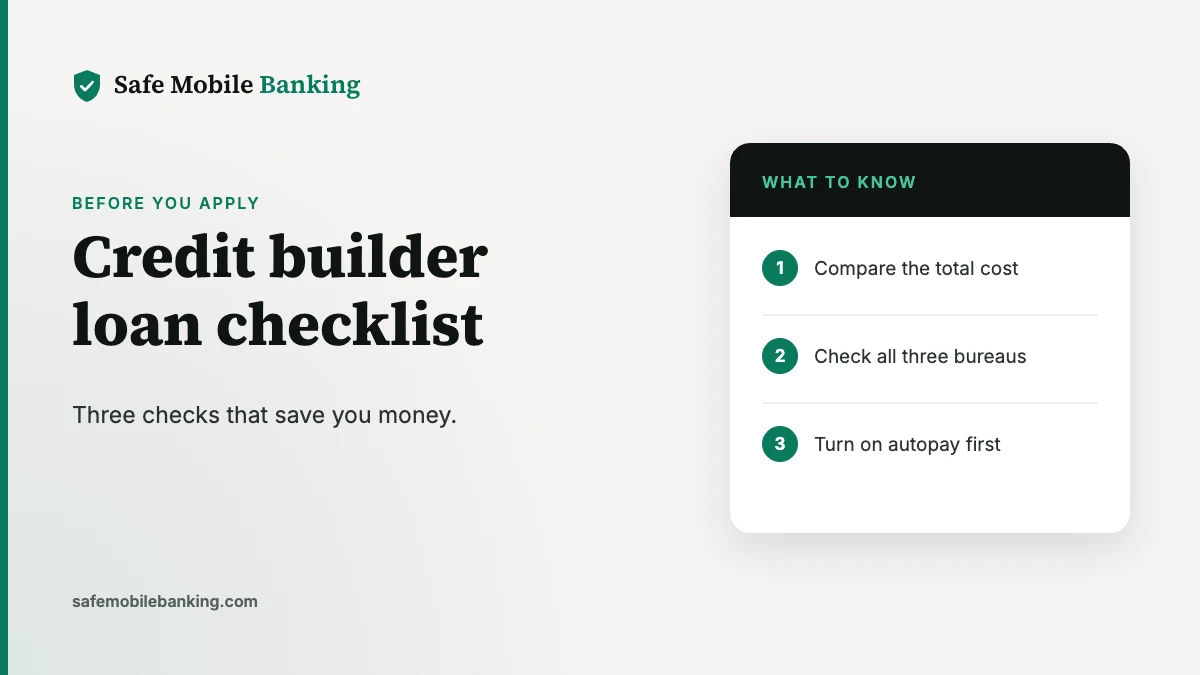
- Compare the total cost, not the monthly payment. Subtract what you get back from what you pay in. On that math, Self’s $25 plan ($89) beats Kovo ($240) even though Kovo’s payment is lower.
- Pick a payment you can make 24 times in a row. Late payments get reported too. Set up autopay on day one.
- Check which bureaus it reports to. Self, CreditStrong, Kovo and Kikoff all report to Equifax, Experian and TransUnion. Ask a credit union before you join.
- Add revolving credit if you have none. A credit builder loan builds payment history and credit mix. A credit builder card or Kikoff adds the revolving side.
- Use free tools alongside it. Experian Boost can add bills you already pay, and Credit Karma lets you watch your scores for free.
Who should skip credit builder loans
A CFPB study of credit builder loans found they worked better for people who started with no existing debt, both for getting a score and raising one. For people already carrying debt, taking on the extra payment seemed to make it harder to keep up with other loans. If you’re juggling bills already, pay those on time first. That builds credit at no extra cost.
Also skip them if you need cash now. You don’t get the loan money until the end, so a credit builder loan can’t cover an emergency.
Frequently asked questions
What is a credit builder loan?
A credit builder loan is a small loan made to build credit history. The lender holds the loan amount in a locked account, you make fixed monthly payments that are reported to the credit bureaus, and you get the principal back when you finish. With Self, for example, you pay $25 a month for 24 months and get $511 back.
Do you get your money back from a credit builder loan?
With a true credit builder loan, yes, minus interest and fees. Self returns $511 to $3,069 depending on the plan, and CreditStrong Instal returns $1,010. Kovo and Kikoff are different: you don’t get your payments back.
Do credit builder loans check your credit?
The online options on this page don’t do a hard pull. Self says there’s no hard pull, CreditStrong says there’s no hard or soft pull, and Kovo says there’s no hard pull but checks your background and income. Credit unions set their own rules, so ask before you apply.
Which credit builder loan is cheapest?
Of the nationwide options, Self’s $25 plan has the lowest total cost at $89 over 24 months. Kovo has the lowest monthly payment at $10, but it costs $240 in total because nothing comes back. A credit union loan can cost less than both, so compare its finance charge.
Is a credit builder loan better than a secured card?
They build different parts of your credit. A credit builder loan adds installment payment history. A secured card adds revolving credit, which affects utilization. If you have neither, using one of each on time covers both.
Can you pay off a credit builder loan early?
Self and CreditStrong both say you can pay off or close the account early, and CreditStrong says there’s no penalty. Closing early ends the on-time payment history you were building, so most people finish the term.
Sources
- Self: Credit Builder Account pricing (plans, APRs, finance charges, amounts returned, no hard pull, lending banks; checked Nov 15, 2026)
- CreditStrong: pricing (Instal terms and disclosure, MAGNUM tradelines and admin fee, no hard or soft pull)
- Kovo: Credit Builder ($10 for 24 months, four bureaus, no hard pull, what’s included)
- Kikoff: Credit Account and pricing (not a credit builder loan, no money back, $5 for 12 months, $750 line)
- CFPB: Targeting Credit Builder Loans (who benefits, effect on people with existing debt; July 2020)
- NCUA: credit union locator
How we score and compare products: How we rate.