Advertiser disclosure: If your bank account was hacked, this guide is free and independent. Safe Mobile Banking may earn a commission from some companies we review, but no bank pays for this page. How we make money.
Short answer
Bank account hacked? Call your bank now, using the number on your card, and ask it to freeze the account and reverse the unauthorized transfers. Speed protects you: under federal Regulation E, if your card or login was stolen, your loss is capped at $50 if you report within two business days of finding out, and $500 after that.
- Federal rules cap your loss when you report quickly
- Your bank must investigate, usually within 10 business days
- Wait more than 60 days after your statement and you can lose more
Jump to the 3 steps to take in the first hour (Takes 10 minutes.)
Last verified: November 15, 2026, against Regulation E as published by the Consumer Financial Protection Bureau, the Federal Reserve’s Consumer Compliance Outlook and the FTC’s IdentityTheft.gov.
Bank account hacked? The short version
| When you report | Your maximum loss (card, PIN or login stolen) | Source |
|---|---|---|
| Within 2 business days of learning about it | $50, or the amount taken if less | Regulation E |
| After 2 business days | Up to $500 | Regulation E |
| More than 60 days after the statement showing it | Possibly unlimited for later transfers | Regulation E |
| How long the bank has to investigate | Generally 10 business days; up to 45 with provisional credit | Regulation E |
Bank account hacked: what should you do first?
Call your bank. Use the number on the back of your card or on the bank’s official website, never a number from a text, email or caller. Ask it to freeze the account, lock your card, reverse unauthorized transfers and note the date and time you reported. Write down who you spoke to.
Then change your online banking password and your email password, since hackers often use email to reset bank logins. Turn on two-factor login, sign out other devices, and remove any payees, linked accounts or devices you didn’t add.
Bank account hacked: will your bank give your money back?
Federal law usually limits what you lose. The Electronic Fund Transfer Act and Regulation E cover unauthorized electronic transfers, including debit card, ACH and online transfers. If your card, PIN or login was lost or stolen, your liability is capped at $50 if you notify the bank within two business days of learning about it, and up to $500 if you wait longer.
The 60-day clock matters most. If you don’t report an unauthorized transfer within 60 days after the bank sends the statement showing it, you can be liable for transfers after that point. If the transfer didn’t involve a stolen card or login, you generally owe nothing if you report within 60 days of the statement. Many banks also have their own zero-liability policies that go further.
Your bank generally has 10 business days to investigate. It can take up to 45 days if it gives you a provisional credit for the disputed amount while it works.
How did the hacker get in?
Most account takeovers start with a stolen login, not a broken bank system. Common routes are phishing texts and emails, fake bank calls that ask for a one-time code, reused passwords from other breaches, and SIM swaps that hijack your phone number. If your phone suddenly lost service before the hack, call your carrier too; see our guide on how to prevent a SIM swap.
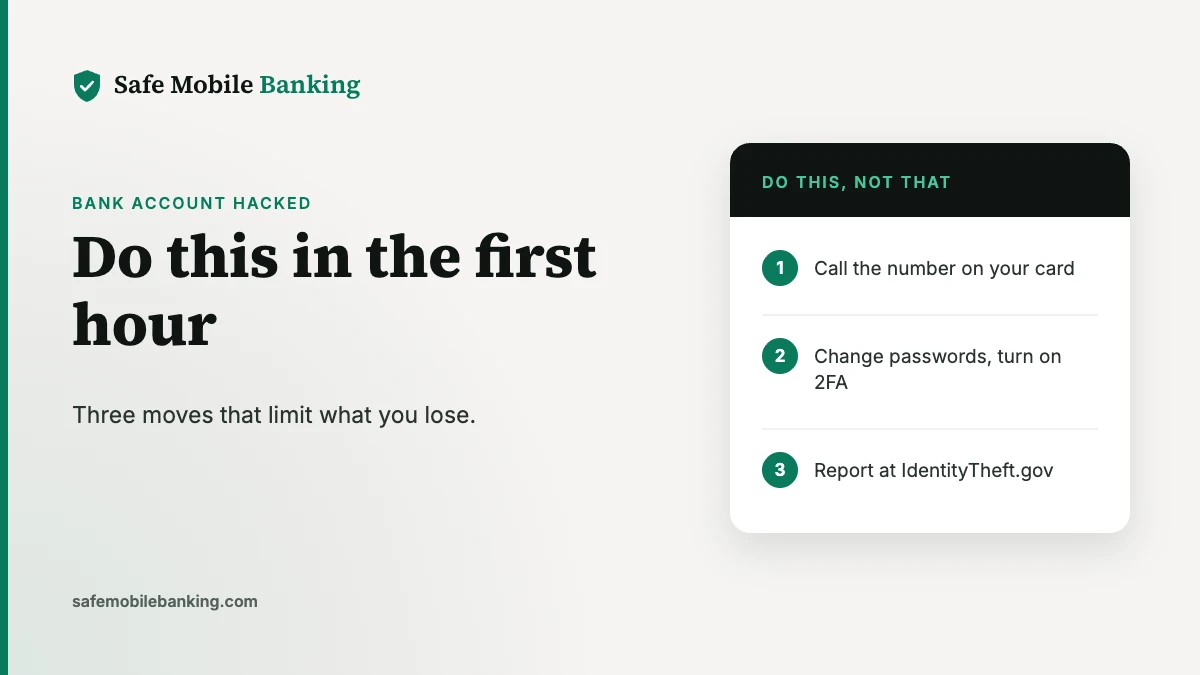
Bank account hacked? 3 steps for the first hour
- Call the number on your card. Freeze the account, lock the card and dispute every unauthorized transfer.
- Change passwords and turn on two-factor login, starting with your email, then your bank.
- Report it at IdentityTheft.gov. The FTC’s site gives you a recovery plan and an identity theft report. Freeze your credit at Equifax, Experian and TransUnion if your personal information was exposed.
Lost money through a payment app instead? See how to report a scam, and check our guides to Zelle and Cash App. Stop fake bank calls with our guide to blocking scam calls on iPhone.
Frequently asked questions
What should I do first if my bank account was hacked?
Call your bank right away using the number on the back of your card or on the bank’s official website, not a number from a text or email. Ask it to freeze the account, reverse unauthorized transfers and lock your card. Then change your banking and email passwords and turn on two-factor login.
Will my bank refund money stolen from my account?
Usually, if you act fast. Under the federal Electronic Fund Transfer Act and Regulation E, if your card, PIN or login was lost or stolen, your loss is capped at $50 if you tell your bank within two business days of learning about it, and $500 after that. If you don’t report an unauthorized transfer within 60 days after the statement showing it, you can lose more.
How long does my bank have to investigate?
Under Regulation E, your bank generally has 10 business days to investigate an error you report. It can take up to 45 days if it gives you a provisional credit for the disputed amount while it investigates.
Should I report a hacked bank account to the government?
Yes. Report it at IdentityTheft.gov, the Federal Trade Commission’s site, which gives you a recovery plan and an identity theft report. You can also file a complaint with the Consumer Financial Protection Bureau if your bank doesn’t resolve it.
How do I know if my bank account was hacked?
Warning signs include transactions you don’t recognize, login or password-change alerts you didn’t trigger, new payees or devices you didn’t add, changed contact details, and being locked out of your account. Check your account in the bank’s app, not through a link someone sent you.
Sources
- Consumer Financial Protection Bureau: Regulation E, section 1005.6 (liability for unauthorized transfers)
- Consumer Financial Protection Bureau: Regulation E, section 1005.11 (error resolution timelines)
- Federal Reserve Consumer Compliance Outlook: Consumer liability under Regulation E (2025)
- Bankrate: Regulation E explained
- IdentityTheft.gov: Report identity theft and get a recovery plan
Safe Mobile Banking is a publisher, not a bank, lawyer or financial advisor. This article is general information, not legal or financial advice. See our editorial standards.