Advertiser disclosure: Safe Mobile Banking may earn a commission from some companies we review. We don’t earn anything from Coinbase, and commissions never change what we say. How we make money.
Short answer
Is Coinbase safe? Coinbase is a regulated, publicly traded U.S. exchange, and it says it keeps most customer crypto offline. The bigger risks are scams and the crypto itself: your coins aren’t FDIC or SIPC insured, and a 2025 insider leak handed scammers customer details.
- U.S. dollar balances held at banks get pass-through FDIC coverage up to $250,000
- Crypto isn’t FDIC or SIPC insured, and losses from your own hacked account aren’t covered
- Coinbase will never ask you to move crypto to a new wallet
Secure your Coinbase account in 5 steps (Free. Takes about 5 minutes.)
Last verified: November 15, 2026, against Coinbase’s help center, Coinbase’s 2025 breach disclosures, the New York Department of Financial Services, the Consumer Financial Protection Bureau complaint database and the Apple App Store.
Is Coinbase safe? The short version
| Question | Answer | Source |
|---|---|---|
| Who runs it? | Coinbase Global, a U.S. company listed on the Nasdaq (COIN) | Coinbase |
| Are my dollars insured? | U.S. dollar balances held at FDIC-insured banks get pass-through coverage up to $250,000. Dollars held in money market funds or Treasuries aren’t described as FDIC insured. | Coinbase help center |
| Is my crypto insured? | No FDIC or SIPC protection. Coinbase’s insurance covers crypto it holds online if Coinbase itself is breached, not your individual account. | Coinbase help center |
| Where is the crypto kept? | Coinbase says less than 2% of customer funds are held online; the rest is offline | Coinbase help center |
| Regulatory record | $50 million New York penalty (2023); SEC lawsuit dropped (2025) | NYDFS; court filings |
| Complaints, last 12 months | 1,021 filed with the federal consumer bureau | CFPB database |
| App rating | 4.7 out of 5 from about 1.8 million ratings | Apple App Store |
Is Coinbase safe for your money? What is insured
Your dollars and your crypto are treated differently.
- U.S. dollars. Coinbase pools customer dollars in custodial accounts at U.S. banks, money market funds or Treasuries. The part held at FDIC-insured banks is eligible for pass-through FDIC insurance, currently up to $250,000 per person. That insurance pays if a partner bank fails. It doesn’t cover scams or a hacked account.
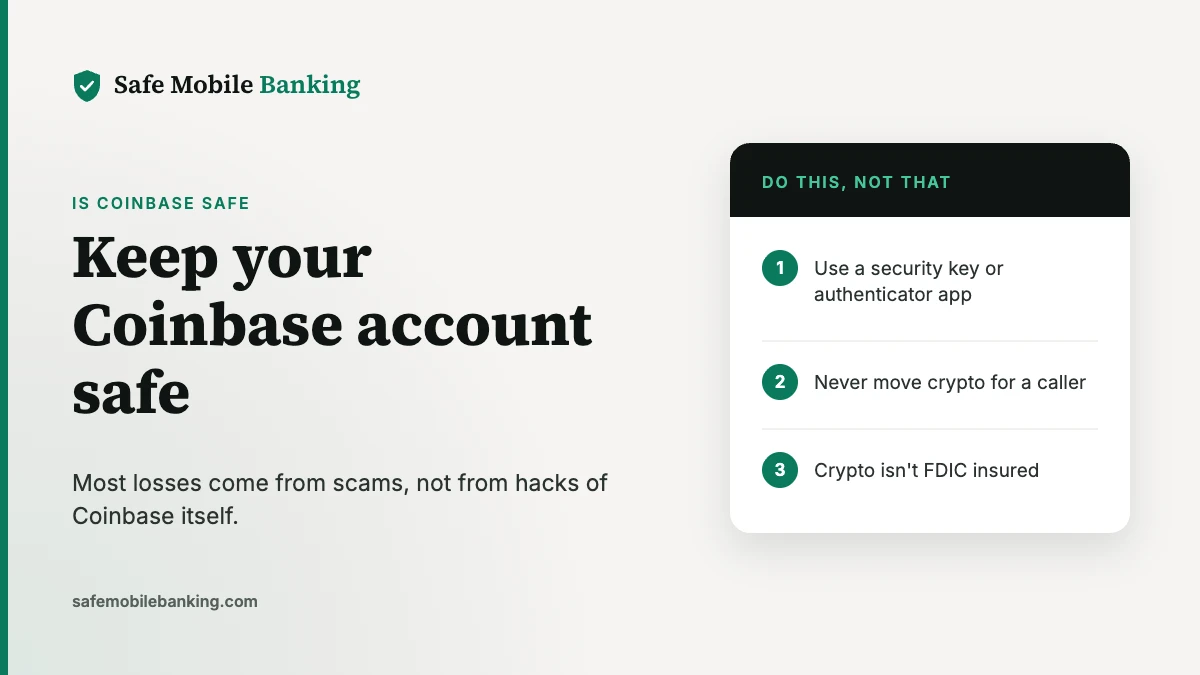
- Crypto. Crypto isn’t FDIC insured, isn’t covered by the Securities Investor Protection Corporation, and isn’t backed by the government. Coinbase says it insures the crypto it holds online against a breach of its own security or employee theft. That policy doesn’t cover losses from a compromise of your individual account.
Plain version: if Coinbase itself is breached, there’s a policy. If someone gets into your account, or you send coins to a scammer, you’re usually on your own.
What happened in the 2025 Coinbase data breach?
In May 2025, Coinbase told the Securities and Exchange Commission that criminals had paid overseas support contractors to copy customer data from internal support tools. The criminals then demanded $20 million to keep quiet. Coinbase refused and offered a $20 million reward for information leading to their arrest instead.
- Who was affected: 69,461 people, according to Coinbase’s filing with the Maine Attorney General. The access began in December 2024.
- What was taken: names, addresses, phone numbers, emails, the last 4 digits of Social Security numbers, masked bank account numbers, images of government IDs, and balance snapshots and transaction history.
- What wasn’t taken: passwords, two-factor codes, private keys or customer funds, Coinbase said.
- Cost: Coinbase estimated $180 million to $400 million for remediation and reimbursements, and said it would reimburse retail customers who were tricked into sending funds to the scammers as a result, after review.
The lesson matters for every customer, not just the 69,461: a scammer who calls you may already know your name, address and balance. That knowledge proves nothing.
What does Coinbase’s regulatory record show?
- New York, January 2023. The New York Department of Financial Services found Coinbase’s compliance program inadequate, including its customer background checks. Coinbase agreed to pay a $50 million penalty and to spend $50 million more on its compliance program.
- Securities and Exchange Commission, 2023 to 2025. The SEC sued Coinbase in 2023, alleging it operated as an unregistered exchange, broker and clearing agency. In February 2025 the SEC agreed to drop the case. The allegations were never proven in court.
What do Coinbase’s complaint records show?
The Consumer Financial Protection Bureau logged 1,021 complaints against Coinbase, Inc. from November 15, 2025 to November 15, 2026. The top issues:
- Other transaction problems: 274
- Fraud or scams: 225
- Money not available when promised: 172
- Other service problems: 79
Coinbase closed 590 with an explanation and 399 with monetary relief; 30 were still in progress. That monetary-relief share is higher than most payment apps we’ve reviewed.
Complaints are consumers’ claims as logged by the Consumer Financial Protection Bureau. The bureau doesn’t verify them, and a complaint isn’t proof of wrongdoing.
What Coinbase scams should you watch for?
- Fake Coinbase support calls. The caller says your account is under attack and you must move your crypto to a “safe” wallet. Coinbase says a real employee will never ask for your password or two-factor code, or give you a new wallet address or recovery phrase to move funds to.
- Fake security texts and emails. A link to “verify” a login or “cancel” a withdrawal leads to a copy of Coinbase’s sign-in page.
- Investment and romance scams. Someone you met online coaches you to buy crypto on Coinbase, then send it to a “trading platform” you can’t withdraw from. The Federal Trade Commission says investment scams drew $7.9 billion in reported losses in 2025, the most of any fraud type.
For how fake company messages work in general, see our guide to spotting a PayPal scam email. The same callback trick is used against Coinbase customers.
How do I make my Coinbase account safer? 5 steps
- Use a security key or an authenticator app for two-step verification. Text-message codes can be stolen through a SIM swap.
- Use a unique password that you don’t use anywhere else, stored in a password manager.
- Never move crypto because someone contacted you. Support never asks you to send funds to a new address.
- Reach Coinbase only through the app or help.coinbase.com. Don’t use phone numbers from search results or messages.
- Lock your phone number with your carrier. Our guide to preventing SIM swap fraud shows the free carrier setting.
Is Coinbase safe for you? Who should use it
A reasonable fit if you:
- Want to buy crypto through a regulated U.S. company.
- Will turn on strong two-step verification and ignore unsolicited “support.”
- Understand crypto prices can fall sharply and your coins aren’t insured.
Skip it, or keep amounts small, if you:
- Need money you can’t afford to lose for bills or emergencies.
- Are buying crypto because someone you met online told you to.
- Want deposit insurance on everything you hold.
Frequently asked questions
Is Coinbase safe to use?
Coinbase is a regulated, publicly traded U.S. exchange, and it says less than 2% of customer funds are held online. Most losses come from scams and account takeovers, so use a security key or authenticator app and never move crypto because someone contacted you.
Is my crypto on Coinbase FDIC insured?
No. Crypto isn’t FDIC insured or covered by SIPC. U.S. dollar balances held at FDIC-insured banks get pass-through FDIC coverage up to $250,000. Coinbase’s own insurance covers crypto it holds online if Coinbase is breached, not losses from your individual account.
Was Coinbase hacked?
In 2025 Coinbase disclosed that criminals bribed overseas support contractors to copy data on 69,461 people, including names, addresses and ID images. Coinbase said passwords, private keys and funds weren’t exposed, and offered to reimburse customers tricked into sending funds as a result.
Will Coinbase ever call me to move my crypto?
No. Coinbase says a real employee will never ask for your password or two-factor code, or give you a new wallet address to move funds to. Hang up and contact Coinbase through the app or help.coinbase.com.
Can Coinbase freeze my account?
Yes. Like banks and payment apps, Coinbase can restrict accounts during security or compliance reviews. Money not available when promised was the third most common complaint to the federal consumer bureau over the last year.
Sources
- Coinbase Help: How is Coinbase insured? (checked Nov 15, 2026)
- Help Net Security: Coinbase breach and SEC filing details (May 2025)
- SecurityWeek: Maine Attorney General filing, 69,461 affected (May 2025)
- New York Law Journal: Coinbase $50 million NYDFS penalty (January 2023)
- TechCrunch: SEC agrees to drop Coinbase lawsuit (February 2025)
- Consumer Financial Protection Bureau complaint database (company: Coinbase, Inc.; Nov 15, 2025 to Nov 15, 2026)
- Federal Trade Commission: 2025 fraud losses
- Coinbase on the Apple App Store
Safe Mobile Banking is a publisher, not a financial advisor. This article is general information, not financial or investment advice. Crypto is volatile and can lose value. Coinbase is a trademark of Coinbase, Inc.; we’re not affiliated with Coinbase. See our editorial standards.