Advertiser disclosure: This Self vs Kikoff comparison may contain partner links. Safe Mobile Banking may earn a fee if you sign up, at no cost to you. It never changes a Safe Mobile Banking Score or the order of this page. How we make money.
Short answer
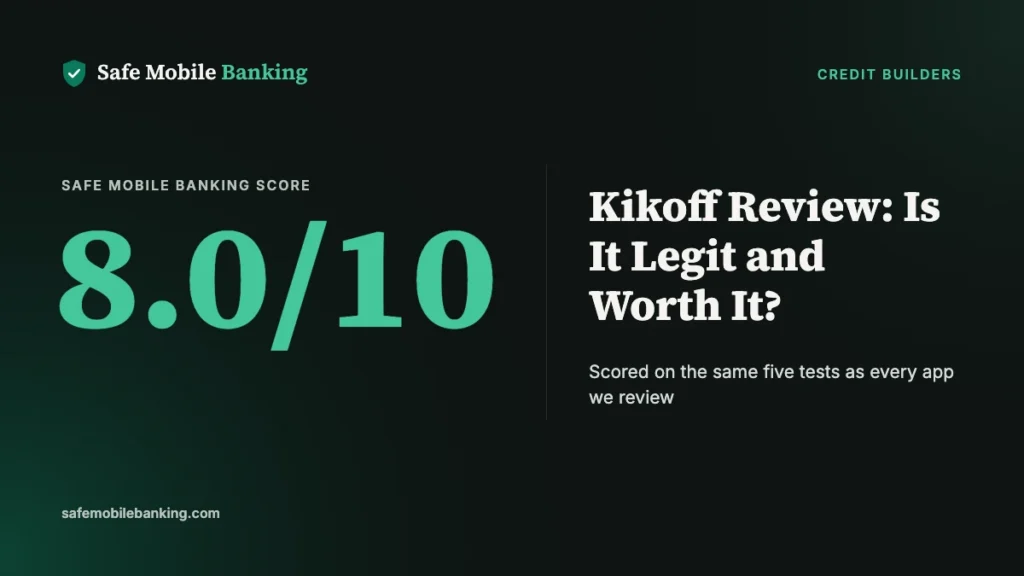
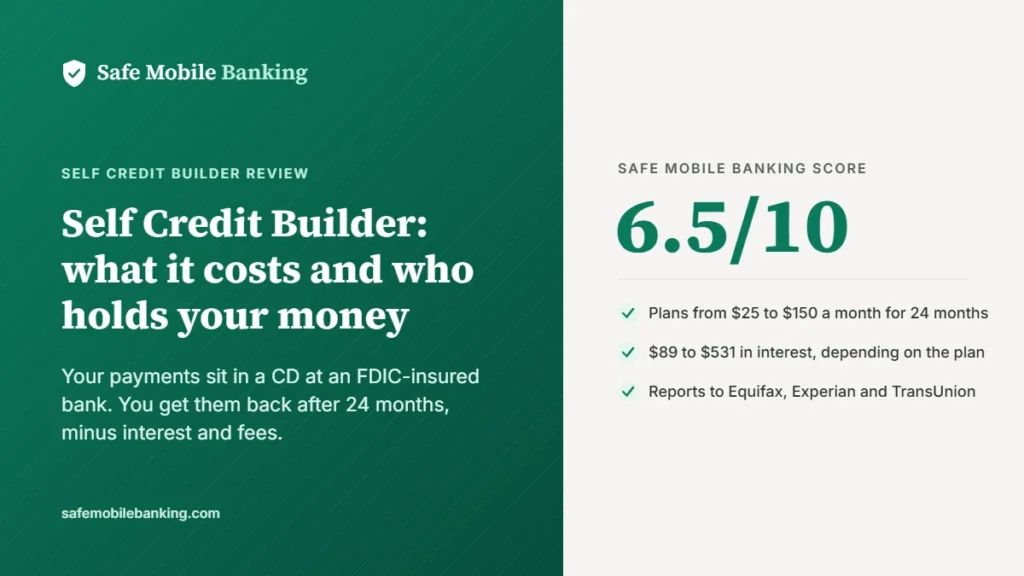
Self vs Kikoff: which is better? Kikoff costs less and scores higher for safety, 8.0 out of 10 to Self’s 6.5. Its Basic plan is $5 a month and gives no money back. Self is a 24-month loan from FDIC-insured banks that returns your savings minus interest, $89 on the smallest plan. Pick Kikoff for low cost, Self for forced savings.
Compare your own cost in the calculator (Self, Kikoff, Kovo and Chime side by side. Nothing you type is stored.)
Last verified: November 27, 2026.
Self vs Kikoff at a glance
Listed in Safe Mobile Banking Score order, highest first.
| Item | Kikoff | Self |
|---|---|---|
| Safe Mobile Banking Score | 8.0 / 10 | 6.5 / 10 |
| What it is | A credit line you can only use in the Kikoff Store | A credit builder loan held in a certificate of deposit (CD) |
| Monthly cost | $5 Basic, $20 Premium or $35 Ultimate | $25, $35, $48 or $150 payment |
| Term | Basic: 12 months for $60, billed monthly | 24 months on every plan |
| Money back at the end | None. You pay a plan fee. | Yes, minus interest and fees |
| Interest | None on the credit account | 15.51% to 15.92% APR |
| Credit bureaus | Equifax, Experian and TransUnion | Equifax, Experian and TransUnion |
| Credit check | None to sign up | No hard pull |
| Complaints, last 12 months | 3,494 filed with the federal consumer bureau | 4,755 filed with the federal consumer bureau |
| Apple App Store | 4.93 average from 285,814 ratings | 4.85 average from 342,097 ratings |
What is the real difference between Self and Kikoff?
They build credit in two different ways.
Self is a loan. Lead Bank, Sunrise Banks, N.A. or First Century Bank, N.A. lends you a set amount and parks it in a CD. You pay it down for 24 months. Self reports each payment to the three bureaus as an installment loan. At the end, the CD money is released to you, minus interest and fees.
Kikoff is a store credit line. The Basic plan opens a $750 line that Kikoff reports to the three bureaus. You can only spend it in the Kikoff Store, so most of it sits unused. That keeps your reported balance low. You pay a monthly plan fee, and none of it comes back.
So the Self vs Kikoff choice comes down to this: do you want a savings habit with interest, or a cheaper fee with nothing returned?
Self vs Kikoff: what each costs over two years
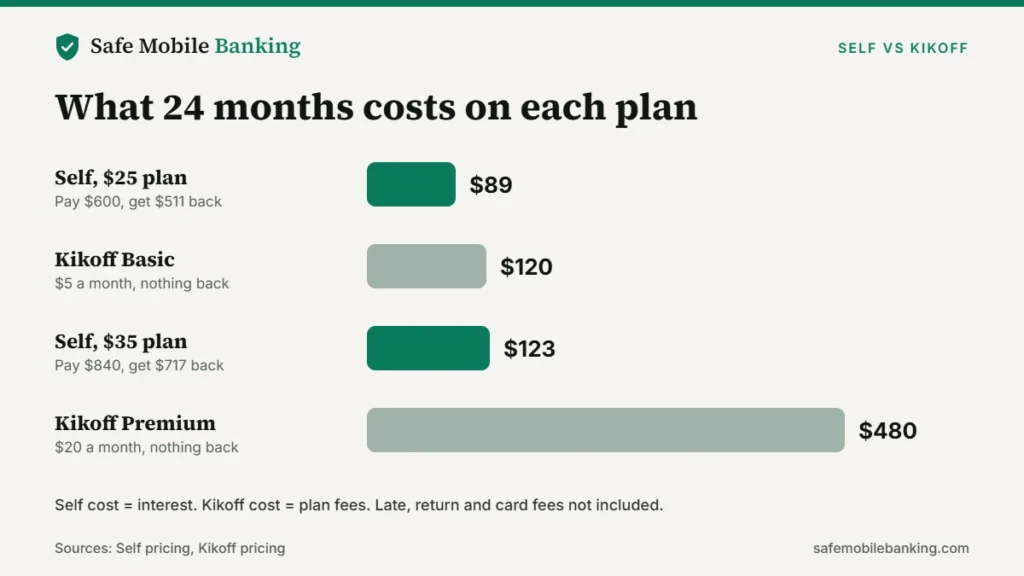
Here is what the entry plans cost if you keep them for 24 months. Figures come from each company’s pricing page.
| Plan | You pay | You get back | Your cost |
|---|---|---|---|
| Kikoff Basic ($5 a month) | $120 | $0 | $120 |
| Self ($25 a month) | $600 | $511 | $89 in interest |
| Self ($35 a month) | $840 | $717 | $123 in interest |
| Kikoff Premium ($20 a month) | $480 | $0 | $480 |
On cost alone, Self’s $25 plan beats Kikoff Basic over two years, $89 to $120. But Self ties up $25 a month, and its extra fees can add up. Self charges a late fee of 5% of the payment once you’re 15 days past due, $15 for each failed bank payment, and a convenience fee if you pay by debit card. Kikoff’s pricing page lists no interest on Basic, and warns that late or missed payments will hurt your credit.
Which is safer, Self or Kikoff?
Both are real, licensed companies. Kikoff scores higher on the Safe Mobile Banking Score because it confirms more account protections. Here is how each scored, test by test, under the written rules on how points are awarded.
| Test | Kikoff | Self |
|---|---|---|
| Deposit and license protection | 3 / 3: KikOff Lending, LLC is a licensed consumer installment lender in Missouri; Kikoff holds no deposits | 3 / 3: loans and CDs held by three FDIC-insured banks, active in BankFind |
| Fee transparency | 1.5 / 2: plan prices public; a term is stated only for the $5 plan | 1.5 / 2: prices, APRs and fees public; early withdrawal penalty amount not public |
| Regulatory record | 1 / 2: no enforcement action found, but 1,000+ complaints a year | 1 / 2: no enforcement action found, but 1,000+ complaints a year |
| Security features | 1.5 / 2: two-step login on every account since June 2023, plus a lockout after failed logins | 0 / 2: we couldn’t confirm customer-side protections on Self’s public pages |
| User ratings | 1 / 1 | 1 / 1 |
| Total | 8.0 / 10 | 6.5 / 10 |
One point in Self’s favor the score doesn’t capture: your savings sit in a CD at an FDIC-insured bank. With Kikoff, there’s no money of yours to protect, only the fees you’ve paid.
What do complaints say about Self and Kikoff?
From November 27, 2025 to November 27, 2026, consumers filed 4,755 complaints about Self Financial Inc. and 3,494 about Kikoff Inc. with the federal consumer bureau. The top issue was the same for both: complaints about incorrect information on a credit report, 1,684 for Self and 1,234 for Kikoff.
That pattern fits the products. A missed payment shows up as a late mark or a collection, and people dispute it. Whichever you choose, pay from a bank account on autopay and keep screenshots of payments and cancellations.
Complaints are consumers’ claims as logged by the Consumer Financial Protection Bureau. The bureau doesn’t verify them, and a complaint isn’t proof of wrongdoing.
Pick Kikoff or Self? A quick guide
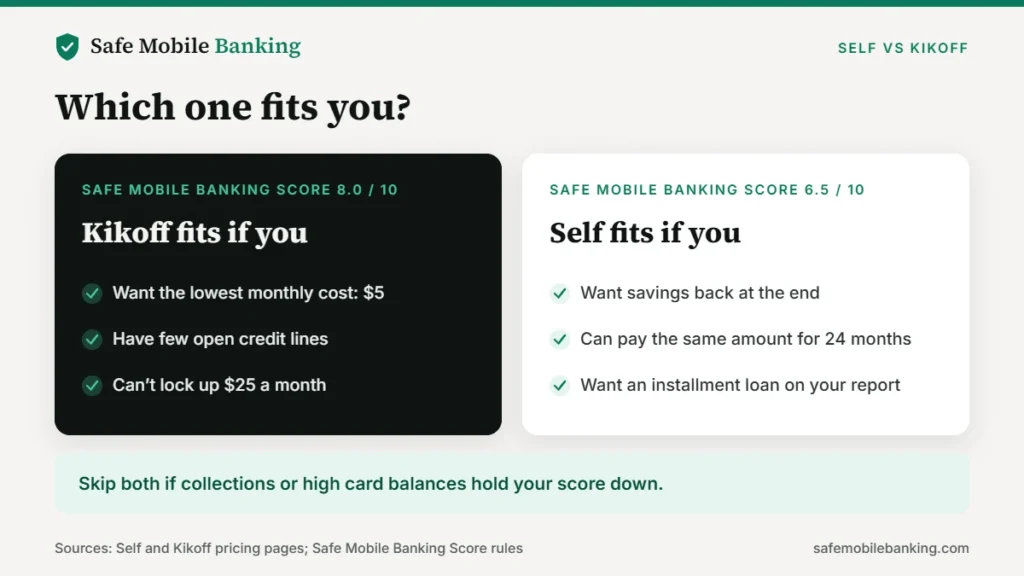
Pick Kikoff if you:
- Want the lowest monthly commitment: $5 on Basic.
- Have few open credit lines and want one with a low balance.
- Can’t lock up $25 a month for two years.
Pick Self if you:
- Want to finish with savings, not just a credit line.
- Can make the same payment for 24 months without missing one.
- Want an installment loan on your report.
Skip both if collections or high card balances are what hold your score down. Neither removes negative history already on your report.
Can you use Self and Kikoff at the same time?
Yes. They are separate accounts from separate companies, and each reports to the three bureaus on its own. That also means two payments to track. A missed payment on either can hurt the score you’re trying to build, so start with one if money is tight.
Check before you switch
Thinking about another app, your own bank or a credit union instead? Check four things first:
- Who holds the money: the named lender, and whether it shows as active in FDIC BankFind.
- Total cost: fees plus interest over the full term.
- Complaints: the 12-month count in the CFPB complaint database.
- Support: a phone number and email you can reach before a problem.
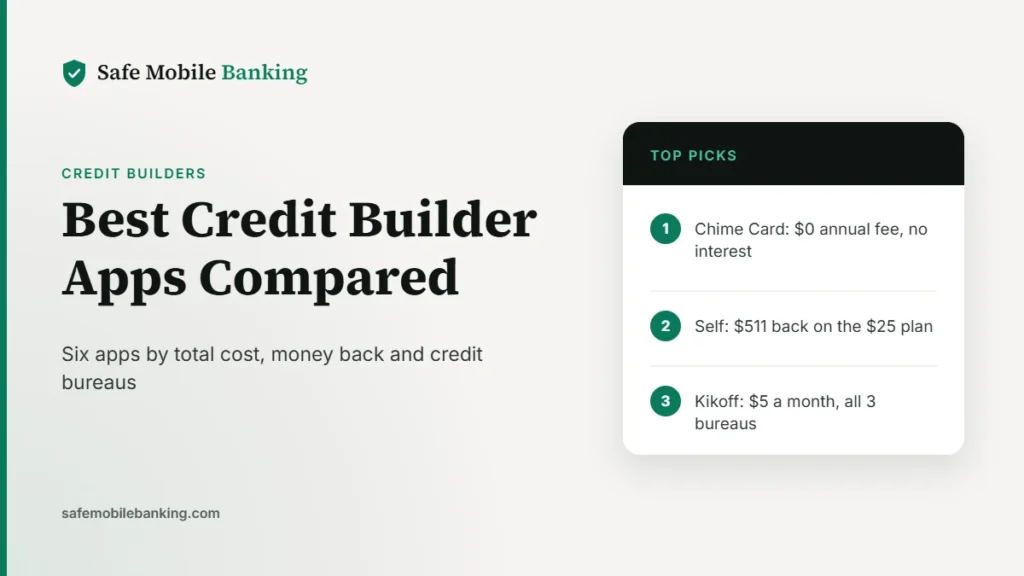
For more options, see our credit builder app comparison and the credit builder loans guide.
Self vs Kikoff: frequently asked questions
Is Self or Kikoff better?
It depends on your goal. Kikoff scores 8.0 out of 10 on the Safe Mobile Banking Score and costs $5 a month on Basic, but returns nothing. Self scores 6.5, ties up $25 or more a month for 24 months, and returns your savings minus interest. Pick Kikoff for low cost and Self for forced savings.
Which is cheaper, Self or Kikoff?
Over 24 months, Self’s $25 plan costs $89 in interest, while Kikoff Basic costs $120 in plan fees. Kikoff asks for far less each month, $5 versus $25. Self’s cost can rise with late fees, failed payment fees or debit card fees, so pay from a bank account on time.
Do Self and Kikoff report to all three credit bureaus?
Yes. Both report to Equifax, Experian and TransUnion. Self reports a 24-month installment loan, starting after your first successful payment. Kikoff reports a credit line, $750 on the Basic plan, that you can only spend in the Kikoff Store. Neither can remove negative history already on your report.
Do you get money back from Self or Kikoff?
Self, yes. Your payments sit in a certificate of deposit at an FDIC-insured bank and come back at the end, minus interest and fees. Kikoff, no. You pay a plan fee and nothing is returned, though Kikoff offers a 45-day money back guarantee on your first plan.
Can I use Self and Kikoff at the same time?
Yes. They are separate accounts from separate companies, and each reports to the three bureaus on its own. That means two payments to keep up with. A missed payment on either one can lower your score, so start with one if your budget is tight.
Sources
- Kikoff, plans and pricing
- Self, Credit Builder Account pricing
- Self, licenses and bank partner disclosures
- Apple App Store, Kikoff listing
- Apple App Store, Self listing
- Consumer Financial Protection Bureau complaint database (Self Financial Inc. and Kikoff Inc.; Nov 27, 2025 to Nov 27, 2026)
- Safe Mobile Banking, Kikoff review (license, security and fee evidence)
- Safe Mobile Banking, Self credit builder review (bank, fee and security evidence)
This Self vs Kikoff comparison is general information, not financial advice. Check each company’s current terms before you sign up.
Related reviews