Advertiser disclosure: This page is a Self credit builder review and may contain partner links. Safe Mobile Banking may earn a fee if you sign up, at no cost to you. It never changes a Safe Mobile Banking Score. How we make money.
Short answer
Is Self worth it? This Self credit builder review found a real loan from FDIC-insured banks, not a gimmick. You pay $25 to $150 a month for 24 months, the money waits in a certificate of deposit, and you get it back at the end minus interest. On the smallest plan that interest is $89. Self fits people with thin or damaged credit who can make every payment on time.
See Self’s current plans (From $25 a month for 24 months. No hard credit pull.)
Last verified: November 24, 2026.
Self credit builder review: the facts at a glance
| Item | What we found | Source |
|---|---|---|
| What it is | A credit builder loan held in a certificate of deposit (CD). You get the money at the end, not the start. | Self |
| Who makes the loan | Lead Bank, Sunrise Banks, N.A. or First Century Bank, N.A., each Member FDIC. Self says it is not a bank. | Self licenses page |
| Plans | $25, $35, $48 or $150 a month, all for 24 months | Self pricing |
| APR | 15.51% to 15.92%, depending on the plan | Self pricing |
| Credit bureaus | Equifax, Experian and TransUnion, starting after your first successful payment | Self |
| Credit check | No hard pull | Self pricing |
| Complaints, last 12 months | 4,828 filed with the federal consumer bureau | CFPB database |
| App Store rating | 4.8 from 341,650 ratings | Apple App Store |
How does Self Credit Builder work?
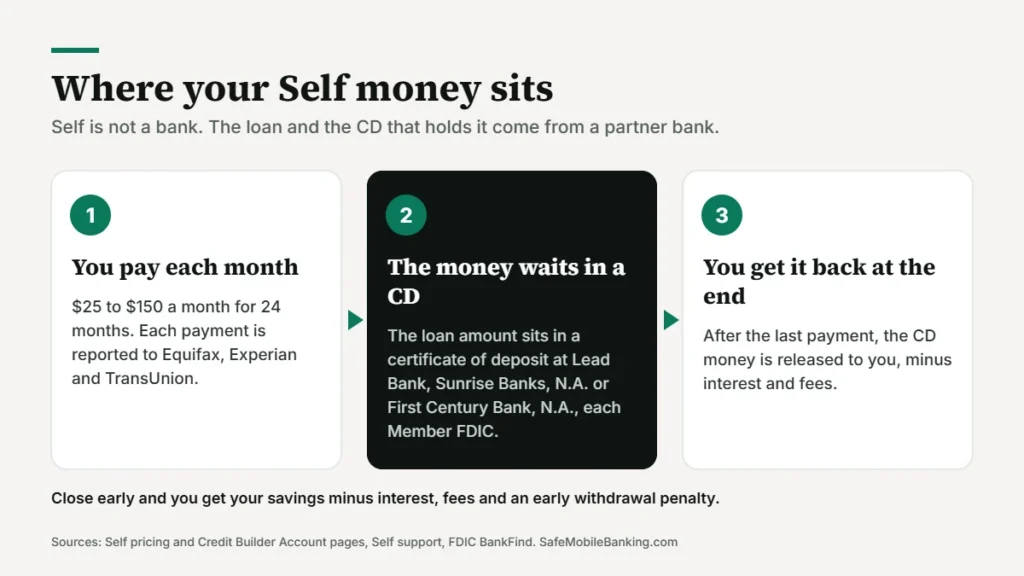
Self works backward from a normal loan. A partner bank lends you a fixed amount, but it doesn’t hand it over. The money goes into a CD at the bank. You pay the loan down each month, and Self reports those payments to all three credit bureaus.
- You pick a plan and open the account. There’s no hard credit pull.
- You pay the same amount each month for 24 months.
- After your first successful payment, the loan shows up on your credit reports as an installment account.
- When the last payment clears, the CD is released to you, minus interest and fees.
The point is payment history. Self notes that payment history makes up 35% of a credit score. On-time payments help. Late ones hurt: Self warns that missed payments may be reported as delinquent, and that its product won’t remove negative history already on your report.
What does Self cost?
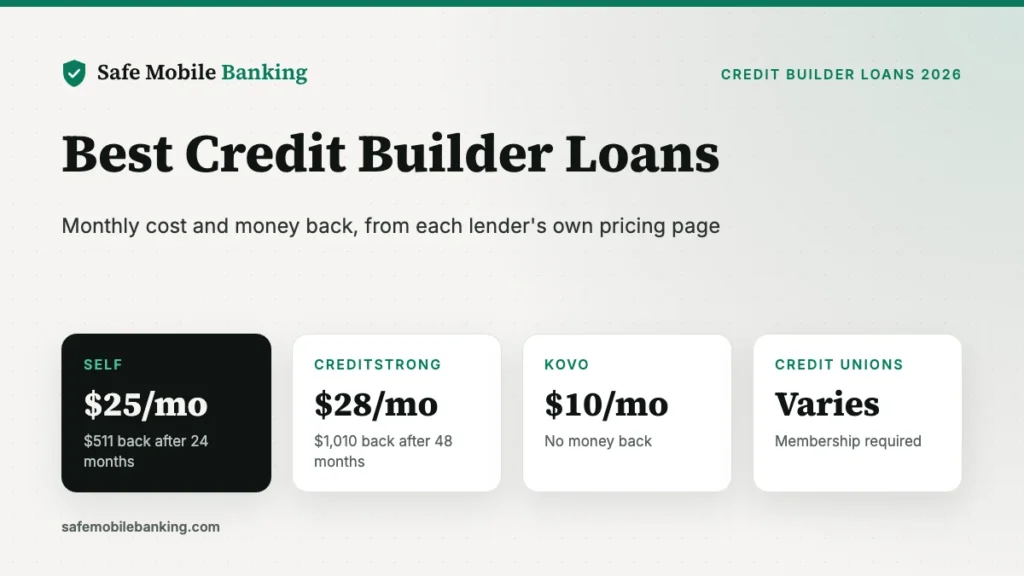
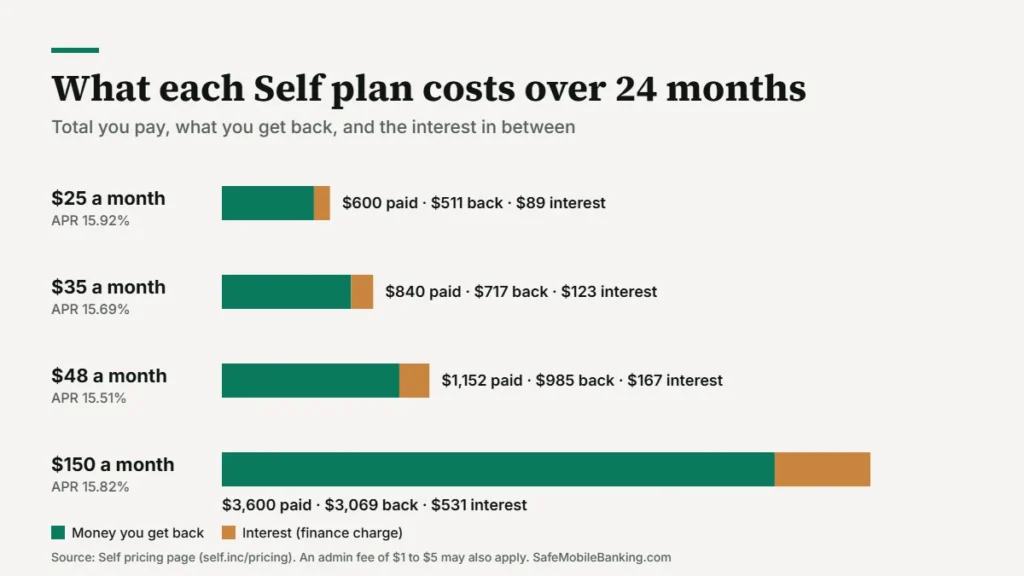
Every plan runs 24 months. The cost is the interest, which Self calls the finance charge. Here are the four plans on Self’s pricing page today:
| Monthly payment | You pay in total | You get back | Interest | APR |
|---|---|---|---|---|
| $25 | $600 | $511 | $89 | 15.92% |
| $35 | $840 | $717 | $123 | 15.69% |
| $48 | $1,152 | $985 | $167 | 15.51% |
| $150 | $3,600 | $3,069 | $531 | 15.82% |
Self says the options you see may vary. Other fees, from Self’s own pages:
- Admin fee: Self may charge a non-refundable admin fee when you open the account. Self’s App Store disclosure puts it at $1 to $5.
- Late fee: 5% of your monthly payment once a payment is at least 15 days past due.
- Returned payment: $15 for each failed payment from a bank account.
- Debit card payments: a convenience fee of $0.30 plus 2.99% of the payment. That’s $1.20 a month on the $25 plan and $4.75 on the $150 plan. Paying from a bank account avoids it.
- Closing early: you can pay off or close early, but Self deducts interest, fees and an early withdrawal penalty. We didn’t find the penalty amount on a public page.
Unpaid fees come out of your payout at the end. On the $25 plan, paying by debit card for 24 months adds $28.80, which takes the total cost from $89 to about $118 before the admin fee.
Is your money safe with Self?
Yes, in the way that matters most. Self says the Credit Builder Accounts and the CDs are made and held by Lead Bank, Sunrise Banks, N.A. or First Century Bank, N.A., each Member FDIC. We checked all three in the FDIC’s BankFind records. Each is active and insured: Lead Bank (certificate 8283), Sunrise Banks, National Association (certificate 18561) and First Century Bank, National Association (certificate 57123).
Self Financial, Inc. describes itself as a software partner for a registered U.S. financial institution. A related company, Self Credit LLC (NMLS ID 2167345), lists state lender, loan broker and collection licenses on its licenses page and says it is not the lender.
Two limits to keep in mind. FDIC insurance protects deposits if a bank fails. It doesn’t protect you from fees, late marks on your credit report or a scammer posing as Self.
Does Self actually raise your credit score?
It can, but Self doesn’t promise a number. Its App Store listing cites a 2025 TransUnion study: customers who opened a 24-month account in early 2024 with a VantageScore 3.0 under 600, and who paid on time, saw an average increase of 47 points by month 12. That is Self’s claim, about one group of customers who did everything right. Self says results vary and that late payments on other Self products or other debts can lower scores.
The score you see in the Self app is a VantageScore 3.0. Self notes that it differs from the FICO score, so your number elsewhere may not match.
What about the Self Visa card?
Self also offers a secured Self Visa Credit Card, issued by the same three banks. Self says you may be able to get it using money you’ve already paid into your Credit Builder Account in as little as three months, with no hard pull. Otherwise, the card needs a security deposit of at least $100. The annual fee is $0 the first year and $25 after that. Self lists a variable APR of 27.74% as of October 1, 2026. Carrying a balance at that rate erases much of what the loan saves you, so pay it in full.
Self also sells rent and utility reporting for $6.95 a month. Rent goes to all three bureaus. Utility and cell phone payments go to TransUnion only.
What do complaints show?
From November 24, 2025 to November 24, 2026, consumers filed 4,828 complaints about Self Financial Inc. with the federal consumer bureau. Most fell into two products: credit reporting (2,602) and debt collection (1,647). The most common issues:
- Complaints about incorrect information on a credit report: 1,708
- Complaints about attempts to collect a debt the person says isn’t owed: 723
- Complaints that the company took or threatened negative or legal action: 661
- Complaints about how the company handled an investigation into an existing problem: 542
Self closed 4,535 of them with an explanation, and 293 were still in progress. It responded on time to 4,797. The pattern tells you where people run into trouble: a missed payment becomes a late mark or a collection, and the customer disputes it. If you sign up, set up autopay from a bank account and keep a payment record.
Complaints are consumers’ claims as logged by the Consumer Financial Protection Bureau. The bureau doesn’t verify them, and a complaint isn’t proof of wrongdoing.
In our search we found no government enforcement action against Self in the last three years.
How does Self protect your account?
Self says it encrypts data at several layers, runs regular vulnerability scans and penetration tests, and completes annual SOC 1 Type 2, SOC 2 Type 2 and PCI DSS audits. Those are controls on Self’s side. We didn’t find a public statement from Self about customer-side protections such as two-step login, account alerts or a card lock. That doesn’t mean Self lacks them. It means we couldn’t confirm them, so the security test scored zero.
Who Self fits, and who should skip it
Good fit if you:
- Have no credit history or a thin file and want an installment loan on your report.
- Can lock in $25 or more every month for two years without missing a payment.
- Like that the money comes back as savings at the end.
Skip it if you:
- Need cash now. You can’t spend the loan until it’s paid off.
- Already have open credit accounts with a long record of on-time payments. You may not need it.
- Expect it to erase late payments or collections already on your report. Self says it won’t.
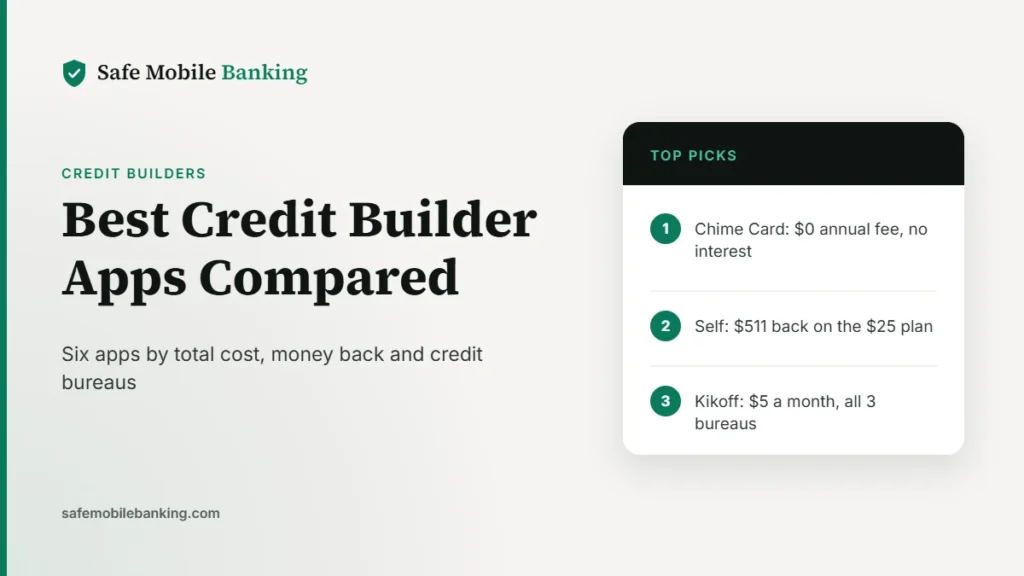
- Want a no-interest option. Kikoff charges a monthly fee instead and gives no money back. Compare the total cost first in our credit builder app comparison or the credit builder loans guide.
How Self scored, test by test
Each test follows the written rules on how points are awarded.
| Test | Points | Why |
|---|---|---|
| Deposit and license protection | 3 / 3 | The loans and CDs are made and held by Lead Bank, Sunrise Banks, N.A. and First Century Bank, N.A., each active and FDIC-insured in BankFind. Self Credit LLC lists its state licenses under NMLS ID 2167345. |
| Fee transparency | 1.5 / 2 | Plan prices, APRs, finance charges, the late fee, return fee and debit card fee are public. The early withdrawal penalty amount isn’t on a public page we found. |
| Regulatory record | 1 / 2 | We found no enforcement action in the last three years, but consumers filed 4,828 complaints with the federal consumer bureau in 12 months. |
| Security features | 0 / 2 | We couldn’t confirm two-step login or two customer-side protections on Self’s public pages. Self describes encryption and audits on its own systems. |
| User ratings | 1 / 1 | 4.8 on the Apple App Store from 341,650 ratings. |
The Safe Mobile Banking Score rates protection and transparency. It doesn’t judge whether a credit builder loan is the right tool for you.
Self credit builder review: frequently asked questions
Is Self credit builder legit?
Yes. Self is a real company, and its Credit Builder Accounts are loans made and held by Lead Bank, Sunrise Banks, N.A. or First Century Bank, N.A., each Member FDIC. Payments are reported to Equifax, Experian and TransUnion. Consumers filed 4,828 complaints about Self with the federal consumer bureau in the 12 months to November 24, 2026, mostly about credit reporting and debt collection.
What is Self credit builder?
It is a credit builder loan. A partner bank lends you a fixed amount and holds it in a certificate of deposit while you pay it off over 24 months. Each payment is reported to the three major credit bureaus. When the loan is paid, you get the CD money back, minus interest and fees.
How much does Self cost?
Plans run $25 to $150 a month for 24 months. Interest ranges from $89 on the $25 plan to $531 on the $150 plan, at APRs of 15.51% to 15.92%. Self says an admin fee of $1 to $5 may apply, and paying by debit card adds $0.30 plus 2.99% of each payment.
Does Self do a credit check?
Self says there is no hard pull on your credit to open a Credit Builder Account, and no minimum credit score. Accounts are still subject to approval. Because there is no hard pull, applying shouldn’t add a hard inquiry to your credit report.
Can I get my money from Self early?
You can pay off or close your account early. Self then releases your savings minus interest, fees and an early withdrawal penalty. You can’t spend the loan amount at the start. It stays in the CD until the loan is paid off or the account is closed.
What happens if I miss a Self payment?
Self charges a late fee of 5% of the monthly payment once a payment is at least 15 days past due, and $15 for each failed bank payment. A missed payment may be reported to the credit bureaus as delinquent, which can lower your score. Unpaid fees come out of your payout.
Sources
- Self, Credit Builder Account pricing
- Self, Credit Builder Account and FAQ
- Self, licenses and bank partner disclosures
- Self Support, Credit Builder Account fees
- Self, payment authorization and convenience fee disclosure
- Self, paying off a Credit Builder Account early
- Self, Self Visa Credit Card
- Self, Trust and Security
- Apple App Store, Self listing and disclosures
- FDIC BankFind (certificates 8283, 18561 and 57123)
- Consumer Financial Protection Bureau complaint database
This Self credit builder review is general information, not financial advice. Check the current terms on Self’s site before you sign up.
Related reviews