Advertiser disclosure: Is Google Pay safe? We answer that independently. Safe Mobile Banking may earn a commission from some companies we review, but we don’t earn anything from Google, and commissions never change what we say. How we make money.
Short answer
Is Google Pay safe? Yes for tap to pay. Google Wallet sends stores a virtual account number instead of your real card number and requires a screen lock before you pay. But in the US, Google Pay no longer sends money between people. That feature ended June 4, 2024, so anyone asking you to “send GPay” deserves suspicion.
- Virtual account number replaces your card number at checkout
- Screen lock required; Find My Device can lock or erase a lost phone
- US person-to-person payments ended in June 2024
See 3 settings that lock down Google Wallet (Free. Two minutes on your phone.)
Last verified: November 15, 2026, against Google Wallet Help, Google’s safety center, the Consumer Financial Protection Bureau and its complaint database.
Is Google Pay safe? The short version
| Question | Answer | Source |
|---|---|---|
| What do stores see? | A virtual account number, not your real card number | |
| Lock required? | Yes. No screen lock, no tap to pay | |
| Lost phone? | Find My Device can lock it, sign you out or erase it | |
| Send money to people (US)? | No. Ended June 4, 2024 with the US Google Pay app | Google, news reports |
| Regulator | CFPB supervision order (December 2024) withdrawn May 2025 | CFPB |
| Complaints, last 12 months | 238 filed with the federal consumer bureau | CFPB database |
How does Google Pay protect your card?
When you add a card to Google Wallet, Google creates a virtual account number for it. In stores, the merchant gets that number, not your real card number, so a breach at the store doesn’t expose your actual card. Google says your payment info is stored with encryption.
You must set up a screen lock (PIN, pattern, password or fingerprint) before you can tap to pay. If you turn the lock off, Google removes the virtual account number from your phone. For online shopping, Chrome can also offer a virtual card number in place of your real one.
Can you still send money with Google Pay?
Not in the US. Google shut down the US Google Pay app on June 4, 2024, and ended person-to-person payments with it. Tap to pay and checkout moved to the Google Wallet app; leftover balances could be moved to a bank through the Google Pay website.
That change matters for scams. If a seller, “landlord” or stranger in the US asks you to send money through Google Pay, the feature doesn’t exist here, so stop and verify before you pay any other way. For safer ways to pay people, see is PayPal safe.
Has Google Pay had regulatory problems?
In December 2024, the Consumer Financial Protection Bureau ordered Google Payment Corp. under federal supervision, citing consumer complaints about its peer-to-peer product. Google sued, saying the bureau relied on a small number of unproven complaints about a product it no longer offered. On May 7, 2025, the bureau withdrew the order because that product had been discontinued, and Google dropped its lawsuit. The order was not a finding of wrongdoing.
What do Google’s payment complaint records show?
The Consumer Financial Protection Bureau logged 238 complaints under Google’s listing in its database (company name: Google Compare Credit Cards Inc.) from November 15, 2025 to November 15, 2026. The top issues:
- Unauthorized transactions or other transaction problems: 43
- Problems with a purchase on a statement: 31
- Trouble using a card: 24
- Trouble accessing funds in a digital wallet: 23
- A company charging an account: 13
Google closed all 238 with an explanation.
Complaints are consumers’ claims as logged by the Consumer Financial Protection Bureau. The bureau doesn’t verify them, and a complaint isn’t proof of wrongdoing.
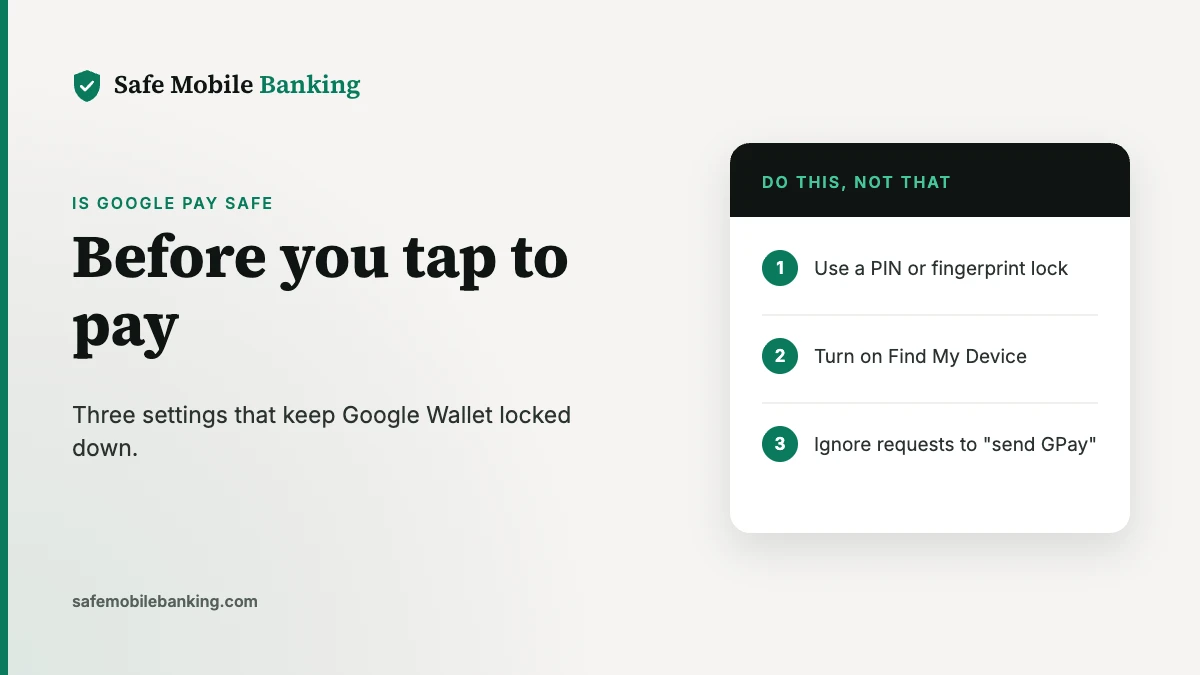
Is Google Pay safe for you? 3 settings to check
- Use a PIN or fingerprint lock. Google Wallet won’t work with weaker unlock methods like Smart Unlock.
- Turn on Find My Device so you can lock or erase your phone if it’s lost.
- Ignore requests to “send GPay.” US person-to-person payments ended in 2024; treat the request as a scam sign.
On an iPhone? See is Apple Pay safe. Already lost money? Follow our guide on how to report a scam.
Frequently asked questions
Is Google Pay safe?
Yes. When you tap to pay in a store, Google sends the merchant a virtual account number instead of your real card number, and you must have a screen lock to pay. The bigger risks are an unlocked phone, a hacked Google account, and scammers who ask you to send money through Google Pay.
Can I still send money with Google Pay in the US?
No. Google shut down the US Google Pay app on June 4, 2024, and with it the ability to send, request or receive money from other people. Tap to pay and online checkout moved to Google Wallet. If someone in the US asks you to send money through Google Pay, treat it as a red flag.
What is a Google Pay virtual account number?
It’s a stand-in for your real card number, created when you add a card to Google Wallet. Stores receive the virtual number when you pay, and your actual account number isn’t shared. If you turn off your screen lock, Google removes the virtual number from your device.
What if my phone with Google Wallet is lost or stolen?
Use Google Find My Device to lock your phone, sign out of your Google account or erase it. Google Wallet also requires your screen lock for payments. Then call your card issuer to report the phone lost and watch your statements.
Who regulates Google Pay?
Google Payment Corp. is subject to the Consumer Financial Protection Bureau’s enforcement authority. The bureau ordered it under supervision in December 2024, but withdrew that order in May 2025 because the peer-to-peer product it focused on had been discontinued.
Sources
- Google Wallet Help: Keep your payment info safe (virtual account number, screen lock, encryption)
- Google Wallet Help: Verify it’s you to make a purchase
- Google Help: unsupported screen locks (Smart Unlock)
- Google Safety Center: A more secure way to pay (Find My Device)
- 9to5Google: GPay app and P2P payments stop working in the US (June 4, 2024)
- Consumer Financial Protection Bureau: withdrawal of Google Payment Corp. supervision (May 7, 2025)
- Axios: Google drops its lawsuit
- Consumer Financial Protection Bureau complaint database (company: Google Compare Credit Cards Inc.; Nov 15, 2025 to Nov 15, 2026)
Safe Mobile Banking is a publisher, not a bank or financial advisor. This article is general information, not financial advice. Google Pay and Google Wallet are trademarks of Google LLC; we’re not affiliated with Google. See our editorial standards.