Advertiser disclosure: Safe Mobile Banking may earn a commission from some companies we review. We don’t earn anything from Albert, and commissions never change what we say. How we make money.
Short answer
Is Albert legit? Yes. Albert is a real financial app whose banking is provided by Stride Bank, N.A., Member FDIC, with deposits eligible for pass-through FDIC insurance. The real cost is the subscription: plans run $19.99 to $39.99 a month and renew until you cancel.
- Cash and Savings funds eligible for up to $250,000 in pass-through FDIC insurance
- Instant Advance: no interest, no late fees, no subscription required
- Most complaints are about charges and trouble stopping withdrawals
Check these 3 things before you pay for Albert (Free. Two minutes in the app.)
Last verified: November 15, 2026, against Albert’s website disclosures, the Consumer Financial Protection Bureau complaint database and the Apple App Store.
Is Albert legit? The short version
| Question | Answer | Source |
|---|---|---|
| Is Albert a bank? | No. Banking services are provided by Stride Bank, N.A., Member FDIC. Savings funds are held at Wells Fargo. | Albert |
| Is my money insured? | Cash and Savings funds are eligible for up to $250,000 in pass-through FDIC insurance, with conditions | Albert |
| What does it cost? | Subscription plans from $19.99 to $39.99 a month; they auto-renew | Albert |
| Cash advances? | Instant Advance from $25 to $1,000 based on eligibility; no interest or late fees | Albert |
| Complaints, last 12 months | 274 filed with the federal consumer bureau | CFPB database |
| App rating | 4.7 out of 5 from about 344,000 ratings | Apple App Store |
Is Albert a real bank?
No, and Albert says so: it’s a financial technology company. Its banking services are provided by Stride Bank, N.A., Member FDIC, and savings funds are held at Wells Fargo. Albert says Cash and Savings funds are eligible for up to $250,000 in FDIC insurance on a pass-through basis, subject to conditions. That insurance covers a bank failure, not fees or scams.
Investing is separate. Albert’s investment accounts are offered through Albert Securities, a SIPC member, and aren’t FDIC insured; they can lose value.
Some older reviews name Sutton Bank as Albert’s banking partner. Albert’s own site now lists Stride Bank.
What does Albert cost?
Albert’s subscription plans range from $19.99 to $39.99 a month and renew automatically until you cancel. Its credit features work differently:
- Instant Advance: $25 to $1,000 based on eligibility, with no interest or late fees and no subscription required.
- Instant Line of Credit: issued by FinWise Bank, $25 to $1,000, with draw fees.
- Instant Loan: starts at $1,000, based on eligibility and credit; a transfer fee may apply to external transfers.
Read the fee shown before each advance or draw. A $10 fee on a $100 advance repaid in two weeks is an expensive way to borrow.
What do Albert’s complaint records show?
The Consumer Financial Protection Bureau logged 274 complaints against Albert Corporation from November 15, 2025 to November 15, 2026. The top issues:
- A lender or other company charging your account: 58
- Closing an account: 42
- Managing an account: 29
- Can’t stop withdrawals from a bank account: 20
- Unexpected fees or interest: 16
Albert closed all 274 with an explanation. The pattern points to subscriptions and automatic withdrawals, so track what you pay and cancel promptly if you stop using the app.
Complaints are consumers’ claims as logged by the Consumer Financial Protection Bureau. The bureau doesn’t verify them, and a complaint isn’t proof of wrongdoing.
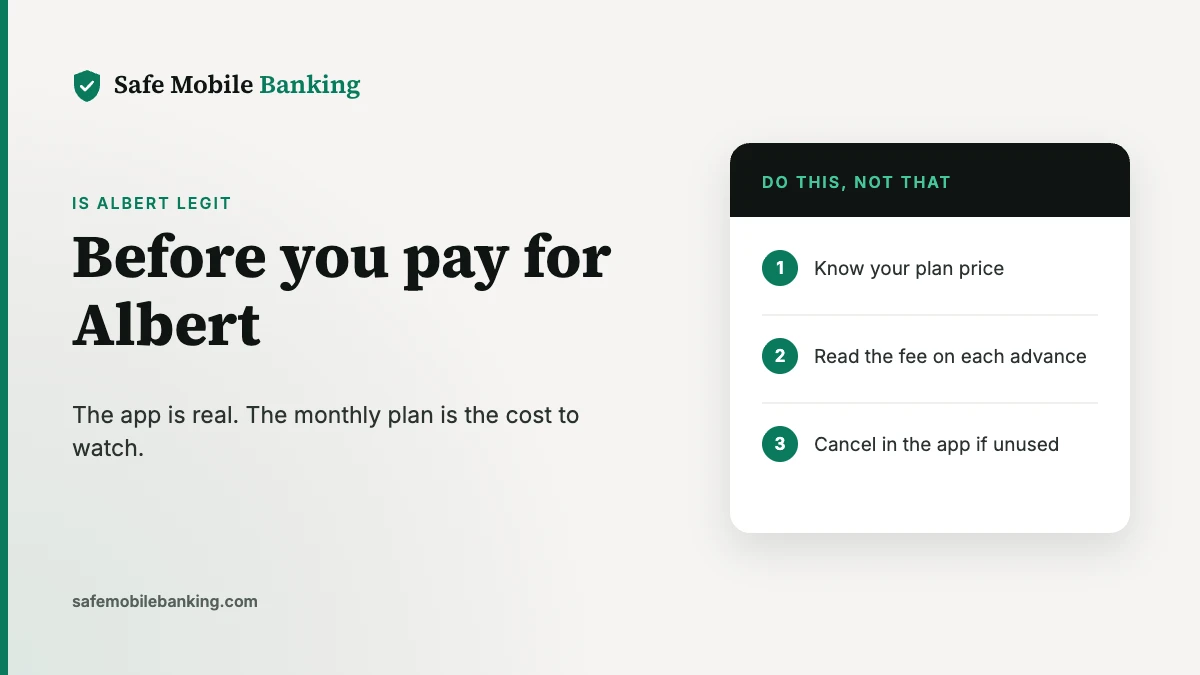
Is Albert legit for you? 3 checks before you pay
- Know your plan price. Write down which plan you picked and when it renews.
- Read the fee on each advance or draw and compare it with a credit union small-dollar loan.
- Cancel in the app if you stop using it, and check your bank statement the next month to confirm the charges stopped.
Albert links to your other bank accounts to watch your spending; see Is Plaid safe? for how those connections work. If someone contacts you posing as Albert support, follow our steps on how to report a scam.
Who should use Albert, and who should skip it?
A reasonable fit if you:
- Want budgeting, banking and small advances in one app.
- Will use the paid features enough to justify the monthly price.
- Track subscriptions and cancel what you don’t use.
Skip it if you:
- Only need an occasional small advance; free options may fit better.
- Already pay for other budgeting apps.
- Struggle to keep a buffer for automatic withdrawals.
Frequently asked questions
Is Albert a legit app?
Yes. Albert Corporation is a real financial technology company. It isn’t a bank; its banking services are provided by Stride Bank, N.A., Member FDIC. The main costs to watch are its monthly subscription plans and fees on some advance and credit features.
Is my money safe in Albert?
Albert says Cash and Savings funds are eligible for up to $250,000 in FDIC insurance on a pass-through basis, with conditions. Savings funds are held at Wells Fargo. FDIC insurance doesn’t cover Albert’s investment accounts, which are covered by SIPC instead.
How much does Albert cost?
Albert’s site lists subscription plans from $19.99 to $39.99 a month, which renew until you cancel. Instant Advance has no interest or late fees and doesn’t require a subscription, but other credit features have draw or transfer fees.
How much can I get from an Albert advance?
Albert lists Instant Advance limits from $25 to $1,000, based on eligibility. The amount you see in the app is your limit; no interest or late fees apply to Instant Advance.
Why do people complain about Albert?
Over the last year, the most common complaints to the federal consumer bureau were about charges to accounts, closing accounts and trouble stopping withdrawals. Know your plan price and cancel in the app if you stop using it.
Sources
- Albert: Website disclosures (plans, Instant Advance, line of credit, Stride Bank, FDIC and SIPC; checked Nov 15, 2026)
- Consumer Financial Protection Bureau complaint database (company: Albert Corporation; Nov 15, 2025 to Nov 15, 2026)
- Albert on the Apple App Store
Safe Mobile Banking is a publisher, not a financial advisor. This article is general information, not financial advice. Albert is a trademark of Albert Corporation; we’re not affiliated with Albert. See our editorial standards.