Advertiser disclosure: Safe Mobile Banking may earn a commission from some companies we review. We don’t earn anything from Zelle, and commissions never change the Safe Mobile Banking Score or what we say. How we make money.
Short answer
Is Zelle safe? Yes, for sending money to people you know. But Zelle works like cash: once the person is enrolled, the money lands in their bank account in minutes and you can’t cancel it.
- Runs inside your bank’s app, with your bank’s sign-in and fraud checks
- No purchase protection, so never use it to buy from strangers
- Scams you approve yourself are refunded only in limited cases
Check a Zelle payment in 30 seconds (Free. Five questions before you tap Send.)
Last verified: November 14, 2026, against Zelle’s own scam fact sheet and FAQs, bank Zelle FAQs (Wells Fargo, Chase), the Consumer Financial Protection Bureau complaint database and court reporting on the New York Attorney General’s lawsuit.
Is Zelle safe? The short version
| Question | Answer | Source |
|---|---|---|
| Who runs Zelle? | Early Warning Services, LLC, a company owned by seven large U.S. banks. You use Zelle inside your own bank or credit union’s app. | Zelle; court filings |
| Can I cancel a payment? | Only if the person hasn’t enrolled with Zelle yet. Once they’re enrolled, the money is gone. | Zelle FAQ; Wells Fargo; Chase |
| Is there purchase protection? | No. Zelle is built for people you know and trust. | Zelle FAQ |
| Am I refunded if my account is hacked? | Yes. Banks on the network must reimburse confirmed fraud after an investigation. | Zelle scam fact sheet |
| Am I refunded if I’m tricked into paying? | Only for “certain qualifying imposter scams.” Most other scams aren’t covered. | Zelle scam fact sheet |
| Who sets my limits? | Your bank or credit union, not Zelle. | Zelle FAQ |
| Complaint record | 654 money-transfer complaints filed against Early Warning Services from Nov 14, 2025 to Nov 14, 2026. 301 were about fraud or scams. | CFPB complaint database |
Is Zelle safe to use?
The system itself is solid. Zelle runs inside your bank’s app, so it’s protected by your bank’s sign-in, two-factor checks and fraud monitoring. Zelle’s network rules require banks to use controls such as two-factor authentication, biometrics and real-time screening for risky payments, and to show scam warnings before some payments go out.
Zelle says more than 99.95% of payments are completed without any report of scam or fraud. That’s Zelle’s own figure, not an independent audit. And it hides the real risk: Zelle doesn’t get hacked very often, but people get talked into sending money. Zelle moves money in minutes, and that speed is exactly what scammers count on.
Can you get your money back on Zelle?
It depends on who pressed Send.
- Someone else sent it (your account was taken over). That’s unauthorized fraud. Federal law and Zelle’s network rules require your bank to investigate and reimburse confirmed fraud. Report it to your bank right away.
- You sent it, but you were tricked. That’s an authorized payment. Zelle requires banks to refund only “certain qualifying imposter scams,” such as someone pretending to be your bank or a government agency. Zelle doesn’t publish the full rules, so whether you qualify is up to your bank.
- You sent it to the wrong person. If they’re enrolled, the money is already in their account. Ask them to send it back, and call your bank.
There’s one exception. If the person you paid hasn’t enrolled with Zelle yet, the payment shows as pending. You can cancel it from your Zelle activity, and if they don’t enroll within 14 days, the money comes back to you on its own.
Is Zelle safe to receive money from strangers?
Receiving money is low-risk. The money arrives in your own bank account, and nobody can pull it out without your sign-in. The danger is what the stranger asks you to do next. Watch for three scams:
- The “accidental” payment. Someone sends you money by mistake and asks for it back. The original payment often came from a stolen account, so it gets reversed, and the money you sent back is gone. Don’t send it back yourself. Tell your bank.
- The fake “business account” upgrade. A buyer says their payment is stuck until you pay to upgrade to a business account. Zelle has no such fee.
- The verification code. Anyone who asks you to read back a code from your bank is trying to take over your account. Your bank will never ask for it.
Is Zelle safe for Facebook Marketplace?
Not for buying. Zelle has no purchase protection, so if the item never shows up or isn’t as described, Zelle won’t help. Only pay with Zelle after you’ve met the seller in person and are holding the item.
When you’re selling, Zelle is reasonably safe once the money is actually in your account. Check your banking app before you hand anything over, and ignore any email or text claiming the buyer has already paid. For buying online from someone you’ve never met, a credit card or a Venmo payment tagged as goods and services gives you a way to dispute it. Our guide Is Venmo safe? explains how that tag works. Cash App has no purchase protection on payments to people either; see Is Cash App safe?
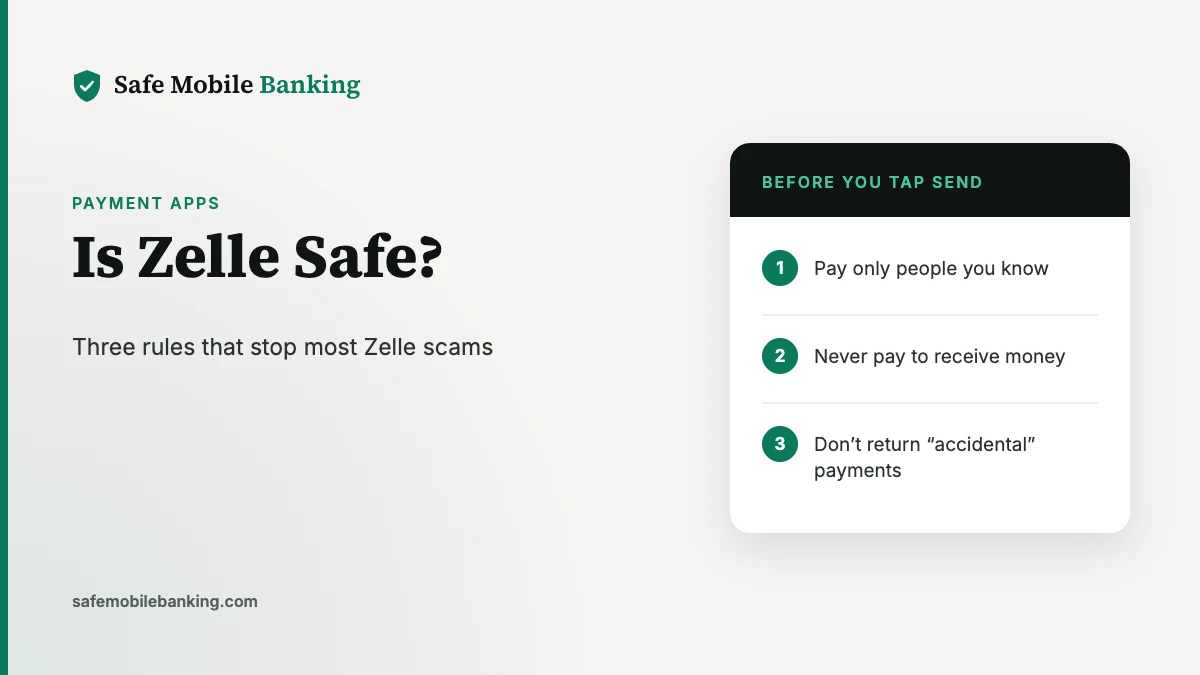
Before you tap Send: a 30-second Zelle checklist
- Do I know this person in real life? If not, use a payment method with purchase protection.
- Did they contact me first, and are they rushing me? Pressure and urgency are the most common signs of a scam. Hang up and call the company back at a number you already know.
- Does the name my bank shows match the person I expect? Check it before you confirm.
- Is anyone asking me to “send money to myself” or to read back a code? No bank does this. It’s a scam every time.
- Am I paying for something I haven’t seen? Then don’t use Zelle.
Lock down the account behind it as well. Turn on your bank’s two-factor sign-in and payment alerts. If your codes come by text message, a SIM swap can hand them to a criminal. Our guide to preventing SIM swap fraud shows the free carrier lock that closes that gap.
What do the complaint records and lawsuits show?
The Consumer Financial Protection Bureau logged 654 money-transfer complaints against Early Warning Services from November 14, 2025 to November 14, 2026. The top issues were fraud or scams (301) and other transaction problems (159). Every one was closed with an explanation; none were closed with monetary relief. Many Zelle complaints are filed against the customer’s own bank instead, so this count understates the total.
Complaints are consumers’ claims as logged by the Consumer Financial Protection Bureau. The bureau doesn’t verify them, and a complaint isn’t proof of wrongdoing.
Two lawsuits shape the picture:
- Consumer Financial Protection Bureau (December 2024). The bureau sued Early Warning Services, JPMorgan Chase, Bank of America and Wells Fargo, alleging they failed to protect Zelle users from fraud. It dropped the case in March 2025.
- New York Attorney General (August 2025). The state sued Early Warning Services, alleging weak verification let scammers take more than $1 billion. On July 20, 2026, a New York judge refused to dismiss the case. Early Warning calls the lawsuit politically motivated and says it will appeal. The allegations haven’t been proven in court.
Zelle vs. Venmo vs. a credit card: which protects you more?
| Situation | Zelle | Venmo | Credit card |
|---|---|---|---|
| Paying a friend or family member | Strong: fast and free at most banks | Strong | Not built for it |
| Item never arrives | No protection | Covered only if tagged goods and services | Dispute rights |
| Account hacked | Bank must reimburse confirmed fraud | Report to Venmo right away | Fraud liability protection |
| Can I cancel? | Only before the person enrolls | Usually not | Dispute after the charge |
Who should use Zelle, and who should skip it?
A good fit if you:
- Pay rent, split bills or send money to family and friends you know.
- Want money to move bank to bank in minutes, usually with no fee.
- Check the recipient’s name every time before you confirm.
Skip it if you:
- Buy from strangers online or on marketplaces.
- Get payment requests from people who contacted you first.
- Need a way to dispute a purchase. Use a credit card instead.
Frequently asked questions
Is Zelle safe to receive money from strangers?
Receiving money is generally safe, because it lands in your own bank account. The risk is the follow-up: never send back an “accidental” payment, never pay to “upgrade” to receive money, and never share a code from your bank.
Can a Zelle payment be reversed?
Only if the person hasn’t enrolled with Zelle yet; you can cancel it while it’s pending. Once they’re enrolled, the money is in their account. Your bank must reimburse confirmed unauthorized fraud, and some imposter scams may qualify for a refund.
Is Zelle safe for Facebook Marketplace?
Not for buying. Zelle has no purchase protection. Pay only in person after you’ve checked the item, or use a payment method with dispute rights.
Does Zelle charge fees?
Zelle doesn’t charge you to send or receive money. Your bank could set its own fees, so check its Zelle terms.
Is the Zelle app still available?
The standalone Zelle app stopped sending and receiving money on April 1, 2025. You now use Zelle through your bank or credit union’s app or website.
Sources
- Zelle: Fact sheet, Zelle and scams (reimbursement policy, network safeguards, fraud rate; checked Nov 14, 2026)
- Zelle FAQ (cancellations and limits)
- Wells Fargo: Zelle questions
- Chase: Zelle support
- Consumer Financial Protection Bureau complaint database (company: Early Warning Services, LLC; product: money transfer; Nov 14, 2025 to Nov 14, 2026)
- American Banker: Early Warning loses bid to toss NY Zelle fraud suit (July 2026)
- Hunton Andrews Kurth: New York Attorney General sues Zelle (August 2025)
- PYMNTS: Zelle removes ability to send or receive money through its app (April 2025)
Safe Mobile Banking is a publisher, not a financial advisor. This article is general information, not financial advice. See how we rate and our editorial standards.