Advertiser disclosure: Is Acorns safe? We answer that independently. Safe Mobile Banking may earn a commission from some companies we review, but we don’t earn anything from Acorns, and commissions never change what we say. How we make money.
Short answer
Is Acorns safe? Yes. Its brokerage is an SEC-registered FINRA and SIPC member, and its checking and savings sit at FDIC-insured banks. The real risk is cost: plans run $4 to $12 a month for new customers, a flat fee that can eat most of the growth on a small balance. And investments can lose value.
- SEC-registered adviser; brokerage is a FINRA and SIPC member
- Checking and savings at FDIC-insured partner banks
- $4 to $12 monthly fee; heavy on small balances
See 3 checks before you pay for Acorns (Free. Takes one minute.)
Last verified: November 15, 2026, against Acorns’ pricing page and Form CRS, SIPC, the Consumer Financial Protection Bureau complaint database and the Apple App Store.
Is Acorns safe? The short version
| Question | Answer | Source |
|---|---|---|
| Who runs it? | Acorns Grow Incorporated; Acorns Advisers (SEC adviser) and Acorns Securities (broker-dealer) | Acorns |
| Investment protection | SIPC member brokerage: up to $500,000 if the firm fails, not market losses | Acorns, SIPC |
| Bank protection | Checking and savings at Lincoln Savings Bank or nbkc bank, FDIC up to $250,000 combined | Acorns |
| Monthly fee | $4, $8 or $12 for new customers since August 17, 2026 | Acorns |
| Complaints, last 12 months | 119 filed with the federal consumer bureau | CFPB database |
| App rating | 4.7 out of 5 from about 961,000 ratings | Apple App Store |
How does Acorns protect your money?
Acorns splits your money by type. Investments go through Acorns Advisers, an SEC-registered investment adviser, and Acorns Securities, an SEC-registered broker-dealer that’s a member of FINRA and SIPC. If a SIPC member brokerage fails, SIPC protects customers up to $500,000, including $250,000 in cash. SIPC doesn’t cover losses when the market falls.
Acorns Checking, Emergency Savings and Mighty Oak are held at Lincoln Savings Bank or nbkc bank, members FDIC, and insured up to $250,000 per depositor across those accounts. Acorns itself isn’t a bank, and its investment products are not FDIC insured.
How much does Acorns cost?
Acorns charges a flat monthly fee. For customers signing up on or after August 17, 2026, Bronze is $4, Silver is $8 and Gold is $12 a month. Earlier customers pay $3 for Bronze and $6 for Silver, according to Acorns’ Form CRS.
A flat fee hits small balances hardest. On a $500 balance, $4 a month is $48 a year, almost 10% of your money, which your investments have to earn back before you gain anything. At $10,000, the same fee is under 0.5%. If your balance is small, ask whether the extras you’re paying for, like the IRA match on Silver and Gold, outweigh the fee.
What do Acorns’ complaint records show?
The Consumer Financial Protection Bureau logged 119 complaints against Acorns Grow Incorporated from November 15, 2025 to November 15, 2026. The top issues:
- Managing an account: 42
- Closing an account: 23
- A company charging an account: 13
- Fraud or scam: 8
- Money not available when promised: 6
Acorns closed all 119 with an explanation. For an app with about 961,000 App Store ratings, that’s a small number of federal complaints.
Complaints are consumers’ claims as logged by the Consumer Financial Protection Bureau. The bureau doesn’t verify them, and a complaint isn’t proof of wrongdoing.
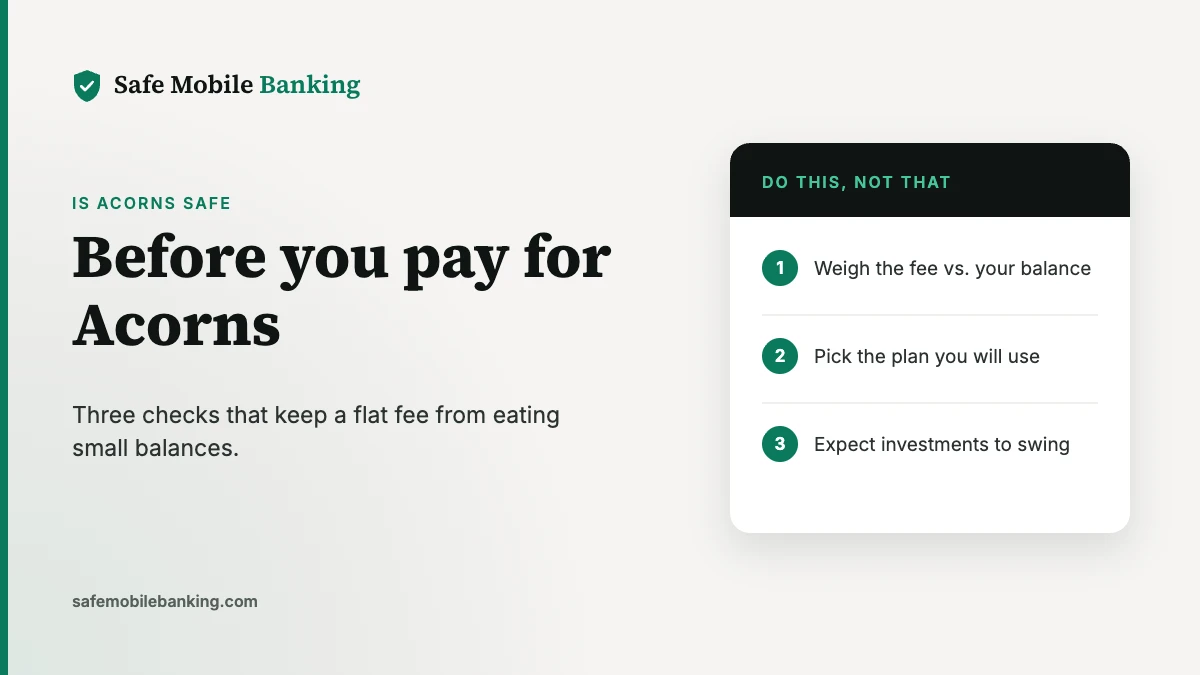
Is Acorns safe for you? 3 checks before you pay
- Weigh the fee against your balance. Twelve months of fees divided by your balance is your yearly cost as a percentage.
- Pick the plan you’ll use. Don’t pay for Gold features you won’t touch.
- Expect investments to swing. Keep money you need soon in checking or savings, not the investment account.
Comparing investing apps? See is Robinhood safe and is Coinbase safe.
Frequently asked questions
Is Acorns safe?
Yes. Acorns Advisers is an SEC-registered investment adviser, and Acorns Securities is an SEC-registered broker-dealer and a FINRA and SIPC member. Acorns Checking and Emergency Savings are held at FDIC-insured banks. Your investments can still lose value, and the monthly fee can outweigh gains on small balances.
Is Acorns FDIC insured?
Its banking accounts are. Acorns Checking, Emergency Savings and Mighty Oak are held at Lincoln Savings Bank or nbkc bank, members FDIC, and insured up to $250,000 per depositor combined. Acorns investments are not FDIC insured and may lose value.
Is my money protected if Acorns goes out of business?
Your investment account is held through Acorns Securities, a SIPC member. SIPC protects customers of failed member brokerages up to $500,000, including $250,000 in cash. It doesn’t protect against market losses.
How much does Acorns cost?
For customers signing up on or after August 17, 2026, Acorns plans cost $4 (Bronze), $8 (Silver) or $12 (Gold) a month. Customers who signed up earlier pay $3 or $6 for Bronze and Silver; Gold is $12. The fee is flat, so it costs more, as a share, on small balances.
What do Acorns complaints say?
The Consumer Financial Protection Bureau logged 119 complaints against Acorns Grow Incorporated from November 2025 to November 2026. The top issues were managing an account (42) and closing an account (23). Acorns closed all 119 with an explanation.
Sources
- Acorns: Pricing (plans, partner banks, FDIC, entities; checked Nov 15, 2026)
- Acorns: Form CRS (fees by sign-up date, SEC registration, FINRA and SIPC; August 3, 2026)
- SIPC: What SIPC protects
- Consumer Financial Protection Bureau complaint database (company: Acorns Grow Incorporated; Nov 15, 2025 to Nov 15, 2026)
- Acorns on the Apple App Store
Safe Mobile Banking is a publisher, not a bank or financial advisor. This article is general information, not investment advice. Investing involves risk, including loss of principal. Acorns is a trademark of Acorns Grow Incorporated; we’re not affiliated with Acorns. See our editorial standards.