Advertiser disclosure: Safe Mobile Banking may earn a commission from some companies we review. We don’t earn anything from Plaid, and commissions never change what we say. How we make money.
Short answer
Is Plaid safe? Yes, for most people. Plaid encrypts your data, says it doesn’t sell it, and lets you cut off any app at my.plaid.com. It’s safest when your bank sends you to its own sign-in page; with older connections, Plaid stores your bank login.
- Encrypted with AES-256 and TLS; Plaid says it doesn’t sell or rent personal information
- The Plaid Portal shows every connected app and lets you stop sharing
- Paid $58 million in 2022 to settle a data privacy class action; Plaid denied the claims
Check which apps can see your bank (Free. Two minutes at my.plaid.com.)
Last verified: November 15, 2026, against Plaid’s data and safety pages, Plaid’s consumer help center, the 2022 Cottle v. Plaid settlement order and the Consumer Financial Protection Bureau complaint database.
Is Plaid safe? The short version
| Question | Answer | Source |
|---|---|---|
| What is Plaid? | A company that connects apps like Rocket Money to your bank account. It isn’t a bank and doesn’t hold your money. | Plaid |
| How is my data protected? | AES-256 and TLS encryption; multi-factor authentication on Plaid’s own systems; continuous monitoring | Plaid: How we handle data |
| Does Plaid store my bank password? | Not with OAuth or API connections. Yes with older non-OAuth connections. | Plaid help center |
| Do connected apps get my password? | No. Plaid says it never shares your credentials with the apps you connect. | Plaid help center |
| Does Plaid sell my data? | Plaid says it doesn’t sell or rent personal information | Plaid: How we handle data |
| Legal record | $58 million class action settlement (2022); Plaid denied the allegations | U.S. District Court, N.D. California |
| Can I cut off access? | Yes, at my.plaid.com, the Plaid Portal | Plaid |
What does Plaid do when you connect your bank?
When an app asks you to “connect your bank,” it often opens Plaid. You pick your bank, prove the account is yours, and choose which accounts to share. Plaid then passes the app only the data it needs, such as your balance, transactions or account and routing numbers. Plaid doesn’t hold your money, and the app never gets your bank password from Plaid.
Does Plaid store your bank password?
It depends on how your bank connects, and this is the most important thing to understand about Plaid.
- OAuth and API connections. Plaid sends you to your bank’s own website or app to sign in. Large banks such as Chase, Wells Fargo and Capital One use this method. Plaid doesn’t store your credentials.
- Non-OAuth connections. You type your bank username and password into Plaid’s screen. Plaid says it stores those credentials and uses them to collect data for the apps you’ve chosen.
Plaid says some banks are still moving to OAuth. If you’re asked to type your bank password into a Plaid screen, and your bank offers another way to link, such as entering your account and routing numbers, consider that instead.
Does Plaid sell your data?
Plaid says it doesn’t share personal information without your permission and doesn’t sell or rent it to outside companies. It shares data only with the apps you choose, and shows you which accounts will be shared before you link.
That policy was tested in court. In Cottle v. Plaid, users alleged that Plaid used bank logins to collect and sell more financial data than they agreed to. Plaid denied the allegations and settled in 2022 for $58 million. The settlement required Plaid to delete certain data, collect and store less, improve its privacy disclosures, and tell users about the Plaid Portal. The allegations were never proven in court.
What do Plaid’s complaint records show?
The Consumer Financial Protection Bureau logged 19 complaints against Plaid Inc. from November 15, 2025 to November 15, 2026. The most common issues were managing an account (4), incorrect information on a report (2), managing a mobile wallet account (2) and problems with the company’s investigation of an existing issue (2). Plaid closed all 19 with an explanation. Problems with a connection often show up as complaints against the bank or the app you were linking instead.
Complaints are consumers’ claims as logged by the Consumer Financial Protection Bureau. The bureau doesn’t verify them, and a complaint isn’t proof of wrongdoing.
How to check which apps can see your bank
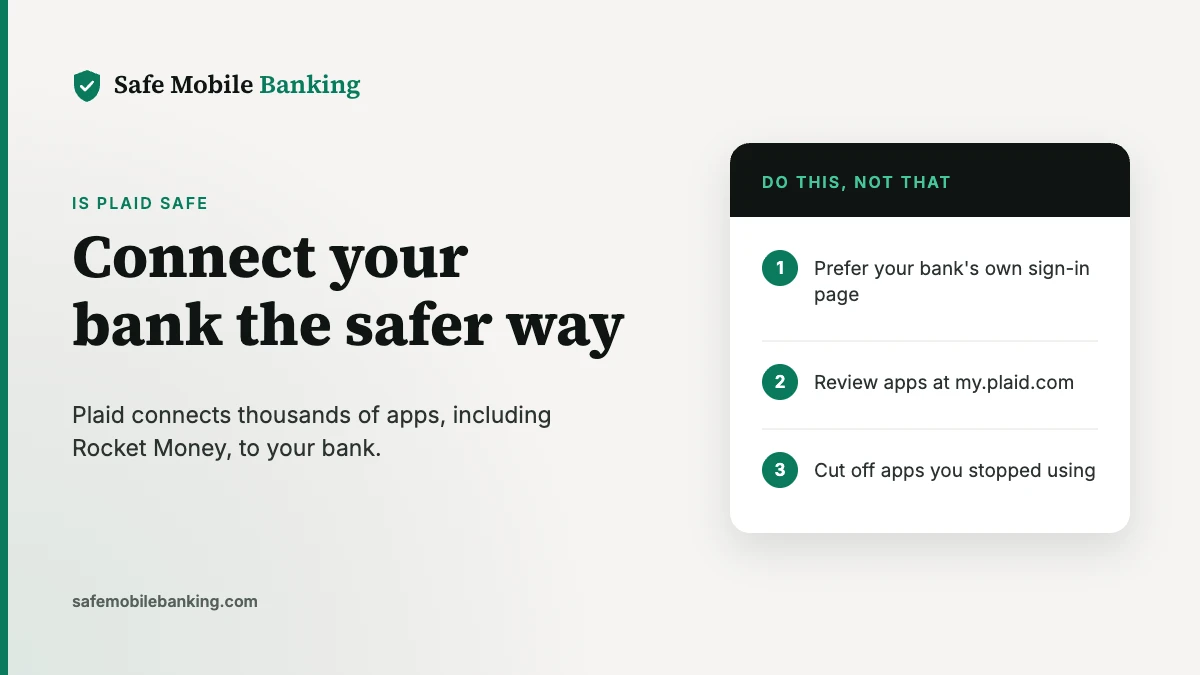
- Go to my.plaid.com and sign in with the phone number you used when linking.
- Review every connected app and the data types each one can see.
- Stop sharing with apps you no longer use. Old connections are data you don’t need floating around.
- Request deletion if you want a clean slate. The Portal has a “Delete my data” request form.
- Check your bank’s connected-apps settings too. Many banks list Plaid connections and let you revoke them there.
Is Plaid safe for Venmo, Rocket Money and other apps?
Plaid is the connection, not the app. Once you link, the app’s own protections matter more: whether payments can be reversed, whether your balance is insured, and how it handles scams. See our reviews of Rocket Money, Venmo and Cash App for those details.
Scammers also pose as Plaid or your bank to get you to “relink” an account through a fake page. Link accounts only from inside the app you’re using, never from a text or email.
Frequently asked questions
Is Plaid safe to use?
Plaid is widely used and encrypts data with AES-256 and TLS, and it says it doesn’t sell or rent personal information. It’s safest when your bank uses an OAuth connection, where you sign in on your bank’s own page and Plaid doesn’t store your password.
Does Plaid store my bank password?
It depends on your bank. With OAuth and API connections, Plaid doesn’t store your credentials. With older non-OAuth connections, Plaid says it stores your credentials to collect data. Either way, Plaid says it doesn’t share your credentials with the apps you connect.
Does Plaid sell my data?
Plaid says it doesn’t sell or rent personal information to outside companies and shares data only with the apps you choose. In 2022 Plaid paid $58 million to settle a class action alleging it collected and sold data without consent; Plaid denied the allegations.
How do I see which apps have access through Plaid?
Go to my.plaid.com, the Plaid Portal. It shows which apps you’ve connected and what data they can see, lets you stop sharing, and has a form to request that Plaid delete your data.
Why does Venmo or Rocket Money ask me to use Plaid?
Many apps use Plaid instead of building their own bank connections. Plaid verifies your account and passes the app only the data you approve, such as balances or transactions. The app never receives your bank password from Plaid.
Sources
- Plaid: How we handle data (encryption, data sharing, Plaid Portal; checked Nov 15, 2026)
- Plaid Help: Ways apps using Plaid can connect to your accounts (OAuth vs. non-OAuth credential storage)
- Plaid Help: Does Plaid have access to my credentials?
- Plaid Docs: OAuth (sign-in at your bank’s site or app)
- Cottle v. Plaid Inc., order granting final approval of class action settlement (N.D. Cal., 2022)
- Consumer Financial Protection Bureau complaint database (company: Plaid Inc.; Nov 15, 2025 to Nov 15, 2026)
Safe Mobile Banking is a publisher, not a financial advisor. This article is general information, not financial or legal advice. Plaid is a trademark of Plaid Inc.; we’re not affiliated with Plaid. See our editorial standards.